
Robinhood Crypto Review: Fees, Safety, and Limits
Retail interest in crypto trading through mainstream brokerage apps has grown alongside tighter federal scrutiny of digital-asset platforms. Robinhood occupies an unusual position in that space: a Nasdaq-listed brokerage (NASDAQ: HOOD) that layers crypto trading onto an app originally built for commission-free stocks and options. This review examines how Robinhood Crypto is structured, what it costs, and where its custody and regulatory posture differ from dedicated exchanges.
At a Glance: Robinhood Crypto Snapshot
- Operating entity: Robinhood Crypto, LLC, a Delaware-organized, wholly owned subsidiary of Robinhood Markets, Inc. (NASDAQ: HOOD)
- Jurisdiction/licensing: Licensed by NYDFS for virtual currency business activity, registered with FinCEN as a money services business, and separately licensed as a money transmitter in dozens of individual states
- Supported assets: A limited roster of major cryptocurrencies on the core US app (the exact live count is best confirmed on Robinhood’s own coin-availability page, since third-party counts vary)
- State availability: All 50 states plus DC for account access, though specific coins may be restricted in states such as New York or Texas
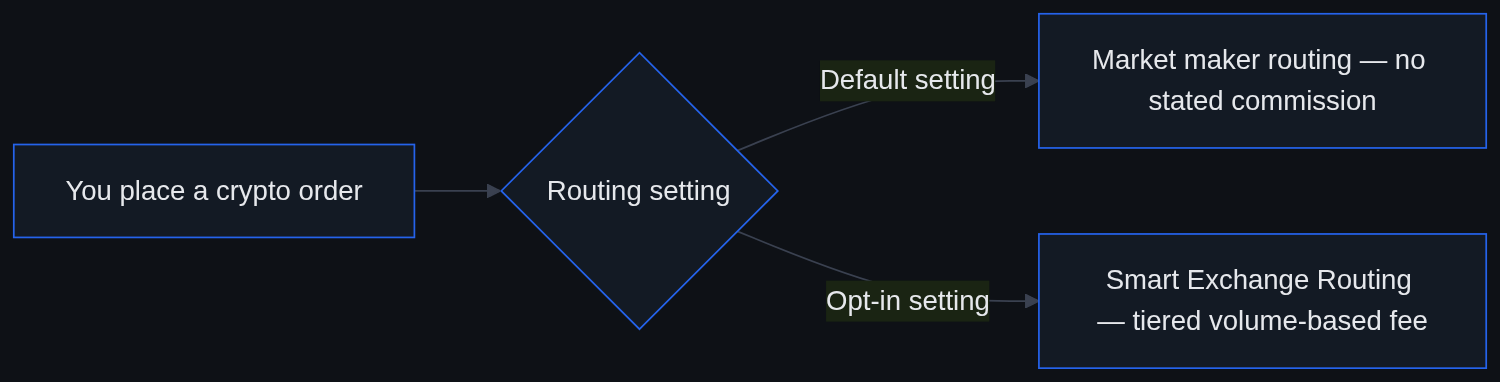
- Fee model: $0 commission on standard, market-maker-routed orders; a tiered 0.03%-0.95% fee applies only to orders using Smart Exchange Routing
- Minimum trade/stake: As little as $1
- Staking: Available on select assets (e.g., ETH, SOL), with a combined fee equal to 25% of APY earned
- Insurance: Crypto holdings are not covered by FDIC or SIPC protection
Quick verdict: Robinhood Crypto can be a reasonable, low-friction entry point for people who already use Robinhood for stocks and want to add a handful of major coins without opening a separate account. Active traders, altcoin collectors, and anyone prioritizing self-custody or deep charting tools will likely find dedicated exchanges better suited to their needs.
What Is Robinhood Crypto?
Robinhood Markets, Inc. is a publicly traded company whose Class A common stock trades on the Nasdaq Global Select Market under the ticker HOOD, according to the company’s own SEC filings. (SEC.gov) Crypto trading is handled through a distinct subsidiary, Robinhood Crypto, LLC, which SEC filings describe as a Delaware-organized entity wholly owned by the parent company and legally separate from Robinhood’s broker-dealer arms, Robinhood Financial LLC and Robinhood Securities, LLC.
That separation matters. Robinhood’s stock and options business is a registered broker-dealer subject to SIPC coverage for eligible securities and cash. Crypto assets purchased through Robinhood Crypto are not securities positions in that same regulatory sense, and Robinhood’s own crypto customer agreement states plainly that crypto holdings are not protected by FDIC or SIPC insurance.
In practical terms, Robinhood Crypto functions less like a full-service exchange (Coinbase, Kraken) and more like a simplified, bundled crypto-buying feature attached to a mainstream brokerage app — convenient for casual buyers, but narrower in scope than platforms built crypto-first.
Is Robinhood Safe for Crypto?
Safety in this context has several layers: legal registration, custody practices, account protections, and track record. Each is worth unpacking separately rather than answering with a single yes or no.
Regulatory Status
Robinhood Crypto is not a “registered exchange” in the SEC or CFTC sense used for securities or derivatives markets. Instead, it operates under the money-transmitter and money-services-business framework that governs most US crypto platforms. It holds a New York BitLicense-equivalent authorization from the NYDFS, is registered with FinCEN as an MSB (subject to Bank Secrecy Act obligations), and carries individual money transmitter licenses across a long list of states, including Alabama, Alaska, Arkansas, and Connecticut, among others.
This is a meaningfully different regulatory posture from a broker-dealer offering, and it’s worth understanding before assuming crypto held at Robinhood carries the same protections as stocks held there.
Custody Model
Like most retail platforms, Robinhood Crypto uses custodial wallets it controls on behalf of users rather than giving customers direct control of private keys inside the main app. Users who want self-custody can instead use the separate Robinhood Wallet product, which is a distinct offering from the custodial Robinhood Crypto account — a distinction that has caused confusion among users expecting one product to behave like the other.
What Is and Isn’t Covered
Uninvested cash balances swept into partner banks through Robinhood’s cash-management features can carry FDIC pass-through coverage, but this applies to cash, not to crypto. Robinhood’s crypto customer agreement is explicit that crypto assets themselves fall outside both FDIC and SIPC protection — a distinction shared with essentially every crypto platform in the US, since neither FDIC nor SIPC insurance was designed to cover digital assets.
Regulatory Scrutiny
In May 2024, Robinhood Crypto, LLC disclosed that it received a Wells Notice from SEC staff, indicating a preliminary staff determination to recommend an enforcement action alleging violations related to securities registration and custody requirements tied to RHC’s crypto listings and platform operations. (SEC.gov) The SEC’s Division of Enforcement subsequently closed the matter: in February 2025 it notified Robinhood Crypto that it did not intend to recommend an enforcement action, and no charges were filed.
Separately, older reports referencing a 2021 customer-data incident and any related regulatory follow-up were not independently re-verified in this research pass; readers concerned about that history should check FTC.gov or Robinhood’s own SEC filings directly rather than relying on secondary summaries.
Account-Level Security Features
Robinhood supports two-factor authentication and biometric login on its mobile app, standard features across most retail brokerage and exchange apps in 2026. As with any platform, users concerned about account takeover should enable app-based or hardware-key 2FA rather than SMS-only verification where possible.
User Sentiment
Public forums such as Reddit have hosted recurring threads warning users about historical crypto-withdrawal limitations and customer-service friction on Robinhood. Review aggregators including Trustpilot have also collected a large volume of customer-service complaints tied to the broader Robinhood platform, though exact current ratings should be checked live on Trustpilot’s site rather than assumed, since aggregate scores shift over time. These accounts are anecdotal rather than authoritative, but they reflect a consistent theme worth weighing: users have historically flagged support responsiveness as a weak point.
Neutral takeaway: Robinhood Crypto is a licensed, regulated money-transmitter operation tied to a publicly traded parent company, but “safe” should not be read as equivalent to deposit insurance. Crypto assets carry market risk and custodial risk regardless of platform, and Robinhood’s own disclosures make that explicit.
Robinhood Crypto Fees Explained
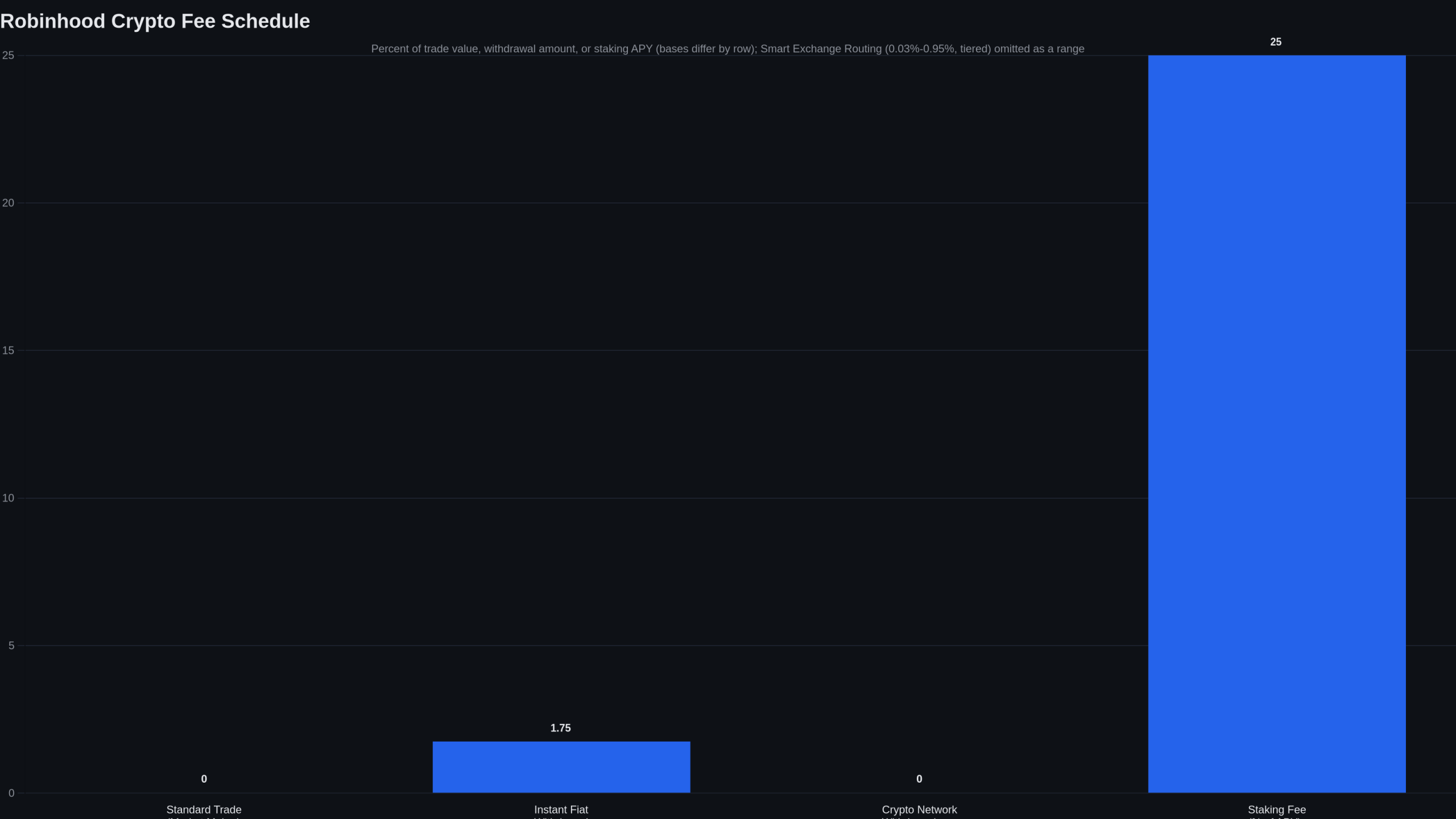
Robinhood markets its crypto product as commission-free, which is true for standard orders routed to a market maker. A separate tiered fee structure applies only when an order uses Robinhood’s Smart Exchange Routing feature, and a distinct fee applies to instant fiat withdrawals. Fee percentages listed below reflect Robinhood’s published schedule; competitor figures vary by account tier and should be confirmed directly with each exchange before trading, since third-party fee schedules change frequently.
| Fee type | Robinhood Crypto | Other exchanges (general) |
|---|---|---|
| Standard market-maker-routed trade | $0 commission | Varies by exchange — often maker/taker spreads |
| Smart Exchange Routing trade | 0.03%-0.95%, tiered by 30-day volume | Varies by exchange |
| Instant fiat withdrawal (bank/debit) | 1.75% of amount (min $1, max $150) | Varies by exchange |
| Standard (non-instant) bank withdrawal | $0 | Varies by exchange |
| Crypto network withdrawal | Network fee only, no Robinhood markup | Varies by exchange |
| Staking fee | 25% of APY earned (partner fee capped at 2.75%) | Varies by platform |
| Minimum trade/stake | $1 | Varies by exchange |
Fees and availability verified as of July 7, 2026.
The “no commission” framing works because most orders are routed directly to a market maker at $0 stated commission; only orders explicitly using Smart Exchange Routing incur the tiered percentage fee. It’s worth noting that “$0 commission” does not mean the trade is entirely costless: Robinhood discloses that it receives compensation from its market-maker partners that is built into the bid-ask spread on each order, so the real cost of a standard trade shows up in the spread rather than as a separate line-item fee. The more commonly cited hidden cost for casual users is the 1.75% instant withdrawal fee on fiat transfers out — standard (non-instant) transfers remain free but take longer to settle. Staking, meanwhile, isn’t free either: Robinhood’s combined fee structure takes a quarter of the yield generated, with a portion passed to its staking partner and the remainder retained by Robinhood.
For a broader comparison of how spread-based and tiered-commission models stack up across exchanges, see LakeBTC’s crypto exchange fees guide.
Can You Withdraw Crypto From Robinhood?
Yes — Robinhood Crypto supports transferring supported coins to external wallet addresses, a feature that was notably absent for years and remains one of the most searched questions about the platform. Robinhood states that network (gas) fees are passed through to users at cost, with no additional markup charged on top for the transfer itself.
Historically, crypto held in a Robinhood Crypto account could not be withdrawn to an outside wallet at all in the platform’s early years, a limitation that generated significant user frustration and is still referenced in older Reddit threads warning newcomers about the risk of being unable to move funds off the platform. That gap has since closed with the addition of withdrawal functionality, though users should confirm current supported-coin lists before assuming every listed asset is withdrawable, since not all coins available for trading are necessarily enabled for external transfer.
Practical steps generally look like this:
- Confirm the specific coin is enabled for external transfer within the Robinhood app’s crypto section.
- Add and verify the destination wallet address, double-checking the network type matches the asset being sent.
- Initiate the transfer and review any daily or per-transaction limits shown in the app before confirming.
- Monitor the transaction on a block explorer until it confirms on-chain, since network congestion can affect settlement time independent of Robinhood’s own processing.
State-level nuances also apply: Robinhood Connect, the company’s crypto purchase-linking product, is available across US states, the US Virgin Islands, and Puerto Rico with the explicit exception of New York, and individual coins may carry separate “not available for trading in New York” or “not available in Texas” flags even where account access itself is otherwise nationwide.
Robinhood Crypto Pros and Cons
Pros
- Bundles commission-free stock and options trading with crypto in a single app, reducing account sprawl for casual investors
- $0 commission on standard market-maker-routed crypto orders
- Low $1 minimum for trades and staking, lowering the barrier for small allocations
- Network-fee-only crypto withdrawals with no added platform markup
- Staking available on select proof-of-stake assets for users who want passive yield without running their own validator infrastructure
Cons
- Narrower coin selection than dedicated exchanges like Coinbase or Kraken, which list a much broader range of assets
- Coin availability and trading access are not uniform nationwide — certain assets are restricted in states like New York and Texas
- No advanced order types or professional charting tools comparable to dedicated trading platforms
- Recurring public complaints about customer-service responsiveness on review sites and forums
- Crypto holdings are not covered by FDIC or SIPC insurance, and the platform was the subject of a 2024 SEC Wells Notice tied to its crypto listings and custody practices (the SEC closed that investigation in February 2025 with no enforcement action)

Robinhood Crypto vs Competitors
Robinhood vs Coinbase
Coinbase supports a substantially broader roster of tradable assets and offers both a simplified consumer interface and an advanced-trading tier with its own fee schedule. Robinhood’s appeal by contrast is bundling: one app for stocks, options, and a limited set of major cryptocurrencies. Traders who want deep altcoin selection or professional order books generally lean toward Coinbase Advanced Trade or comparable platforms; those who want simplicity and already use Robinhood for equities may prefer staying in one ecosystem. For a full side-by-side, see LakeBTC’s best crypto exchange guide, which compares fee structures and supported-asset counts across platforms.
Robinhood vs Kraken
Kraken‘s Pro interface targets active traders with margin, futures, and detailed order-book tools that Robinhood’s crypto product does not attempt to replicate. Robinhood remains oriented toward buy-and-hold or occasional-trade users rather than high-frequency or derivatives-focused traders.
Robinhood Wallet vs Robinhood Crypto
These are two separate products and a common source of confusion. Robinhood Crypto is the custodial trading feature inside the main brokerage app, where Robinhood controls the private keys on the user’s behalf. Robinhood Wallet is a distinct self-custody application where users hold their own keys. Choosing between them is really a choice between custodial convenience and self-custody control, and the two should not be assumed interchangeable.
Tax Reporting and 1099 Treatment
Crypto tax reporting requirements for US brokers have been evolving alongside IRS broker-reporting rules, including the phase-in of Form 1099-DA for digital-asset transactions. Robinhood provides transaction history exports intended to support tax preparation, but exact form requirements and reporting thresholds change as IRS rules phase in; users should confirm current requirements directly on IRS.gov and in Robinhood’s own tax center rather than relying on prior-year assumptions, since broker-reporting obligations for crypto have been in transition.
As a practical habit, exporting a full transaction history (buys, sells, staking rewards, and transfers) each tax year — rather than waiting until filing season — makes reconciliation with tax software considerably easier, particularly for accounts with staking income mixed in with trading activity.
Staking and Yield Features: A Compliance Check
Robinhood’s staking feature lets eligible users stake supported assets such as ETH and SOL starting from as little as $1 in crypto value. The advertised yield is not fixed: Robinhood’s total fee equals 25% of the APY earned, made up of a staking-partner fee capped at 2.75% plus Robinhood’s own retained portion. That structure means the net yield an individual receives will typically run below the gross protocol-level staking rate quoted for a given network.
It’s also worth distinguishing custodial staking of this kind from non-custodial or DeFi staking, where a user retains control of the underlying keys and interacts directly with a protocol’s smart contracts. Custodial staking through a platform like Robinhood removes the technical complexity of running or delegating to a validator directly, but it also means the user is trusting the platform’s operational and counterparty risk rather than interacting with the protocol themselves. Staking rewards, whichever route is used, are not guaranteed and can change based on network conditions, validator performance, and platform fee adjustments.
Who Should (and Shouldn’t) Use Robinhood for Crypto
Robinhood Crypto tends to suit people who are already comfortable in the Robinhood app for stocks and options and want to add a small, occasional crypto allocation without managing a separate exchange account. The $1 minimum and network-fee-only withdrawals make it approachable for beginners testing exposure to major coins.
It’s a weaker fit for active traders who need deep order books, margin, or a long tail of altcoins; for self-custody purists who want to hold their own keys from day one (Robinhood Wallet, not Robinhood Crypto, addresses that need); and for New York residents, who face restrictions on specific coins and on Robinhood Connect despite broader account access being nationwide.
Is Robinhood Crypto Worth It in 2026?
Robinhood Crypto’s fee structure is competitive for standard, non-instant transactions, and its bundling of stocks, options, and crypto in one app remains its clearest differentiator. That said, the platform’s narrower coin lineup, state-by-state restrictions, its 2024 SEC Wells Notice history (closed by the SEC in February 2025 with no enforcement action), and lack of FDIC/SIPC coverage for crypto assets are all factors that deserve equal weight in any decision. Crypto assets remain volatile and are not bank deposits; past performance of any coin or staking yield is not indicative of future results, and prospective users should weigh custody preferences and risk tolerance carefully before allocating funds to any platform, Robinhood included.
Frequently Asked Questions
Is Robinhood safe for crypto?
Robinhood Crypto operates as a licensed money-services business with state money-transmitter registrations and NYDFS authorization, which provides a regulatory baseline. However, crypto assets held there are not covered by FDIC or SIPC insurance, and the subsidiary faced SEC scrutiny in 2024, including a Wells Notice tied to its crypto listings and custody practices; the SEC closed that investigation in February 2025 without recommending an enforcement action. “Safe” in this context means regulated and disclosed, not free of risk, since crypto assets carry inherent market and custodial risk on any platform.
Is it safe to buy crypto through Robinhood?
Buying crypto through Robinhood carries the same market volatility as buying it anywhere else, plus platform-specific custodial risk since Robinhood holds the private keys on the user’s behalf in its default crypto product. Users who want more control over custody can use the separate Robinhood Wallet self-custody app instead.
What are Robinhood’s crypto fees?
Standard market-maker-routed crypto trades carry $0 commission. Orders using Smart Exchange Routing incur a tiered fee of 0.03% to 0.95% based on trailing 30-day volume. Instant fiat withdrawals cost 1.75% of the amount (minimum $1, maximum $150), while standard bank withdrawals are free. Crypto withdrawals to external wallets pass through network fees only, with no Robinhood markup. Staking carries a combined fee equal to 25% of APY earned.
Can you withdraw crypto from Robinhood to an external wallet?
Yes, for supported assets. This wasn’t always the case — external withdrawals were unavailable for years after launch, which drove considerable user criticism — but the feature is now live, with network fees passed through at cost. Not every listed coin is necessarily enabled for external transfer, so it’s worth confirming a specific asset’s withdrawal status in-app before assuming it applies universally.
What are the main pros and cons of Robinhood crypto in 2026?
Pros include commission-free standard trades, a low $1 minimum, fee-free network withdrawals, and the convenience of one app for stocks and crypto. Cons include a narrower asset selection than dedicated exchanges, state-by-state coin restrictions, no FDIC/SIPC coverage for crypto, recurring customer-service complaints, and a 2024 SEC Wells Notice against the crypto subsidiary (closed by the SEC in February 2025 with no enforcement action).


