Coinbase Review: Fees, Safety, and Who It’s For

Coinbase is a publicly traded, US-registered cryptocurrency exchange that is generally considered safe from a regulatory and custody standpoint, though it charges higher fees than many competitors and has experienced a significant customer-data security incident. This review breaks down Coinbase’s fee structure, security track record, and the types of users it suits best, and where alternatives may be a better fit.
In this article
- At a Glance: Coinbase Snapshot
- Our Verdict
- What Is Coinbase? Company Background
- Coinbase Fees Explained
- Is Coinbase Safe?
- Coinbase Pros and Cons
- Coinbase vs. Coinbase Advanced Trade: What’s the Difference?
- Customer Support and Complaint Trends
- Taxes and Reporting: Can the IRS See Your Coinbase Wallet?
- Who Is Coinbase Best For?
- How Coinbase Compares to Other Exchanges
- FAQ
At a Glance: Coinbase Snapshot
- Founded: 2012; Coinbase operates as a remote-first company with no formal corporate headquarters (maintains an office in San Francisco), per Coinbase’s own announcement
- Public company status: Coinbase Global, Inc. completed a direct listing on Nasdaq (COIN) on April 14, 2021, and remains an active SEC-reporting company. See Coinbase’s SEC filings for current corporate details.
- Regulatory status: Registered as a Money Services Business (MSB) with FinCEN and holds a New York BitLicense as a virtual currency business, according to the Federal Register
- State licensing: Licensed as a money transmitter in most US jurisdictions; holds a New York money transmitter license and BitLicense obtained in January 2017
- Fee models: Spread-plus-fee pricing on the standard app; tiered maker/taker fees (as low as 0.0% maker) on Coinbase Advanced Trade
- Custody: Commercial crime insurance covering hot, warm, and cold storage assets, with a stated policy limit of $320 million, per Coinbase’s custody FAQ
- Available in: The US (with some state variation) and internationally, per Coinbase’s regulatory compliance page
- Best for: Beginners, long-term holders, and users who prioritize regulatory transparency over the lowest possible fees
- Less ideal for: Fee-sensitive active traders who don’t switch to Advanced Trade
Our Verdict
Coinbase’s core value proposition rests on its status as a long-standing, publicly traded, US-regulated exchange rather than on being the cheapest place to trade. For someone opening a first crypto account, the combination of a simple buy/sell interface, broad asset selection, and documented compliance history generally outweighs the cost premium versus rivals. Active traders who compare per-trade costs closely may still want to route volume through Coinbase Advanced Trade rather than the standard app, or consider a lower-fee venue outright.
This assessment reflects editorial analysis of publicly available fee schedules, regulatory filings, and security disclosures, it is not personalized financial advice, and readers should verify current terms directly with Coinbase before transacting.
What Is Coinbase? Company Background
Coinbase was founded in 2012 and grew into one of the largest cryptocurrency trading platforms serving US customers by volume and registered users. The company went public via a direct Nasdaq listing under the ticker COIN on April 14, 2021, and continues to file periodic disclosures, including Form 8-K reports, with the SEC, which are the authoritative source for its financial and corporate status.
Coinbase now operates several distinct products under one corporate umbrella:
- Coinbase.com / the mobile app: the beginner-oriented buy/sell interface most retail users first encounter
- Coinbase Advanced Trade: a maker/taker order-book trading environment aimed at more experienced users
- Base app (formerly Coinbase Wallet): a self-custody wallet separate from exchange-held balances; Coinbase rebranded Coinbase Wallet as the Base app in July 2025
- Coinbase Prime: institutional custody and trading infrastructure
- Coinbase One: a subscription sold in three tiers (Basic at $4.99/month, Preferred at $29.99/month and a higher-priced Premium tier) that waives standard trading fees up to a monthly volume cap that rises with the tier, per Coinbase’s subscription page
USDC, a dollar-pegged stablecoin you can hold and trade on Coinbase, is issued by Circle, not by Coinbase.
Coinbase Fees Explained
Standard Coinbase App Fee Structure
On the standard Coinbase app, pricing includes a spread built into the quoted buy/sell price, roughly 0.50%, plus a separate “Coinbase Fee” that is either a flat amount or a percentage depending on the transaction size and payment method used, according to Coinbase’s pricing disclosures. Debit card purchases, bank transfers, and wire transfers each carry different fee levels, and the exact figure is shown before a trade is confirmed rather than published as a single flat rate.
Coinbase Advanced Trade Fee Schedule
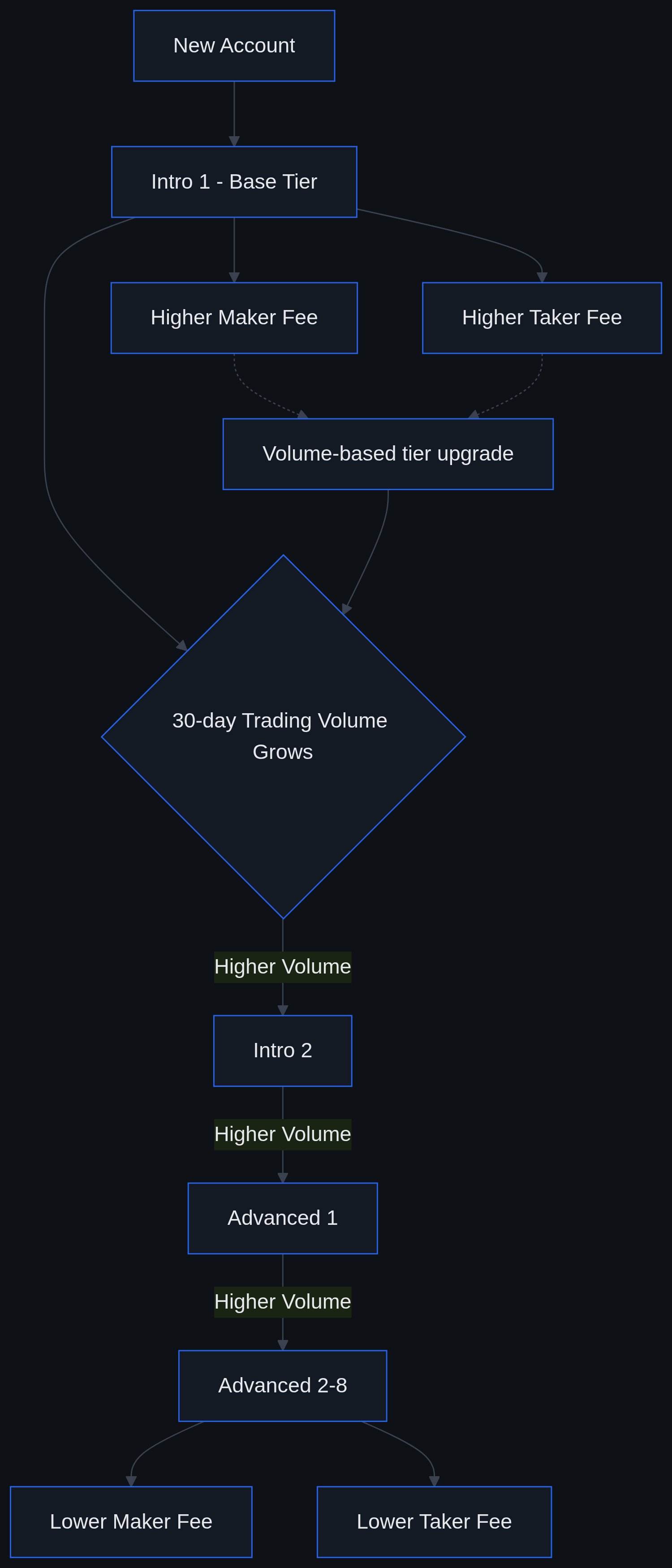
Coinbase Advanced Trade uses a maker-taker model across more than 550 spot trading pairs. Maker fees can fall as low as 0.0%, including a 0.0% maker fee across 22 stable pairs, with the applicable tier determined by trailing 30-day trading volume or account balance, and no subscription is required to access this pricing, per Coinbase’s Advanced Trade page. Higher-volume traders generally move down the fee curve automatically as volume accumulates.
Other Fees to Know
- Coinbase One: from $4.99/month (Basic) to $29.99/month (Preferred) and above, it provides zero trading fees on standard Coinbase.com trades up to a volume limit, but this benefit explicitly excludes Advanced Trade, DEX transactions, and derivatives, and a spread is still applied on buys, sells, and converts even for subscribers
- Network/withdrawal fees: vary by asset and blockchain congestion at time of transfer
- Conversion fees: asset-to-asset conversions on the standard app carry the same spread-based pricing as buys and sells
Fee Comparison Table
| Platform / Tier | Maker Fee | Taker Fee | Notes |
|---|---|---|---|
| Coinbase (standard app) | ~0.50% spread + variable Coinbase Fee | Fee amount shown pre-trade; varies by payment method | |
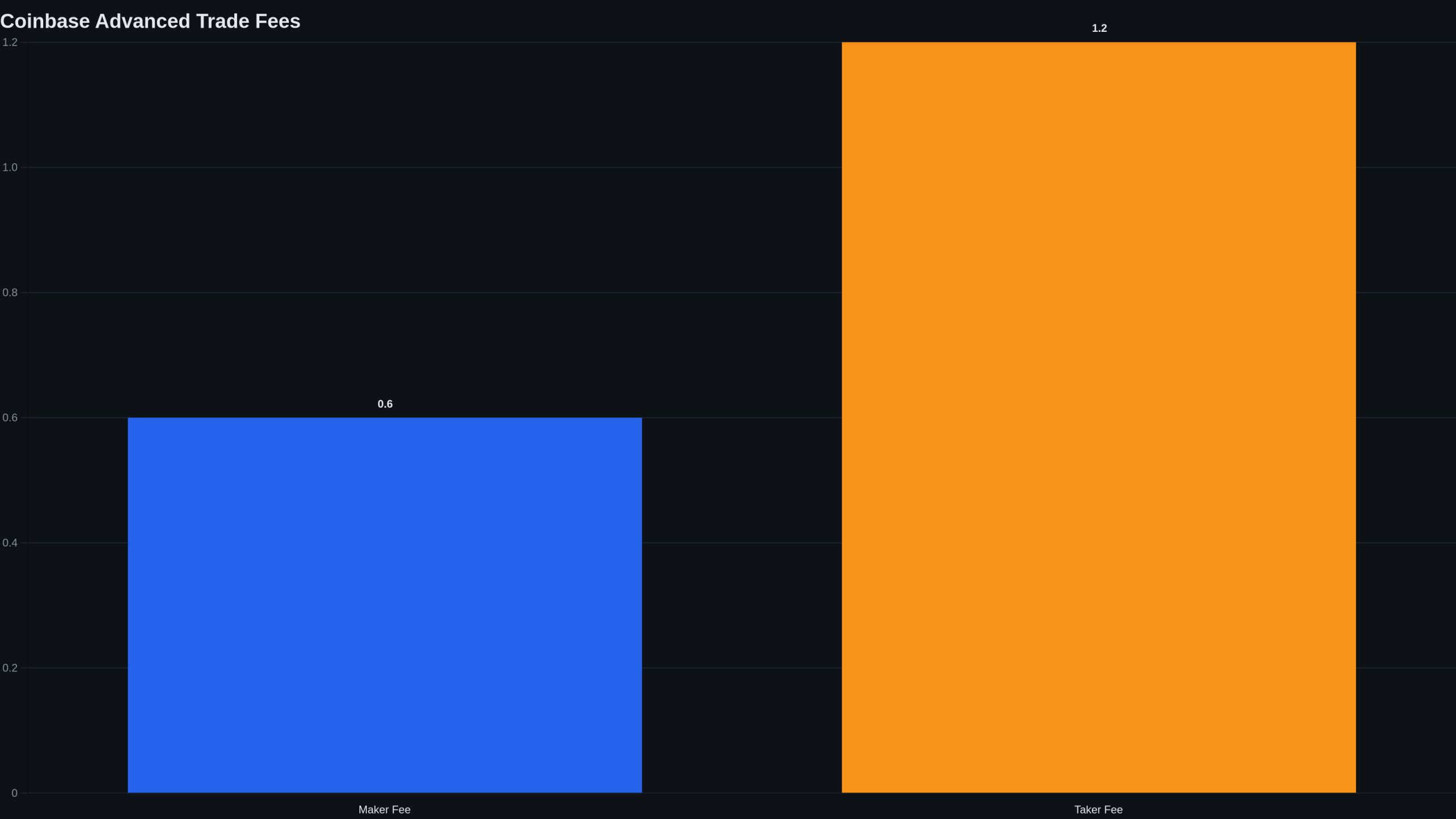
| Coinbase Advanced Trade (base tier) | 0.60% | 1.20% | Entry tier under $1K 30-day volume; 0.35% / 0.75% from $1K and 0.25% / 0.40% from $10K, falling to 0.0% maker at the top tiers |
| Kraken (Kraken Pro) | 0.40% | 0.80% | Entry tier under $2.5K 30-day volume since the July 9, 2026 restructure; 0.22% / 0.38% from $10K volume or $20K held on the platform. The simple Kraken app charges 1% plus spread on Instant Buy |
| Binance.US | 0.00% | 0.02% | Flat rate on all spot pairs since April 2026; select pairs trade at 0.00%/0.01% |
Fees and availability reviewed September 21, 2026, against each platform’s published fee schedule.
Exchange fee schedules change frequently and can vary by region, payment method, and account tier. For a broader breakdown of how exchange pricing models differ, see our guide to crypto exchange fees.
Is Coinbase Safe?
Regulatory Compliance and Licensing
Coinbase, Inc. is registered as a Money Services Business with FinCEN and holds a New York BitLicense as a virtual currency business, according to the Federal Register. It is also licensed as a money transmitter in most US states and separately operates Coinbase Custody Trust Company, LLC under a limited-purpose trust charter granted by the NYDFS. This layered licensing structure is one reason Coinbase is often positioned as a comparatively compliance-forward option among US exchanges, though licensing alone does not eliminate operational or cyber risk, as discussed below.
Notably, NYDFS reached a $100 million settlement with Coinbase in January 2023 over deficiencies in its Bank Secrecy Act/AML program, transaction monitoring, and cybersecurity practices, according to White & Case’s summary of the settlement. That history is relevant context for anyone weighing Coinbase’s compliance track record rather than assuming a clean regulatory record.
Security Infrastructure
Coinbase supports two-factor authentication via SMS, authenticator apps, and hardware security keys. On custody, a 2019 company disclosure put cold-storage allocation at roughly 98% of customer crypto assets, with a small remainder held in hot wallets, a figure that predates several product changes and should be re-checked against current Coinbase disclosures rather than treated as a live number, per CoinDesk’s reporting at the time.
Insurance and Fund Protection
Coinbase maintains a commercial crime insurance policy covering hot, warm, and cold storage assets with a stated limit of $320 million per incident and overall, according to Coinbase’s custody FAQ. This is a private insurance arrangement, not a government-backed guarantee. US dollar cash balances held at Coinbase may be eligible for FDIC pass-through insurance up to the standard FDIC deposit insurance limit (currently up to $250,000 per depositor; verify current terms at fdic.gov), but that protection applies only to cash, never to crypto holdings. Cryptocurrency assets are not covered by FDIC or SIPC insurance under any circumstances, and their value can fluctuate significantly.
Track Record: Hacks and Incidents
Coinbase’s exchange infrastructure itself has not been reported as directly breached in the way some competitors have experienced wallet-level hacks; most individual account losses reported by users have stemmed from phishing or social-engineering attacks against the account holder rather than a compromise of Coinbase’s core systems. That said, Coinbase disclosed a significant data-security incident in a Form 8-K filed with the SEC on May 14, 2025. According to the filing, criminals bribed overseas customer-support contractors to copy internal customer data, including names, addresses, and dates of birth, though the incident did not involve compromise of passwords or private keys, per Coinbase’s SEC 8-K filing.
A breach notification filed with the Maine Attorney General’s office indicated 69,461 customers were affected, a small share of Coinbase’s overall user base though the exact proportion should be verified at the source rather than treated as a fixed percentage, per reporting from leodex.io’s summary of the disclosure. Coinbase refused the attackers’ $20 million extortion demand and instead offered a $20 million reward for information leading to arrests, according to the same reporting. Coinbase’s own estimate of remediation and customer reimbursement costs from the incident ranges between $180 million and $400 million, per third-party analysis of the company’s 8-K disclosure from CM-Alliance.
Is Coinbase Legit and Safe? A Direct Answer
Coinbase is a legitimate, licensed, publicly traded exchange with a documented regulatory and custody framework, which places it among the more transparent options available to US users. That said, “safe” is relative: the platform has faced a regulatory settlement over AML/cybersecurity gaps and a 2025 data-incident tied to insider bribery rather than a technical hack. Users should weigh Coinbase’s institutional-grade infrastructure against the reality that crypto assets are never government-insured and that account-level security (strong 2FA, phishing awareness) remains the user’s own responsibility.

Coinbase Pros and Cons
Pros
- Publicly traded company with SEC-filed disclosures, offering a level of financial transparency uncommon among crypto exchanges
- Broad asset selection and beginner-friendly interface for first-time buyers
- Multiple licensing layers, including a NYDFS BitLicense and FinCEN MSB registration
- Cold-storage custody practices and a sizable commercial crime insurance policy
- Coinbase One subscription can meaningfully reduce trading costs for frequent standard-app users, and staking options are available for eligible assets
Cons
- Standard app fees (spread plus variable fee) are generally higher than tiered maker/taker models on competing platforms
- Fee structure can be difficult for casual users to calculate precisely before confirming a trade
- The 2025 data-security incident and 2023 NYDFS settlement highlight that compliance status does not guarantee an incident-free record
- User reviews commonly cite slow customer support response times and account verification holds
On the direct question of Coinbase’s biggest downside: cost is the most consistently cited drawback in independent reviews, with the standard app’s blended spread-and-fee pricing costing more per trade than Advanced Trade or several rival exchanges, particularly for smaller or frequent transactions.
Coinbase vs. Coinbase Advanced Trade: What’s the Difference?
Interface and Order Types
The standard Coinbase app offers simple market buy/sell functionality designed for quick transactions. Coinbase Advanced Trade adds an order-book interface with charting tools, limit orders, and stop-limit orders, features aimed at users who want more control over execution price.
Fee Differences
The standard app bundles a roughly 0.50% spread with an additional variable fee, while Advanced Trade charges tiered maker/taker fees that can fall to 0.0% for maker orders depending on volume, with no separate spread fee. For an identical dollar amount, Advanced Trade will typically work out cheaper for anyone willing to use the order-book interface, though the exact difference depends on trade size, payment method, and current volume tier.
Comparison Table
| Feature | Coinbase (Standard App) | Coinbase Advanced Trade |
|---|---|---|
| Order types | Market buy/sell | Market, limit, stop-limit |
| Fee model | Spread + variable fee | Tiered maker/taker |
| Charting tools | Basic price view | Advanced charting |
| Best for | Beginners, occasional buyers | Active traders, larger volumes |
Who Should Use Which
Beginners and users making periodic purchases (such as dollar-cost averaging) may find the standard app’s simplicity worth the fee premium. Active traders, or anyone transacting larger dollar amounts regularly, are generally better served by switching to Advanced Trade, which uses the same underlying account but a different interface and pricing structure.
Customer Support and Complaint Trends
Support Channels
Coinbase offers in-app chat, email support, phone callback options, and an extensive help center covering account, trading, and verification issues.
What Reviews Say
Coinbase holds a 4.0 out of 5 “Great” TrustScore on Trustpilot across more than 20,000 reviews, per Trustpilot’s aggregated data, with recurring praise for ease of use alongside criticism of fee levels. Community discussion on platforms like Reddit shows a similarly polarized pattern: many users report the platform as reliable for basic buying and selling, while a subset describe frustration with account holds or slower support resolution during disputes.
Why Can’t I Get My Money Out of Coinbase?
Withdrawal delays are among the most common complaints in user reviews, and they typically stem from a handful of identifiable causes rather than platform-wide dysfunction:
- Identity verification holds: new or recently updated accounts may be flagged for additional KYC review
- AML/compliance review: transactions matching certain risk patterns can trigger manual review before funds are released
- Standard ACH processing times: bank transfers commonly take one to five business days to settle, independent of any account issue
- Suspicious activity flags: unusual login locations or transaction patterns can pause withdrawals as a security precaution
Users experiencing a hold should check Coinbase’s status page for known outages, contact support directly, and be prepared to provide identity documentation promptly, since most holds resolve once verification is completed rather than indicating fund loss.
Taxes and Reporting: Can the IRS See Your Coinbase Wallet?
1099 Forms Coinbase Issues
Coinbase issues tax forms such as 1099-MISC to eligible US users, and broker information-reporting requirements for digital assets (including the newer 1099-DA framework) are being phased in under current US tax law. Exact form types and thresholds change as IRS rules evolve, so users should confirm current requirements directly on the IRS’s digital assets guidance page.
IRS Data-Sharing History
The IRS has previously used a “John Doe” summons to compel Coinbase to turn over records on a defined set of account holders as part of a broader enforcement effort around 2016–2018. Combined with ongoing broker reporting obligations, this history indicates that transactions on Coinbase are not anonymous from a tax-authority perspective; exchange-held accounts are generally visible to the IRS through reporting requirements and, where applicable, summons authority.
What This Means for Users
Funds held in an exchange account differ from assets moved to self-custody wallets in terms of what a third party can report automatically. Regardless of where assets are held, taxpayers remain responsible for accurate reporting, and maintaining independent records of cost basis and transaction dates is good practice given how reporting rules continue to evolve. This is general information, not tax advice, consult a qualified tax professional and the IRS’s official digital asset guidance for your specific situation.
Who Is Coinbase Best For?
Best for Beginners and First-Time Buyers
The standard app’s simplicity, combined with Coinbase’s regulatory profile, makes it a common entry point for people buying their first cryptocurrency.
Best for Long-Term Holders
Users who buy and hold rather than trade frequently may benefit from staking options on eligible assets and, for heavier standard-app users, the fee-waiver structure available through Coinbase One.
Less Ideal for Active Day Traders
Frequent traders using the standard app absorb the spread-plus-fee cost on every transaction, which compounds meaningfully over high trade volume; those users are generally better served by Advanced Trade or a lower-cost competitor.
Institutional and High-Net-Worth Users
Coinbase Prime serves institutional clients with dedicated custody and execution infrastructure, separate from the retail-facing app and Advanced Trade products.
How Coinbase Compares to Other Exchanges
| Exchange | Fee Model | Notable Trait |
|---|---|---|
| Coinbase | Spread+fee (standard) / tiered maker-taker (Advanced) | Publicly traded, layered US licensing |
| Kraken | Tiered maker-taker | Privately held (Payward, Inc.); confidentially filed for a US IPO in late 2025, with listing plans paused as of mid-2026 |
| Gemini | Tiered/flat depending on interface | Nasdaq-listed (GEMI) since September 2025; operates as a New York trust company |
| Binance.US | Flat 0% maker / 0.02% taker | US affiliate of global Binance; restored USD services in 2025 and cut spot fees in April 2026 |
For deeper side-by-side breakdowns, see our comparisons of Coinbase vs. Kraken and Coinbase vs. Gemini, or browse our roundup of the best crypto exchanges for additional context.
FAQ
Is Coinbase legit and safe?
Yes, in the sense that Coinbase is a licensed, publicly traded, SEC-reporting exchange registered as an MSB with FinCEN and holding a NYDFS BitLicense. It has also faced a 2023 regulatory settlement and a 2025 data-security incident, so “safe” should be understood as relative to industry norms rather than absolute, crypto holdings are never government-insured.
Why can’t I get my money out of Coinbase?
Withdrawal delays typically trace back to identity verification holds, standard ACH processing times of one to five business days, or an automatic compliance flag on the transaction. Contacting support with requested documentation usually resolves these holds.
What is the downside of Coinbase?
The most frequently cited drawback is cost: the standard app’s spread-plus-fee pricing tends to run higher than tiered maker/taker models on Advanced Trade or competing exchanges, and some users report slow customer support during disputes.
Can the IRS see my Coinbase wallet?
Exchange-held Coinbase accounts are subject to broker information-reporting requirements and, historically, IRS summons authority, meaning account activity is generally visible to tax authorities. Confirm current reporting rules at IRS.gov.
Is Coinbase Advanced Trade cheaper than the regular Coinbase app?
Generally yes. Advanced Trade’s tiered maker/taker model, which can fall to a 0.0% maker fee at certain volumes, typically costs less than the standard app’s combined spread and variable fee, though the exact savings depend on trade size and volume tier.
Update history 1
- Corrected who issues USDC: Circle, not Coinbase.