Gemini Exchange Review: Fees, Safety, and Features

Gemini is a New York-based cryptocurrency exchange founded by Cameron and Tyler Winklevoss that operates as a state-chartered trust company rather than a typical corporate exchange. It is broadly considered a safety-focused platform aimed at security-conscious retail users and institutions, though its fee structure and regulatory history deserve a closer look before you decide whether it fits your needs.
In this article
- At a Glance: Gemini Exchange Snapshot
- What Is Gemini Exchange?
- Is Gemini Safe? (Security & Regulatory Deep Dive)
- Gemini Fees Explained
- Key Features and Products
- Account Setup and Verification (How It Works)
- Gemini Exchange Pros and Cons
- Gemini vs. Coinbase: Head-to-Head Comparison
- Gemini vs. Other Exchanges (Kraken, Binance.US)
- Customer Support and User Experience
- Regulatory and Legal Track Record
- Tax and Reporting Considerations for Gemini Users
- Who Should (and Shouldn’t) Use Gemini
- FAQ
At a Glance: Gemini Exchange Snapshot
Quick-Facts Data Box
- Founded: 2014, by Cameron and Tyler Winklevoss (received its NYDFS trust charter and launched publicly in October 2015)
- Headquarters: New York, NY
- Regulatory structure: Operates as a New York State-chartered trust company; confirm current charter status and any open matters at dfs.ny.gov
- Corporate structure: Publicly traded on the Nasdaq Global Select Market under ticker GEMI since its September 2025 IPO, in addition to its NYDFS trust charter
- Supported countries/states: Available in the US and Singapore. Gemini closed its UK, EU and Australian operations in April 2026 to refocus on the US; state-by-state availability and licensing should be checked at Gemini’s own licenses page before signing up
- Asset count and fee ranges: 80+ supported cryptocurrencies; basic-interface trades carry a spread-based convenience fee plus a transaction fee, while ActiveTrader pricing now starts at 0.60% maker / 1.20% taker (details in the fee table below)
Because fee schedules, supported-asset lists, and licensing footprints are updated by exchanges on a rolling basis, treat any specific numbers cited in third-party content, including this review, as a starting point, not a final answer. Always cross-check against the exchange’s live pricing and legal pages.
Best-For / Not-Best-For Summary
Gemini is generally positioned as a fit for US-based users who prioritize regulatory oversight, custody practices, and a polished interface over rock-bottom trading costs. Active day traders chasing the lowest possible maker/taker spreads, or users who want the widest possible altcoin selection, may find better fits elsewhere in the market.
LakeBTC Quick Verdict
Gemini’s core appeal is its compliance-first posture as a chartered trust company, which appeals to users who weight custody and regulatory structure heavily in their exchange choice. It is less competitive on headline trading fees for casual mobile-app users, so cost-sensitive traders should compare Gemini’s published fee schedule against alternatives before committing meaningful volume.
What Is Gemini Exchange?
Company Background and Founding Story
Gemini was founded in 2014 by Cameron and Tyler Winklevoss and launched publicly in October 2015 after receiving its New York State trust charter, with an early emphasis on regulatory compliance as a market differentiator at a time when many exchanges operated with minimal oversight. The company has since expanded from a spot exchange into a broader set of crypto-finance products, and in September 2025 its parent, Gemini Space Station, Inc., completed an IPO on the Nasdaq Global Select Market under the ticker GEMI.
Regulatory Structure: NYDFS-Chartered Trust Company
Gemini Trust Company operates under a New York State trust charter, which subjects it to oversight by the New York Department of Financial Services (NYDFS) rather than solely to money-transmitter rules used by many other exchanges. This structure is a frequently cited reason Gemini markets itself as a compliance-forward platform, though the current status of its charter and any open regulatory matters should be verified directly with NYDFS rather than assumed from past reporting.
Business Lines Overview
Beyond its retail spot exchange, Gemini has historically offered an active-trader interface, custody services aimed at institutions, a crypto rewards credit card, and, for a period, an interest-bearing product called Gemini Earn. The Earn program became the subject of regulatory scrutiny following the collapse of its lending partner Genesis; see the regulatory section below for how to verify the current status of that matter.
Is Gemini Safe? (Security & Regulatory Deep Dive)
Regulatory Licensing and Compliance Record
Gemini’s core regulatory claim rests on its New York trust charter, supplemented by money transmitter licenses in additional states. Because license rosters and enforcement records change, readers should confirm current state-by-state licensing directly through Gemini’s own legal disclosures and NYDFS records rather than relying on any single article, including this one.
Custody and Insurance
Exchanges that hold customer crypto typically publicize a cold-storage percentage and a crime insurance policy covering digital assets held in custody. Gemini has made claims along these lines in its own marketing and security documentation, but the specific cold-storage percentage and insurance coverage limits are not independently confirmed in this review and should be checked directly at Gemini’s security page before you rely on them.
Separately, USD cash balances held at Gemini’s banking partners may be eligible for FDIC pass-through insurance, subject to program bank terms and standard per-depositor limits. The exact structure and current coverage language should be confirmed in Gemini’s user agreement rather than assumed, since pass-through insurance terms are program-specific and can change.
Historical Security Incidents and Regulatory Fallout
The most consequential episode in Gemini’s recent history involves the Gemini Earn program and its lending counterparty, Genesis, which experienced financial distress that disrupted user withdrawals from Earn. This led to an SEC civil action tied to the Earn program. That matter is now resolved: Genesis settled its own SEC case for a $21 million penalty in March 2024, and Gemini Earn investors received 100% of their frozen assets back through Genesis’s bankruptcy proceedings. On January 23, 2026, the SEC dismissed its lawsuit against Gemini with prejudice, closing the case. Readers can confirm the current docket status directly at the SEC newsroom.
Two-Factor Authentication and Account Security Tools
Like most established exchanges, Gemini supports two-factor authentication and hardware security key options for account login, along with withdrawal address allowlisting and account activity notifications. These account-level controls are standard tools users should enable regardless of which exchange they choose.
How Gemini’s Safety Posture Compares Industry-Wide
Relative to peers such as Coinbase and Kraken, Gemini is frequently grouped among the more compliance-oriented US exchanges due to its trust-company structure, though all three platforms publish their own security and insurance claims that merit independent verification rather than side-by-side assumption. For a deeper platform-by-platform breakdown, see our Coinbase vs Gemini comparison and Kraken vs Gemini comparison.
Gemini Fees Explained
Fee Structure Overview
Gemini has historically used a two-tier approach: a simplified “convenience” fee structure for mobile-app and basic web trades, and a separate maker/taker schedule for users of its ActiveTrader interface, which is typically cheaper at volume but requires opting into the more advanced trading view. Because these figures are updated periodically, the table below should be treated as a framework rather than a locked-in price list.
| Trade Method | Fee Type | Approximate Cost Structure |
|---|---|---|
| Basic/mobile app trade | Convenience fee | A spread-based convenience fee (around 1%) plus a transaction fee that is flat on small orders and percentage-based (1.49%) on larger orders; the all-in quote is shown before you confirm the trade |
| ActiveTrader order | Maker/taker tiers | Entry tier (under $10K 30-day volume): 0.60% maker / 1.20% taker; 0.40% / 0.80% from $10K volume or a $1M balance, 0.25% / 0.50% from $25K, decreasing to 0.00% maker / 0.02% taker at $250M. the February 2025 schedule still started at 0.20% / 0.40% |
| ACH deposit/withdrawal | Bank transfer | Free for standard ACH deposits and withdrawals |
| Wire transfer | Bank transfer | Gemini does not charge for incoming wires; outgoing wire costs depend on currency and bank and are shown before you submit |
| Crypto withdrawal | Network fee | Varies by network and current on-chain congestion; a monthly allotment of free withdrawals applies to many assets |
| Debit/credit card purchase | Card fee | Percentage-based premium, generally higher than bank funding |
Fees reviewed September 21, 2026, against Gemini’s published ActiveTrader fee schedule (dated September 1, 2026).
Hidden Costs to Watch For
The most commonly overlooked cost on convenience-style trades across the industry, not unique to Gemini, is the spread markup built into the quoted price, separate from any disclosed transaction fee. Comparing the same trade size across the basic interface and the active-trader interface is generally the most reliable way to see the true cost difference on any given platform.
How Gemini Fees Stack Up vs. Coinbase and Kraken
At the entry tier, Gemini’s ActiveTrader (0.60% maker / 1.20% taker) now matches Coinbase Advanced Trade’s entry tier and sits above Kraken Pro (0.40% / 0.80% since July 9, 2026). All three are far above Binance.US, which charges 0% maker / 0.02% taker on every spot pair. On the basic interfaces, all three platforms charge materially more than their advanced tiers. Our broader crypto exchange fees guide outlines how to compare maker/taker tiers, withdrawal costs, and card-purchase premiums across platforms so you can benchmark current numbers yourself.
Key Features and Products
Supported Cryptocurrencies
Gemini lists a broad set of major and mid-cap cryptocurrencies, more than 80 as of mid-2026, though the exact count and specific listings change as the exchange adds or delists assets. Check the current asset list on Gemini’s site rather than assuming parity with competitors.
Trading Platforms: App vs. ActiveTrader vs. Web
The standard Gemini mobile app and web interface are built for simplicity, aimed at buy-and-hold users and newcomers. ActiveTrader is a separate, more advanced interface with order-book depth, additional order types, and the tiered maker/taker fee schedule referenced above, aimed at higher-frequency traders.
Gemini Earn: Current Status
Gemini Earn, the exchange’s former crypto-lending product, was suspended amid the Genesis counterparty collapse and subsequent regulatory action. Whether and in what form Earn-style products have resumed is a regulatory-sensitive fact that changes with legal proceedings; confirm the current status directly on Gemini’s official announcements before assuming the product is active.
Gemini Custody and Institutional Services
Gemini offers custody services aimed at institutional clients needing segregated cold-storage arrangements and compliance reporting, positioned alongside its retail exchange as a separate business line.
Gemini Credit Card
Gemini has offered a crypto rewards credit card that returns a percentage of purchases in cryptocurrency rather than cash back. Reward rates and card terms are subject to change and should be confirmed against the current cardholder agreement.
Staking Options
Gemini has offered staking for certain proof-of-stake assets, with reward rates that fluctuate with network conditions and are set by Gemini’s own program terms; verify current eligible assets and reward rates before staking any holdings.
NFT Marketplace
Gemini’s parent company previously operated Nifty Gateway, an NFT marketplace it acquired in 2019. Gemini shut down Nifty Gateway in February 2026, migrating its NFT community into the newer Gemini Wallet product rather than continuing it as a standalone marketplace.
Account Setup and Verification (How It Works)
Sign-Up and KYC Requirements
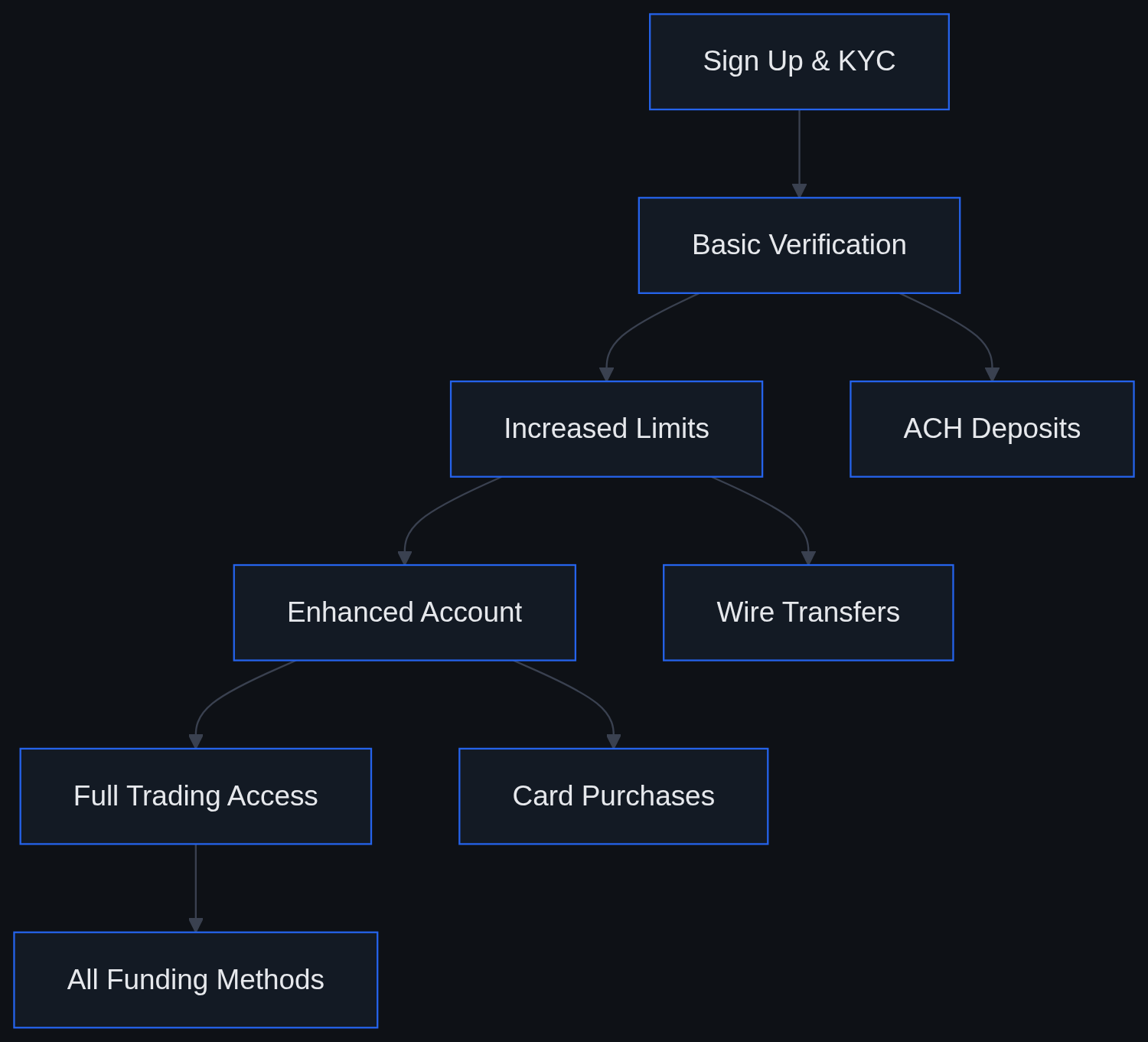
Opening a Gemini account requires standard identity verification consistent with US anti-money-laundering rules, generally including a government ID and basic personal information before trading or withdrawal limits are lifted.
Funding Methods Accepted
Typical funding options include ACH bank transfer, wire transfer, and debit/credit card purchases, each carrying different fee and speed trade-offs as outlined in the fee table above.
Withdrawal Limits and Processing Times
Withdrawal limits typically scale with account verification level and the funding method used; ACH transfers tend to take longer to clear than wire transfers, while crypto withdrawals depend on network confirmation times. Confirm current limits in your account settings, as these are adjusted periodically.
Supported US States and International Availability
Availability varies by state due to differing money-transmitter licensing requirements, and some products or features may be restricted in certain jurisdictions. Check Gemini’s licenses page directly for the current state-by-state list before assuming your state is fully supported.
Gemini Exchange Pros and Cons
Pros
- Operates under a New York trust charter, which brings a distinct regulatory framework compared to many competitors
- Separate ActiveTrader interface offers a more advanced, typically lower-cost trading experience for frequent users
- Institutional custody services aimed at larger asset holders
- Crypto rewards credit card option for users who want passive crypto accumulation through everyday spending
- Clean, beginner-friendly mobile app and web interface
Cons
- Convenience-tier fees for basic app trades can be materially higher than ActiveTrader or competitor low-fee tiers
- Asset selection has historically trailed some larger competitors on niche/altcoin listings
- The Gemini Earn/Genesis episode, resolved in January 2026 with full investor recovery and a dismissed SEC lawsuit, remains a relevant historical data point for users evaluating any lending-style crypto product
- Customer support response times have been a recurring theme in user feedback, though this varies over time and by issue type

Gemini vs. Coinbase: Head-to-Head Comparison
Fee Comparison
Both exchanges use a similar two-tier model: a simplified fee for casual app trades and a lower, volume-tiered schedule for advanced traders (ActiveTrader on Gemini, Coinbase Advanced Trade on Coinbase). At the entry tier the two are now level: ActiveTrader and Coinbase Advanced Trade both charge 0.60% maker / 1.20% taker, though Coinbase drops to 0.35% / 0.75% from $1K in monthly volume while Gemini holds its entry rate until $10K. Exact percentages shift on both platforms, so confirm on each exchange’s live pricing page before large trades. Our dedicated Coinbase review and Coinbase vs Gemini comparison walk through this in more detail.
Asset Selection
Coinbase has generally listed a broader roster of smaller-cap tokens than Gemini, though both platforms adjust listings on an ongoing basis in response to market demand and regulatory considerations.
Security and Insurance
Both exchanges publish cold-storage and insurance claims and both are subject to US regulatory oversight, though the specific structure differs: Gemini combines its NYDFS trust charter with Nasdaq-listed public-company status (ticker GEMI, since its September 2025 IPO), while Coinbase operates as a publicly traded, SEC-reporting exchange under its own licensing arrangement. Neither exchange’s specific insurance coverage figures should be treated as protection against every possible loss scenario; both should be verified at the source before being cited as fact.
User Experience and Mobile App
Both apps are generally rated well for usability among mainstream users, with Coinbase often seen as slightly more feature-dense for casual investors and Gemini positioned around its security-first branding.
Which One Fits Which User
Beginners focused on ease of use may lean toward either platform depending on interface preference; active traders will want to compare ActiveTrader and Advanced Trade fee tiers directly; institutions evaluating custody arrangements should request current documentation from both providers rather than relying on marketing pages alone.
Gemini vs. Other Exchanges (Kraken, Binance.US)
| Factor | Gemini | Kraken | Binance.US |
|---|---|---|---|
| Regulatory / corporate structure | NYDFS trust charter; parent Nasdaq-listed (GEMI) since Sept. 2025 | FinCEN MSB plus state money-transmitter licenses; privately held, with a US IPO confidentially filed in late 2025 | FinCEN MSB plus state licenses; unavailable in some US states |
| Fee model | Convenience fee (basic) / ActiveTrader from 0.60% maker / 1.20% taker | Instant Buy 1% plus spread (simple app) / Kraken Pro from 0.40% maker / 0.80% taker | Flat 0% maker / 0.02% taker on all spot pairs since April 2026 |
| Asset selection | 80+ cryptocurrencies | Several hundred assets and markets | 250+ trading pairs |
| Security posture | NYDFS-supervised custody; publishes cold-storage and insurance claims | Long operating history since 2011 with no reported breach of its core exchange systems | Completed a SOC 2 Type II independent audit (2026) |
Fees and availability reviewed September 21, 2026, against each platform’s published schedules and disclosures.
For a deeper look at how Gemini stacks up against Kraken specifically, see our Kraken vs Gemini comparison. For a broader shortlist of vetted platforms across fee structures and regulatory profiles, see our best crypto exchanges guide.
Customer Support and User Experience
Support Channels Available
Gemini offers support through in-app chat, email ticketing, and, for some account tiers, phone support. Response speed can vary based on issue complexity and account type.
Real User Sentiment Synthesis
Aggregated app-store and third-party review platforms tend to show a mixed but generally workable picture for Gemini: praise for interface clarity and security messaging, alongside recurring complaints about support wait times during high-volume market periods, a pattern seen across most major exchanges rather than unique to Gemini. Current aggregate scores should be checked directly on the App Store, Google Play, and Trustpilot, since these ratings shift continuously.
Regulatory and Legal Track Record
Timeline of Regulatory Actions
Gemini’s most significant recent regulatory episode centered on the Gemini Earn program and its ties to Genesis, which drew SEC scrutiny following Genesis’s 2022 financial troubles. Genesis settled its own SEC matter for a $21 million penalty in March 2024, and Gemini Earn investors recovered 100% of their frozen assets through Genesis’s bankruptcy process. The SEC dismissed its remaining lawsuit against Gemini with prejudice on January 23, 2026, closing the matter. NYDFS, as Gemini’s primary chartering regulator, continues ongoing supervisory oversight of the trust company; confirm the current charter status at dfs.ny.gov.
What This Means for Retail Users Today
For users only using Gemini’s spot exchange rather than lending-style products, the Earn/Genesis matter is primarily a reputational and historical consideration rather than an indicator of current spot-trading risk. Users considering any yield-bearing crypto product on any platform should read current terms carefully and understand that such products carry counterparty risk distinct from simple custody of assets.
Tax and Reporting Considerations for Gemini Users
1099 Forms Issued
Like other major US exchanges, Gemini issues relevant tax forms (such as 1099 series forms) to eligible users based on their account activity and current IRS reporting thresholds. Exact form types and thresholds are set by IRS rules that have been evolving for digital assets, so check current guidance at IRS.gov and Gemini’s own tax-documents page.
Exporting Transaction History
Gemini allows users to export trade and transaction history, which can be imported into common crypto tax software for cost-basis and gain/loss calculations.
Disclaimer
This section is general educational information, not tax advice. Consult a licensed tax professional for guidance specific to your situation.
Who Should (and Shouldn’t) Use Gemini
Ideal User Profiles
Gemini tends to suit security-conscious beginners who value a regulated trust-company structure, institutional users evaluating custody arrangements, and users interested in earning crypto rewards through everyday card spending.
Who Might Prefer Alternatives
Cost-sensitive active traders who transact frequently on the basic app interface, and users seeking the widest possible selection of smaller-cap altcoins, may find better economics or selection on other platforms, worth comparing against options in our exchange comparison guide.
FAQ
Is Gemini safe to use in 2026?
Gemini operates under a New York trust charter and publishes security and insurance claims common to major US exchanges, but “safe” is relative, no exchange can guarantee protection against every possible loss, and specific insurance and custody figures should be verified directly at Gemini’s security documentation before you rely on them for a decision.
What are Gemini’s trading fees compared to Coinbase?
At the entry tier they are level: Gemini’s ActiveTrader and Coinbase Advanced Trade both charge 0.60% maker / 1.20% taker. Coinbase gets cheaper sooner, dropping to 0.35% / 0.75% from $1K in monthly volume, while Gemini holds its entry rate until $10K. On both platforms, the basic app interface costs meaningfully more than the advanced one, combining a spread with additional fees. Since both exchanges update their schedules periodically, confirm current percentages on each platform’s live pricing page before trading.
What are the downsides of using Gemini exchange?
Commonly cited downsides include higher convenience-fee pricing on the basic app compared to the ActiveTrader tier, a narrower altcoin selection than some competitors, and the historical reputational overhang from the Gemini Earn/Genesis matter, even though that specific product’s status has since evolved.
How much does Gemini cost per month or per trade?
Gemini does not charge a flat monthly account fee for standard use; costs are generally transaction-based, combining a disclosed fee with a spread markup on convenience trades, or a lower maker/taker percentage on ActiveTrader. Confirm current rates at gemini.com/pricing before trading, as figures are updated periodically.
Is Gemini exchange reliable for large or institutional transactions?
Gemini offers dedicated custody and institutional services designed for larger asset holders, though institutions should request current documentation on licensing, insurance, and custody terms directly from Gemini rather than relying on general marketing claims.
Note on “Gemini AI” vs. Gemini Exchange
This review covers Gemini Trust Company, the cryptocurrency exchange founded by Cameron and Tyler Winklevoss. It is unrelated to Google’s Gemini AI chatbot product, which is a separate company and product entirely. Readers searching for AI-assistant reviews should look for coverage specific to Google’s Gemini AI rather than this crypto-exchange review.