Kraken vs Gemini: Fees, Security, and Who Wins

Kraken and Gemini are both long-running, US-regulated cryptocurrency exchanges, but they serve somewhat different users. Kraken generally appeals to active traders who want lower advanced-tier fees, a broader asset list, and margin or futures access, while Gemini leans on regulatory branding, all-50-state availability, and a simpler interface built for newer investors. Neither is a universal “winner”, the right choice depends on trading style, state of residence, and how much you weigh compliance credentials against raw feature depth.
In this article
- At a Glance: Kraken vs Gemini
- Why Kraken vs Gemini Is a Recurring Debate
- Company Backgrounds
- Kraken vs Gemini Fees Breakdown
- Gemini vs Kraken Security
- Feature and Platform Comparison
- Ease of Use and Customer Support
- Geographic and Account Availability
- Tax Reporting and Recordkeeping
- Institutional and Advanced Trader Tools
- Community Sentiment and Reputation Signals
- Pros and Cons
- Which Is Better?
- FAQ
At a Glance: Kraken vs Gemini
| Category | Kraken | Gemini |
|---|---|---|
| Founded | 2011, San Francisco | Chartered by NYDFS in October 2015 |
| US state availability | All states except New York and Maine | All 50 US states |
| Cryptocurrencies supported | 500+ (per third-party trackers) | 70+ |
| Primary US regulatory footprint | FinCEN MSB registration; Wyoming SPDI charter via Kraken Financial; SEC/FINRA/SIPC-registered broker-dealer subsidiary | NYDFS limited-purpose trust charter |
| Standard interface fee model | Simple Buy/Sell spread-based pricing | Convenience fee plus transaction fee on instant orders |
| Advanced platform | Kraken Pro (maker/taker, volume-tiered) | ActiveTrader (maker/taker, volume-tiered) |
| Margin/futures for US retail | Available with eligibility restrictions | Not offered on the core retail exchange |
Fees and availability reviewed September 21, 2026.
Why Kraken vs Gemini Is a Recurring Debate
Both platforms rank among the oldest US-facing exchanges still operating without a major asset-loss hack on record, which keeps them at the top of comparison threads on forums like r/CryptoCurrency. Traders there tend to favor Kraken for its fee structure and coin selection, while newer users often gravitate to Gemini for its compliance-first reputation and simpler onboarding. This guide breaks down fees, security posture, features, and account availability so you can weigh the tradeoffs against your own trading pattern rather than general sentiment.
Company Backgrounds
Kraken
Kraken launched in 2011 out of San Francisco and is one of the oldest continuously operating US crypto exchanges, according to public company records. It raised a $5 million Series A round from Hummingbird Ventures and Bitcoin Opportunity Fund in March 2014 and has since expanded into margin, futures (for eligible jurisdictions), and OTC trading. Kraken maintains US registration as a Money Services Business with FinCEN, operates a Wyoming-chartered Special Purpose Depository Institution through its Kraken Financial subsidiary, and runs an SEC/FINRA/SIPC-registered broker-dealer, Kraken Securities LLC, per Kraken’s own licensing disclosures. Kraken’s parent, Payward, Inc., confidentially filed for a US IPO in November 2025 and publicly confirmed the filing in April 2026; as of mid-2026 the company remains privately held, with listing timing dependent on market conditions.
Gemini
Gemini was founded by Cameron and Tyler Winklevoss and became the first exchange to receive a limited-purpose trust charter under New York Banking Law from the New York Department of Financial Services in October 2015, as confirmed in NYDFS’s official press release. That charter underpins much of Gemini’s marketing around regulatory rigor. Gemini’s parent, Gemini Space Station, Inc., completed an IPO on the Nasdaq Global Select Market under the ticker GEMI in September 2025, adding public-company disclosure obligations on top of its trust-charter oversight.
Kraken vs Gemini Fees Breakdown
Fee structure is usually the first thing traders compare, and it’s also the area most subject to change without notice, both exchanges revise tier thresholds periodically, so the numbers below should be treated as a framework rather than a locked-in quote.
Standard/Simple Interface Fees
Kraken’s basic Buy/Sell interface applies a roughly 1% Instant Buy fee plus a spread built into the quoted price, per Kraken’s published fee schedule. Gemini’s basic web and mobile interface layers a spread-based convenience fee (around 1%) on top of a transaction fee for instant orders, flat on small orders and 1.49% on larger ones; the full breakdown is on Gemini’s fee schedule page, since Gemini publishes separate schedules for its retail app, ActiveTrader, Derivatives, Custody, and Transfers products.
Advanced/Pro Platform Fees
Both Kraken Pro and Gemini’s ActiveTrader use maker-taker models with volume-based discounts calculated over rolling 30-day trading activity. Both have raised their entry rates. Kraken Pro now starts at 0.40% maker / 0.80% taker (since July 9, 2026), dropping to 0.22% / 0.38% from $10,000 in 30-day volume or $20,000 held on the platform. ActiveTrader starts at 0.60% maker / 1.20% taker and only drops to 0.40% / 0.80% at $10,000 in volume, so Kraken Pro is the cheaper of the two at every retail tier. Active traders moving meaningful volume typically pay far less on either advanced platform than on the basic consumer interface, but exact tier breakpoints change often enough that it is worth pulling the live table before assuming a specific rate applies to you.
Full Fee Comparison Table
| Fee Type | Kraken | Gemini |
|---|---|---|
| Simple/basic interface | ~1% Instant Buy fee plus spread | Convenience fee (~1%) plus transaction fee (1.49% on larger orders) |
| Advanced platform (maker/taker) | From 0.40% maker / 0.80% taker (entry tier); 0.22% / 0.38% from $10K | From 0.60% maker / 1.20% taker (entry tier); 0.40% / 0.80% from $10K |
| ACH deposit/withdrawal | Typically free | Typically free |
| Wire transfer | Varies by currency and funding provider; shown before you submit | No Gemini fee on incoming wires; outgoing costs depend on bank and currency |
| Network/crypto withdrawal | Varies by asset, passed through | Varies by asset, passed through |
Fees and availability reviewed September 21, 2026, against each platform’s published fee schedule.
Hidden costs worth watching on either platform include spread markups embedded in “simple” buy/sell pricing, convenience-fee stacking on instant orders, and card-purchase surcharges where debit/credit funding is supported. Traders who move meaningful volume can often reduce these costs meaningfully by switching to the advanced order books (Kraken Pro or ActiveTrader) rather than the consumer-facing buy button.
Gemini vs Kraken Security
Regulatory Oversight
Gemini operates under a NYDFS-issued limited-purpose trust charter, which subjects it to New York banking-law examination standards; Gemini also references SOC 1 and SOC 2 Type 2 audits in its compliance materials. Kraken’s US regulatory footprint is built from FinCEN Money Services Business registration, a Wyoming Special Purpose Depository Institution charter for its Kraken Financial subsidiary, and an SEC/FINRA/SIPC-registered broker-dealer subsidiary, per Kraken’s licensing disclosures. Neither structure is inherently “safer” in a legal sense, they reflect different regulatory paths (a state trust charter versus a patchwork of federal MSB registration, a state depository charter, and broker-dealer registration).
Cold Storage, Insurance, and Track Record
Both exchanges describe holding the substantial majority of customer crypto assets in offline cold storage and both support hardware security key authentication (including YubiKey), withdrawal address whitelisting, and standard two-factor authentication. Gemini has referenced crypto insurance coverage for hot-wallet assets through commercial insurance arrangements, though it’s worth noting that crypto holdings, unlike US dollar bank deposits, are not FDIC-insured on either platform. Neither Kraken nor Gemini has a publicly documented history of a major exchange-level asset-loss hack, though past security record is not a guarantee of future safety.
The Gemini Earn Freeze: What Actually Happened
A recurring point of confusion is Gemini’s 2022 Earn program suspension, which followed the collapse of lending partner Genesis Global Capital. This is frequently cited in “why is it so hard to withdraw from Gemini” searches, but it’s important to separate the two products: Gemini Earn was a yield-generating lending program that routed customer funds to Genesis, a separate entity, and is distinct from Gemini’s core exchange custody and standard trading wallets. The matter has since been resolved: Genesis settled its own SEC case for a $21 million penalty in March 2024, Earn users recovered 100% of their frozen assets through the Genesis bankruptcy process, and the SEC dismissed its lawsuit against Gemini with prejudice in January 2026.
Feature and Platform Comparison
- Supported assets: Gemini supports 70+ cryptocurrencies according to its support documentation; Kraken’s asset count is commonly cited in the 500+ range by third-party trackers, though the exact current figure should be confirmed against Kraken’s live supported-assets list.
- Staking: Kraken offers staking across a wider range of assets with varying published yields; Gemini’s staking selection is narrower.
- Margin, futures, and derivatives: Kraken offers margin and futures trading to eligible users in supported jurisdictions plus an OTC desk. Gemini does not offer futures on its core US retail exchange, keeping its retail product closer to spot-only trading.
- Mobile apps: Kraken maintains separate standard and Pro apps; Gemini runs a single unified app.
- API access: Both provide REST and WebSocket APIs suitable for algorithmic and institutional trading workflows.
- Payment methods: Gemini has integrated options like Apple Pay and PayPal funding in some regions; Kraken leans on a broader bank-transfer network including ACH, wire, and SEPA.
Ease of Use and Customer Support
Kraken’s interface, particularly Kraken Pro, is built with order-book depth, charting, and advanced order types that suit intermediate and experienced traders more than first-time buyers. Kraken also advertises 24/7 live chat support. Gemini’s design intentionally simplifies the buying and selling flow for newcomers, though its support model has historically leaned more on email and a help center, which some users report as slower during high-volume periods.
Why Is It So Hard to Withdraw From Gemini?
Withdrawal friction reported by some Gemini users typically traces back to a few standard causes rather than platform-wide dysfunction: identity-verification holds on newly opened accounts, standard ACH processing windows of roughly one to four business days, additional security reviews triggered by unusually large withdrawal requests, and lingering confusion from the separate Earn program freeze discussed above. None of these are unique to Gemini, most regulated exchanges apply similar holds, but they are worth planning around if you need fast access to funds.
Geographic and Account Availability
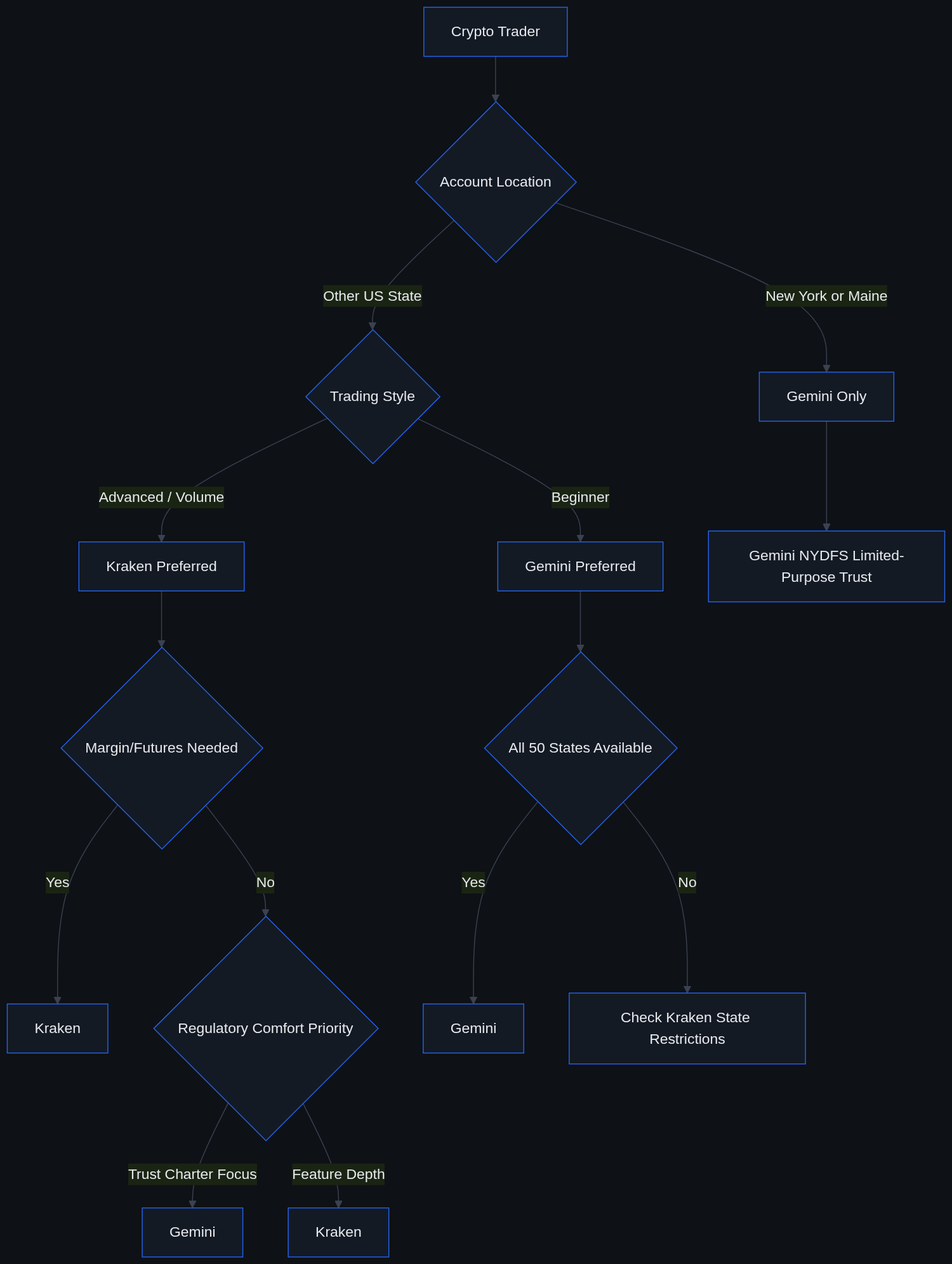
Kraken is not available to residents of New York or Maine, according to Kraken’s regulatory disclosures. Gemini, by contrast, is available in all 50 US states and more than 60 countries per its areas-of-availability page. For residents of New York or Maine specifically, this availability gap effectively narrows the choice toward Gemini or another exchange licensed in those states.
Fees and availability reviewed September 21, 2026.
Tax Reporting and Recordkeeping
Both exchanges generate transaction history exports compatible with third-party tax software such as CoinLedger and Koinly, and both have historically issued IRS information returns tied to reportable activity. Digital-asset broker reporting requirements have continued to evolve; current-year 1099 form requirements and thresholds should be confirmed against IRS.gov guidance rather than assumed from prior tax years, since broker reporting rules for digital assets have been subject to phased implementation.
Institutional and Advanced Trader Tools
Kraken supports institutional and high-volume traders through an OTC desk, Kraken Pro’s deeper order books, and margin/futures access for eligible non-US jurisdictions. Gemini offers Gemini Custody for qualified custody needs, Gemini Clearing for negotiated block trades, and an institutional-grade API alongside ActiveTrader. Funds and high-net-worth traders weighing derivatives exposure and OTC execution may lean toward Kraken, while those prioritizing a regulated custody solution under a trust charter may find Gemini’s institutional stack more aligned with compliance requirements.
Community Sentiment and Reputation Signals
Discussion threads on r/CryptoCurrency and r/Bitcoin generally echo the same split reflected in the fee and feature data: traders citing lower advanced-tier costs and broader asset access tend to favor Kraken, while users citing regulatory comfort, simpler UX, and nationwide availability tend to favor Gemini. App store ratings for both platforms are broadly comparable, though individual review sentiment fluctuates and should be checked directly on the App Store or Google Play before being treated as current.
Pros and Cons
Kraken
- Pros: Broader asset selection, advanced-tier fee tiers that reward volume, margin/futures/OTC access, 24/7 live chat support.
- Cons: Steeper learning curve for beginners, unavailable in New York and Maine, and as a privately held company its public financial disclosures are more limited than those of listed rivals.
Gemini
- Pros: Beginner-friendly interface, available in all 50 states, NYDFS trust charter, hot-wallet insurance references.
- Cons: Higher effective fees on the standard/basic interface, narrower coin and staking selection, withdrawal-hold complaints tied to verification and processing windows.
Which Is Better?
There’s no single answer to “which is better”, it depends on who’s asking. Active and advanced traders who prioritize lower per-trade costs at volume, a wider coin list, and margin/futures access are generally better served by Kraken. Beginners, New York or Maine residents (who can’t use Kraken at all), and users who weight regulatory branding heavily tend to prefer Gemini. Long-term holders looking for broader staking-yield diversity may lean Kraken, while security-first users focused on insured hot-wallet custody and a trust-company structure may lean Gemini. For a broader look at how these two stack up against other regulated platforms, see LakeBTC’s best crypto exchanges roundup.
FAQ
What’s better than Kraken?
“Better” depends on the use case. Coinbase is often cited for its beginner-friendly onboarding and brand recognition, Binance.US for asset breadth in states where it operates, and eToro for its copy-trading feature set. None is universally superior to Kraken, each trades off differently on fees, coin selection, and regulatory footprint. See LakeBTC’s comparisons of Coinbase vs Kraken and Binance vs Kraken for more detail.
Why is it so hard to withdraw from Gemini?
Most reported delays stem from standard identity-verification holds on newer accounts, routine ACH processing windows of one to four business days, added security review on unusually large withdrawal requests, and residual confusion tied to the 2022 Earn program freeze, which was a separate lending product from Gemini’s core exchange custody.
Is Kraken or Gemini safer for beginners?
Both apply comparable account-security tools, two-factor authentication, withdrawal whitelisting, and hardware key support. Gemini’s simpler interface and NYDFS trust charter may feel more approachable for first-time users, while Kraken’s more complex order-book tools carry a steeper learning curve that beginners should approach cautiously.
Do Kraken and Gemini charge fees for holding crypto (custody fees)?
Standard retail accounts on both exchanges are not typically charged an ongoing custody fee simply for holding assets on the platform; costs generally arise from trading, conversion, or withdrawal activity. Institutional custody products, such as Gemini Custody, may carry separate fee structures, check each provider’s current fee schedule directly, since terms vary by product.
Can I use both Kraken and Gemini simultaneously to diversify exchange risk?
Yes. Some traders split holdings across multiple regulated exchanges to reduce single-platform exposure, particularly for larger balances. This approach adds recordkeeping complexity and multiple sets of verification steps, so it’s most useful for users comfortable managing more than one account and tax export process.