Kraken vs Binance in the US: Fees, State Limits and Staking
Binance.com is closed to US residents. Binance.US’s order book costs far less per trade; Kraken works in more states and adds margin and stock trading.
You’re weighing two exchange names, but if you live in the US, only one Binance will open an account for you. Binance.com bars US residents and US citizens, so the account you’d actually get is Binance.US, run by a separate company. The real comparison is Binance.US against Kraken.
On price, Binance.US wins: 0% on orders that rest on the book and at most 0.02% on orders that fill right away, far below Kraken’s entry rates. On reach, Kraken wins: it’s open to residents of 48 states, publishes which ones can stake, and adds margin and stock trading. Where you live settles more of this than fees do.
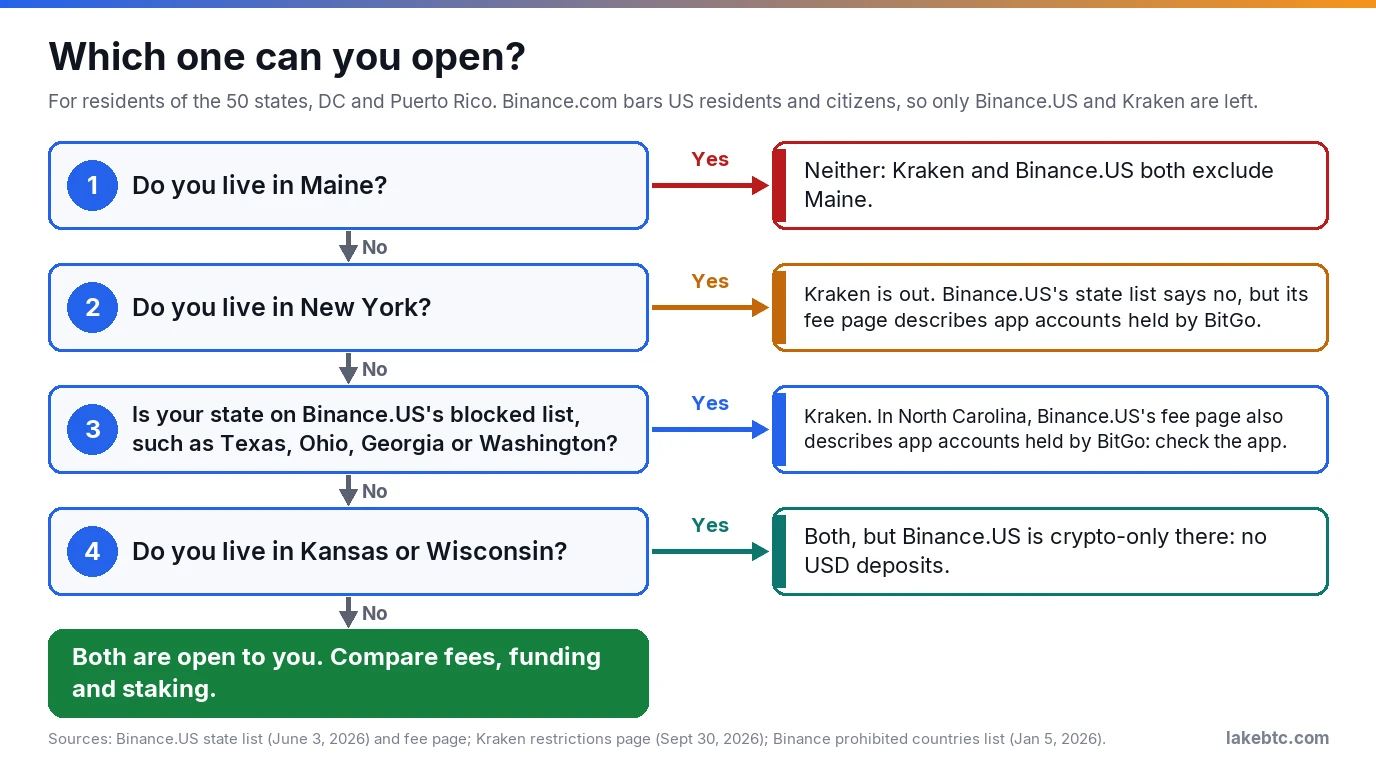
So start with the state table. If your state is on Binance.US’s blocked list, there’s no choice left to make.
Before you open either account
- 🔴 Binance.com isn’t an option from the US: its rules bar residents and citizens, and forbid using a VPN to get around that.
- 🟡 Binance.US can’t register you in 16 states and territories, including Texas and Maine. Kraken excludes only New York and Maine.
- 🟢 On the order book, Binance.US charges 0% maker and at most 0.02% taker. Kraken Pro starts at 0.40% maker and 0.80% taker on crypto pairs.
- 🟡 After an ACH deposit, both hold back withdrawals worth that amount for 7 days, crypto included.
In this article
- Who can open what: Binance.com, Binance.US and Kraken
- State by state: where each one works
- Trading fees: what a $1,000 order costs
- Getting money in and out
- Staking, margin and the rest
- Regulatory record, and what protects your account
- Moving coins from Binance.US to Kraken
- Scams that borrow both names
- Which one fits what you’re doing
- Frequently Asked Questions
- What to do next
Who can open what: Binance.com, Binance.US and Kraken
Binance.com’s List of Prohibited Countries, updated 5 January 2026, names the United States first. You can’t register if you’re located in the US, live there, or hold US citizenship. Citizenship alone rules you out, so living abroad doesn’t change it.
Binance.US is run by BAM Trading Services, a Miami company that licenses its trading technology from Binance Holdings. Under its terms, the two share majority owners but not a corporate or management structure. Your contract is with BAM, which provides the services, not with Binance.com.
Kraken serves US clients through Payward Interactive, which is registered with FinCEN as a money services business. It doesn’t serve residents of New York or Maine, and those are the only two states on its exclusion list.
State by state: where each one works
Both companies publish their own lists, and they don’t line up. This table combines Binance.US’s state list (dated June 3, 2026) with Kraken’s restrictions page (September 30, 2026) and its US staking list (March 30, 2026).
| Where you live | Binance.US | Kraken | Kraken staking |
|---|---|---|---|
| New York | State list says you can’t register; fee page covers app accounts held by BitGo | Not served | No |
| Maine | Can’t register | Not served | No |
| North Carolina | Same as New York | Yes | Yes |
| Texas, Vermont, Washington | Can’t register | Yes | No |
| Alaska, Connecticut, Georgia, North Dakota, Ohio, Oregon | Can’t register | Yes | Yes |
| Kansas | Crypto only, no USD | Yes | Yes |
| Wisconsin | Crypto only, no USD | Yes | No |
| Alabama, California, Illinois, Kentucky, Maryland, New Jersey, South Carolina | Yes | Yes | No |
| Guam, American Samoa, Northern Mariana Islands, U.S. Virgin Islands | Can’t register | Not on Kraken’s excluded list | Not listed |
| Every other state, plus DC and Puerto Rico | Yes | Yes | Yes |
New York and North Carolina are the odd ones. On Binance.US’s state list you can’t register there, but its fee page covers accounts opened in the Binance.US app where BitGo Bank & Trust holds, clears and settles your coins outside Binance.US. Those accounts don’t follow the main fee schedule: conversions carry a spread, and each crypto withdrawal costs 0.05% of its dollar value, or a small minimum fee when 0.05% comes to less. If you’re in either state, open the app and see which sign-up it offers you before you move money.
Kansas and Wisconsin get a crypto-only Binance.US: no USD deposits and no linked bank. You’d fund it by sending crypto in from somewhere else. Connecticut dropped off in 2025, when Binance.US stopped trading there after August 22.
Trading fees: what a $1,000 order costs
Each exchange gives you two ways to buy. The simple Buy screen is quick, and you pay for that. The order book is where the low rates live: Kraken Pro on Kraken, Advanced spot trading on Binance.US. A maker order rests on the book until someone fills it. A taker order fills right away.
On Binance.US, Advanced spot trading costs 0% for makers and 0.02% for takers on every pair except BNB/USD, whose taker fee is 0.01%. That rate started on April 22, 2026, with no volume requirement, and paying the fee in BNB takes another 5% off. The Buy, Sell and Convert screens don’t use those rates. Their cost is a spread built into the price, shown on the Preview Purchase screen before you approve.
On Kraken, the app’s Buy screen charges 1% on instant and recurring buys and 1.5% on custom orders, plus a spread. Kraken+ members skip that fee on up to $10,000 a month, but not the spread.
Kraken Pro starts at 0.40% maker and 0.80% taker on crypto pairs. It drops to 0.30% and 0.60% from $2,500 of 30-day volume, and to 0.22% and 0.38% from $10,000 of volume or $20,000 held on Kraken. Buy-screen volume doesn’t count toward those tiers. USDT/USD and other pairs with a stablecoin as the base currency use a separate schedule that starts at 0.20% on both sides, and USDG pairs such as USDG/USD have their own, lower one.
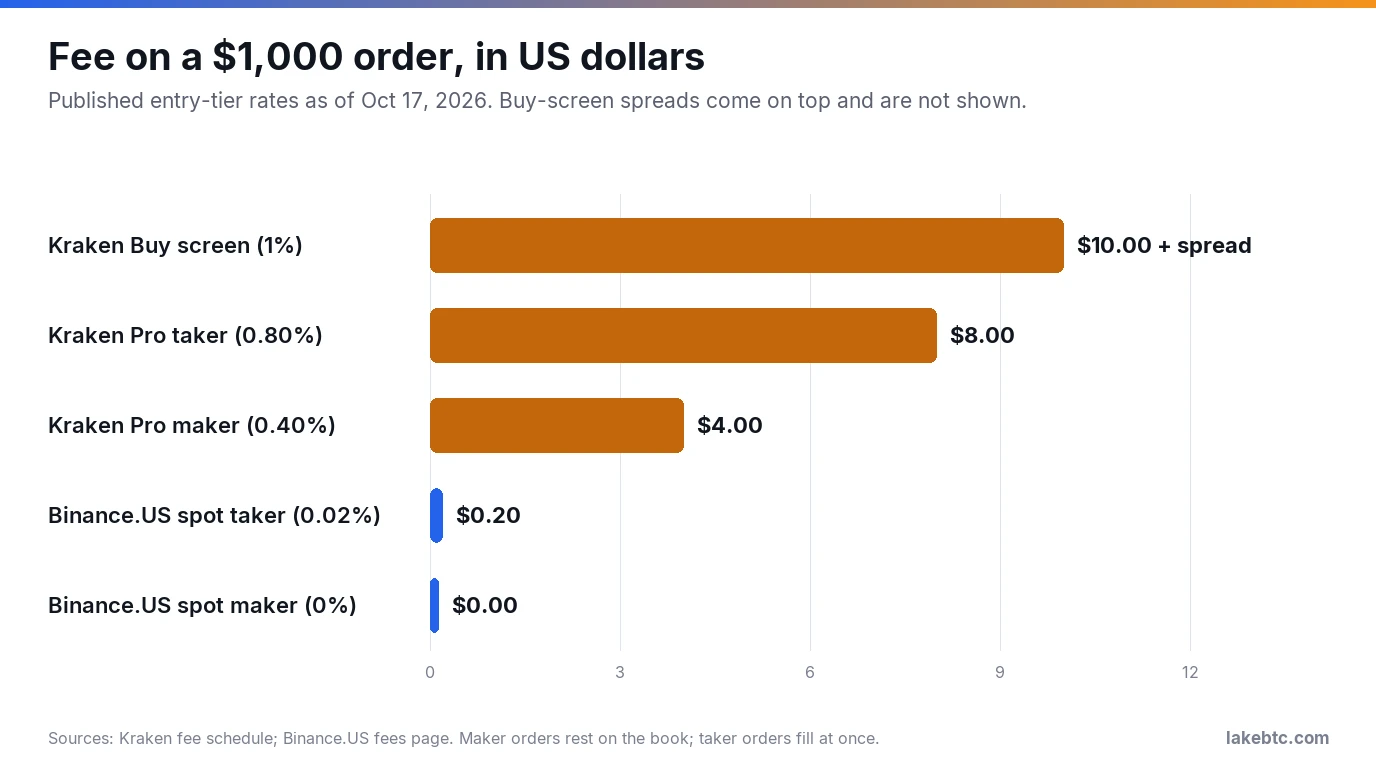
On a market order that size, that’s $0.20 on Binance.US and $8.00 on Kraken Pro. Kraken’s Buy screen costs $10.00 plus the spread. Place one such order a month and the gap between the two order books comes to $93.60 a year. Unless you’re a Kraken+ member, the Buy screen’s 1% fee alone is more than any Kraken Pro rate, before the spread, so learn the order book before you fund a big account.
Getting money in and out
ACH is free in both directions on both exchanges. The differences show up with wires, cards and the hold after a bank deposit. In Texas, Kraken’s Plaid ACH link isn’t available, so look under Deposit for the USD methods your account offers before you plan around ACH.
| Method | Binance.US | Kraken |
|---|---|---|
| ACH deposit and withdrawal | Free | Free; ACH through Plaid isn’t offered to Texas accounts |
| Hold after an ACH deposit | 7 days on the deposited amount, including crypto bought with it | 7 days on cash or crypto equal to the deposit |
| Wire deposit | $0 from Binance.US; your bank may charge | Free by FedWire |
| Wire withdrawal | $25 flat | $4 by FedWire |
| Card deposit | 3.99%, debit or credit | $0.25 + 3.75%, the rate Kraken lists for debit cards; 72-hour withdrawal hold |
| Crypto withdrawal | Fee shown before you confirm | Fee shown when you confirm |
| Everything else | New York and North Carolina accounts through BitGo: 0.05% per crypto withdrawal, with a minimum fee | PayPal deposits: fee shown on the final confirmation page; 72-hour withdrawal hold |
The 7-day hold is the one that catches people. You can trade right away, but cash or crypto worth the new ACH deposit can’t leave either exchange until the week is up. Cards are the expensive route: funding $1,000 that way costs $37.75 on Kraken and $39.90 on Binance.US before you’ve bought anything.
Staking, margin and the rest
Binance.US stakes through outside providers and keeps a service fee of 9.95% to 39.95% of the rewards, already netted out of the rate it shows you. Watch for Soft-Staking. Where it’s offered, Binance.US’s terms let it enroll eligible tokens in your account automatically, and that program keeps 90% of the rewards. You leave it by moving those tokens into regular staking or out of the account.
Kraken offers staking on coins such as ETH, SOL, DOT and ADA, but only to residents of 37 states plus DC and Puerto Rico. California, Texas, New Jersey and eight other states Kraken serves aren’t on that list. US clients who aren’t accredited investors can’t use its Opt-In Rewards.
Kraken’s own pages disagree on its cut. Its staking help page, updated August 19, 2026, puts it at 30% of the rewards on Flexible staking and Auto Earn and 25% on bonded staking below $1 million, while its fee schedule still says 20%. The rates Kraken shows you are before that commission, so work with the higher figure.
Kraken also offers margin to eligible US retail clients, derivatives through Kraken Derivatives US, a futures commission merchant registered with the CFTC, and commission-free stocks and ETFs in select states. Binance.US’s terms name trading and staking as its services; margin and futures don’t appear. Binance.US offers 200+ cryptocurrencies, while Kraken keeps a list of tokens US clients can’t trade. Look up the exact coin you want on each before you fund.
Regulatory record, and what protects your account
In November 2023, Binance Holdings, the company behind Binance.com, pleaded guilty to Bank Secrecy Act violations, failing to register as a money transmitting business, and sanctions violations. It agreed to pay about $4.3 billion. Because Binance served US customers, it had to register with FinCEN, the Justice Department said.
The SEC’s 2023 case named both Binance Holdings and BAM Trading, the company behind Binance.US. The SEC and the defendants agreed to dismiss it with prejudice on May 29, 2025. Binance.US ran crypto-only from July 2023 until it began restoring ACH deposits and withdrawals in February 2025.
Kraken has an SEC record too. In February 2023 it agreed to stop its staking programs and pay $30 million. A separate SEC case filed in November 2023 was dismissed with prejudice under a joint stipulation in March 2025. The staking Kraken offers US clients now is the state-limited product in the table above.
Neither exchange is a bank for your coins. Kraken publishes proof of reserves for BTC, ETH, SOL, USDC, USDT and XRP, and you can check that your own balance was included on the Proof of Reserves page in Kraken Pro. Its Wyoming depository, Kraken Financial, offers custody only to eligible clients in certain states. Binance.US is a FinCEN-registered money services business with money transmitter licenses in 32 states.
Moving coins from Binance.US to Kraken
A transfer between the two is an ordinary crypto withdrawal, and once it leaves Binance.US it can’t be cancelled or reversed. Work in this order:
- On Kraken, click Deposit, pick the coin and choose the network. Use only a network Kraken supports for that coin.
- If it’s your first deposit of that coin, click Generate deposit address. Copy the address and any extra field straight from that screen each time. Don’t type it, and don’t take it from your transaction history. XRP needs a destination tag.
- Look up Kraken’s minimum deposit for that coin. It counts after network fees, and a deposit below it is marked Failed and lost for good.
- On Binance.US, open Wallet on the website (Portfolio in the app) and choose Withdraw. Pick the same coin, paste the address and select the same network. Fill in the memo field if one appears.
- Select Preview Withdrawal. Check the fee, then compare the address with the one on Kraken’s deposit screen at the start, in the middle and at the end: a look-alike address planted by an address-poisoning scam can share the start and end with yours. Confirm, then approve the Withdraw Request Confirmation email.
- Track it under Wallet, then Deposits & Withdrawals. The TxID there lets you follow it on a block explorer.
For a large amount, run steps 4 to 6 with a small test first and wait until it shows up on Kraken. The test has to clear Kraken’s minimum from step 3 as well. If it falls short, a bigger deposit sent afterwards won’t bring it back.
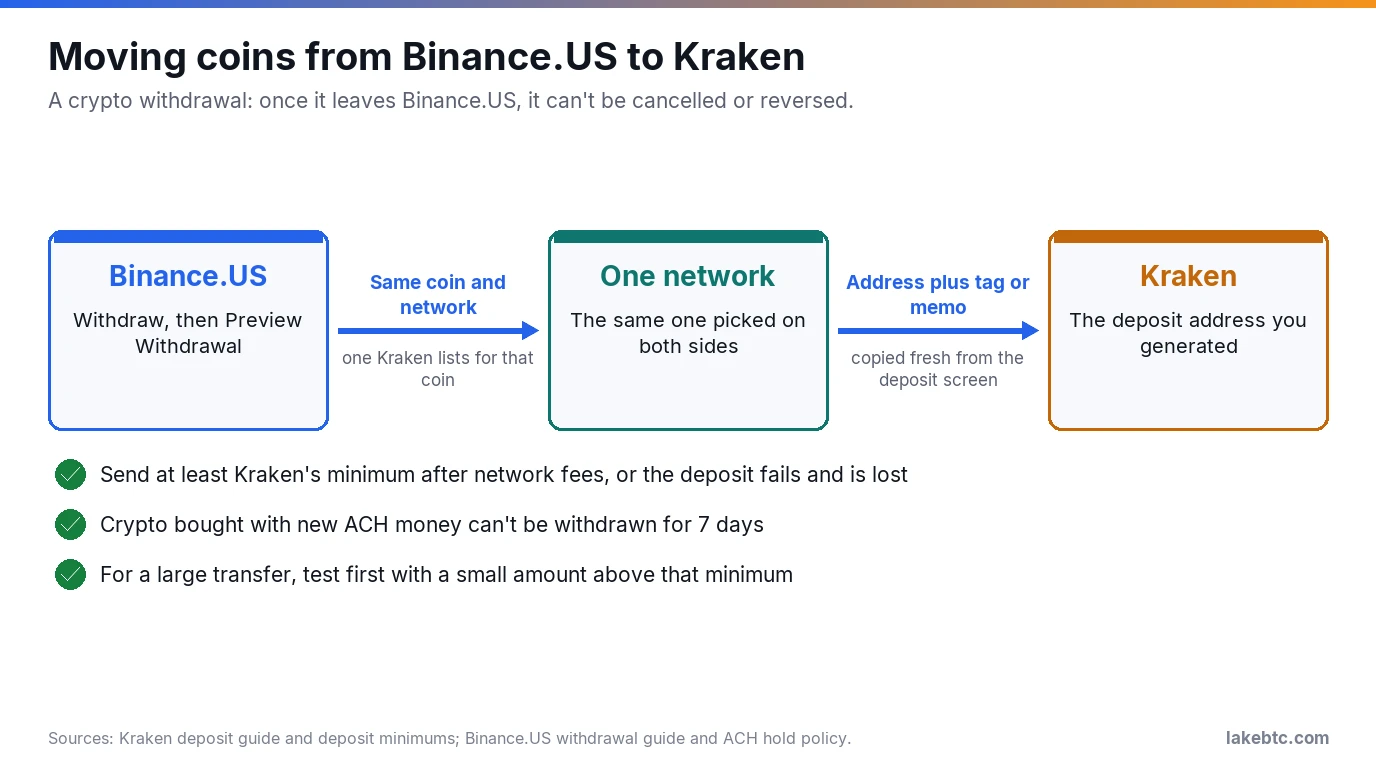
One catch: if you funded Binance.US by ACH in the past week, coins bought with that money stay put until the hold ends. Plan the move for after that, and save a record of what you paid for the coins before they leave Binance.US: the tax question below explains why.
Scams that borrow both names
Americans reported $7.2 billion in losses to crypto investment fraud in 2025, the biggest source of losses in the FBI’s IC3 report for that year. It usually starts with a text, a social media message, an ad or a dating-app match. You’re steered to a trading platform or app that shows fake profits, and when you try to withdraw, you’re told to pay taxes and fees first.
A familiar exchange name on a screen doesn’t make the screen real. Type binance.us or kraken.com yourself, and walk away from any of these:
- Someone telling you to open Binance.com through a VPN. Binance’s own terms forbid it.
- An unexpected call from “Kraken” or “Binance.US”. Kraken Support only calls when you’ve arranged the call first, and Binance.US says it will never call you.
- A request to move your coins to a “safe” wallet, or to pay a fee to unlock a withdrawal. Both are on Kraken’s list of things it will never ask you to do.
Which one fits what you’re doing
Your state decides first. In Texas, Ohio, Georgia, Washington, Oregon, Alaska, Connecticut, North Dakota or Vermont, it’s Kraken, because Binance.US won’t register you. Maine residents get neither.
In New York, Kraken is out and Binance.US’s state list says no too, so the only route left is the BitGo app account its fee page describes. North Carolina has Kraken plus that same possible BitGo route. Either way, check what the Binance.US app offers you before you count on it.
If both are open to you, the way you trade decides. Do you place limit orders and trade often? Binance.US’s free maker orders are hard to beat, as long as it lists your coins. Do you want margin, derivatives or stocks next to your crypto? That’s Kraken. Buying a few hundred dollars a month? Either works. Just use the order book instead of the Buy screen.
Frequently Asked Questions
Is Kraken safe for US citizens?
Kraken is registered with FinCEN as a money services business, which isn’t the same as being insured like a bank. FDIC deposit insurance doesn’t cover crypto assets, and it doesn’t apply when a non-bank such as a crypto company fails. What you control is your own account: turn on two-factor authentication, never read a code to a caller, and keep coins you aren’t trading in a wallet you hold.
Why is Binance blocked in the US?
Binance.com shuts out the US in its own eligibility rules. One of the charges in its 2023 plea was failing to register as a money transmitting business while it served US customers. Americans who want the Binance name get Binance.US, a separately run company with its own state licenses.
Can I use Binance.com with a VPN?
No. Binance.com’s terms of use, effective 21 July 2026, say you must not get around a location restriction with a VPN that changes your IP address. An account opened that way breaks the terms you accept when you sign up.
Does Kraken work in New York?
Not for New York residents. If you move to a state Kraken serves, it lets you re-verify using your new address and a proof-of-residence document.
Do I owe tax when I move crypto from Binance.US to Kraken?
Not if both accounts are yours: the IRS treats a transfer between your own accounts as non-taxable, even if an exchange sends you a form about it. Selling or converting on either exchange is different. As custodial trading platforms, both fit the IRS’s description of brokers that report your sales on Form 1099-DA, starting with transactions on or after January 1, 2025.
Before you move coins, save a record of what you paid for them on Binance.US. Under the IRS’s 2026 instructions for Form 1099-DA, coins transferred into an exchange count as noncovered, so Kraken doesn’t have to report their cost basis when you sell them there. Your own record is what you’ll use to work out the gain or loss.
What to do next
Find your row in the state table first. If both exchanges are open to you, fund by ACH where your account offers it and plan around the hold that follows. Then place your orders on Kraken Pro or Binance.US Advanced spot rather than the Buy screen.
If this is your first purchase anywhere, our step-by-step guide on how to buy crypto covers verification, funding and your first order. If you plan to move coins off either exchange into a wallet you control, learn what a seed phrase protects before you send anything.
Drafted with AI by the LakeBTC Editorial Team, then edited and fact-checked against the sources linked in the text. How we use AI · Report an error
Update history 1
- Rewritten and re-checked against primary sources.