Bybit Review: Features, Fees, and US Availability

Bybit is one of the largest centralized cryptocurrency exchanges by trading volume, yet American traders researching it consistently run into the same wall: can US residents actually use it? The direct answer is no: Bybit does not serve US residents under its own terms of service, and it is best suited to non-US traders seeking derivatives depth rather than to anyone based in the United States. This review walks through Bybit’s product lineup, its fee schedule, its security track record, including the February 2025 exploit, and exactly where US residents stand under Bybit’s own terms of service. We also point to exchanges that do serve the US market directly.
In this article
- At a Glance: Bybit Snapshot
- Is Bybit Legal in the US?
- Bybit Review: Core Features
- Bybit Fees Breakdown
- Is Bybit Safe? Security Deep-Dive
- Pros and Cons
- Bybit Withdrawals: What US and Non-US Users Should Know
- Bybit vs. Coinbase
- Bybit Alternatives for US Traders
- Regulatory and Compliance Outlook
- Verdict: Who Should (and Shouldn’t) Use Bybit
- FAQ
At a Glance: Bybit Snapshot
Bybit is reported to have been founded in 2018 and has grown into one of the higher-volume centralized exchanges globally, though its precise corporate structure, founding details, and current headquarters arrangement are best confirmed on the company’s own legal disclosures rather than assumed from secondary sources. According to CoinGecko’s exchange-ranking research, Bybit ranked as the second-largest centralized exchange by spot trading volume in December 2025, with roughly a 9.5% market share and about $90.0 billion in monthly spot volume, down from $108.1 billion the previous month.
| Category | Detail |
|---|---|
| Global volume rank (spot) | 2nd-largest CEX, ~9.5% market share (Dec 2025, CoinGecko) |
| US availability | Not offered, United States is a listed “Excluded Jurisdiction” |
| Core products | Spot, derivatives/perpetuals, Earn, copy trading, NFT marketplace, Bybit Card |
| Spot trading fee (base tier) | 0.10% maker / 0.10% taker |
| 2025 security incident | ~$1.5 billion (Feb 21, 2025, Safe{Wallet} multisig exploit) |
Fees and availability verified as of 2026-07-26.
Verdict box: who Bybit is (and isn’t) for
Best for: non-US traders who want deep derivatives liquidity, a broad product suite, and competitive base-tier fees. Better to look elsewhere: US residents, since Bybit does not offer accounts, trading, or custody to people in the United States under its own service agreement, and anyone who prioritizes a spotless support-complaint record over raw feature breadth.
Is Bybit Legal in the US?
Bybit’s official stance on US customers
The direct answer to “is Bybit legal in the US” starts with Bybit’s own paperwork rather than US law. According to Bybit’s Service Restricted Countries help page, Section 11.3 of its Service Agreement explicitly lists the United States as an “Excluded Jurisdiction” where Bybit does not offer services or products. That same list covers Mainland China, Hong Kong, Singapore, Canada, North Korea, Cuba, Iran, Uzbekistan, Russian-controlled regions of Ukraine, Sevastopol, Sudan, Syria, and Dubai, with Bybit reserving sole discretion to expand the list further.
That framing matters. It is a self-imposed, contractual restriction, Bybit’s own terms describe the exclusion as applying to jurisdictions “in which we may determine from time to time to terminate the services at our sole discretion,” rather than language pointing to a specific US government prohibition on the platform. In other words, US unavailability is best understood as a business and compliance decision made by Bybit, not evidence that a US regulator has separately banned the exchange by name.
Why the exclusion isn’t the same as a government ban
It’s worth being precise about the distinction, since the two get conflated often in online discussion. US regulators, including the CFTC and SEC, have brought enforcement actions against a number of offshore crypto-derivatives platforms over the years for allegedly serving US customers without proper registration. A careful review of public CFTC.gov, SEC.gov, and DOJ.gov records did not turn up an enforcement action specifically naming Bybit at the time of this review. That absence should not be read as a clean bill of health or as proof no such action exists elsewhere, it simply means this particular exchange’s geo-exclusion appears to be a proactive compliance posture rather than a documented response to a specific US legal action against Bybit. Readers who want the most current picture should check CFTC and SEC enforcement databases directly, since regulatory postures toward offshore derivatives platforms continue to evolve.
What happens if a US resident tries to sign up anyway
Bybit, like most major offshore exchanges, applies IP-based geofencing and identity-verification checks during onboarding. Even if a US-based user manages to create an account, KYC review and periodic compliance screening can flag a US nexus later, through a linked bank account, an IP address, or supporting documents, and trigger a compliance hold. Aggregated Trustpilot complaint patterns cited in Bybit’s public review profile repeatedly describe frozen or delayed withdrawals tied to compliance reviews; this is anecdotal, pattern-level evidence rather than a confirmed statement of Bybit policy, but it is consistent enough across reviewers to be worth flagging.
The VPN workaround: why it isn’t a real solution
Some traders consider using a VPN to mask a US IP address and access Bybit anyway. Doing so conflicts directly with the geo-restriction clause in Bybit’s own service agreement, meaning any account opened this way exists in violation of the platform’s terms from day one. That has practical consequences: if the account is later flagged, funds can be frozen pending a compliance review, and a user who accessed the platform in violation of its terms has limited recourse, since those protections are generally built around properly licensed, US-facing financial relationships rather than accounts opened by evading an exchange’s own geographic restrictions.
Bybit Review: Core Features
Spot trading
Bybit’s spot market covers a large roster of trading pairs against major stablecoins and fiat-adjacent assets, with a standard order book interface, advanced order types, and charting tools aimed at active traders rather than strict beginners.
Derivatives and perpetual futures
Derivatives are arguably Bybit’s core strength, spanning USDT-margined and coin-margined perpetual contracts as well as options. Leverage on perpetual contracts is commonly cited in third-party trader reviews at up to 100x, though that figure comes from review aggregators rather than Bybit’s own current derivatives documentation, and actual maximum leverage varies by contract and account tier, so traders should confirm exact limits on Bybit’s own derivatives pages before opening a leveraged position.
Copy trading and trading bots
Bybit offers a copy-trading feature that lets users mirror the positions of selected lead traders, alongside built-in trading bots (grid, DCA-style, and martingale variants) aimed at automating repetitive strategies without custom code.
Earn products
Bybit’s Earn suite includes flexible and fixed-term crypto savings products, along with liquidity-mining-style offerings, positioned as a way to put idle balances to work rather than leaving them dormant in a spot wallet.
Bybit Card
Where regionally available, the Bybit Card lets users spend crypto balances at point-of-sale, converting holdings to fiat at the time of transaction, a feature more common among global exchanges with card-issuing partnerships than among strictly US-licensed platforms.
NFT marketplace and Web3 wallet
Bybit also runs an NFT marketplace and a Web3 wallet product, extending the platform beyond centralized trading into self-custody and on-chain interactions, which is an increasingly common pattern among large global exchanges trying to bridge CEX and DeFi usage.
Mobile app usability
Trader reviews on platforms like TradingView tend to describe Bybit’s mobile app favorably in terms of interface responsiveness and order execution speed, though this is qualitative reviewer sentiment rather than an independently verified benchmark, and experiences vary by region and account type.
Bybit Fees Breakdown
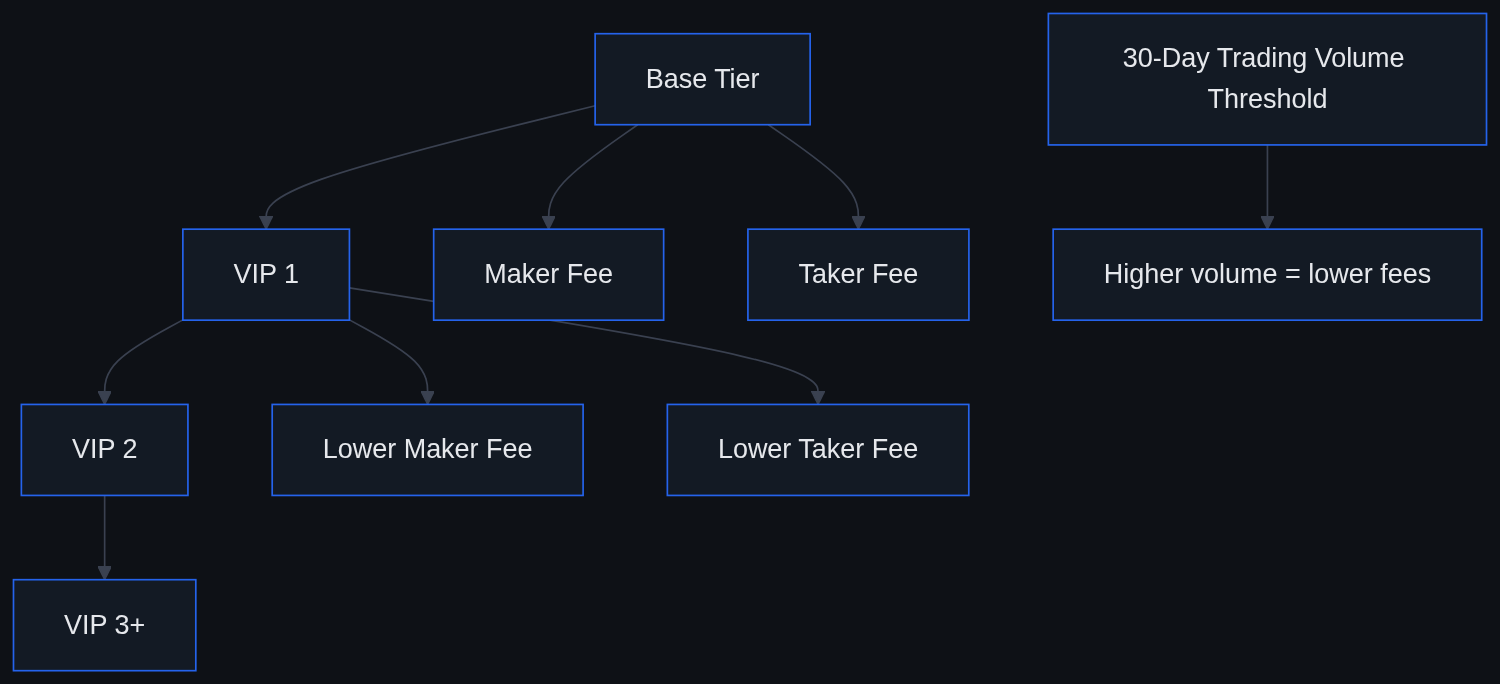
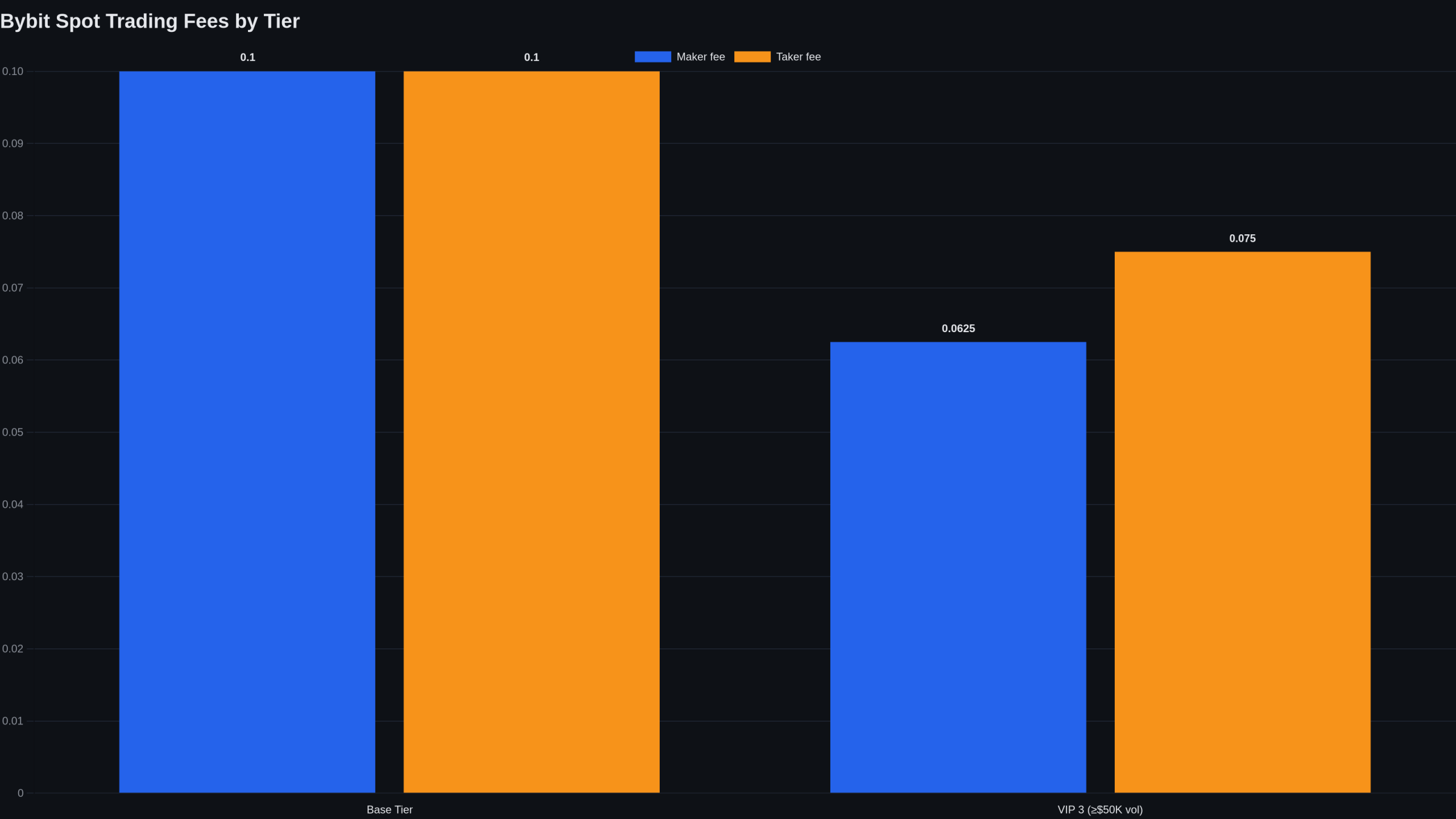
Bybit’s fee structure follows a tiered maker/taker model common among large derivatives-focused exchanges, with discounts unlocked as 30-day trading volume increases.
| Fee type | Maker | Taker |
|---|---|---|
| Spot trading (base tier) | 0.10% | 0.10% |
| Perpetual Pre-Market (non-VIP) | 0.0400% | 0.1000% |
| Spot, VIP 3 (30-day volume ≥ $50,000) | 0.0625% | 0.0750% |
Fees and availability verified as of 2026-07-26.
Derivatives fees
Standard USDT-margined perpetual futures fees are commonly cited across multiple review sources at roughly 0.02% maker and 0.055% taker for base-tier accounts, though the complete current derivatives fee ladder should be confirmed directly on Bybit’s own fee-rate page before relying on it for cost planning, since tiers and rates are adjusted periodically.
Deposit and withdrawal fees
Crypto deposits are typically free, while withdrawal fees are network-dependent and adjust with underlying blockchain gas conditions, a structure common across large exchanges rather than unique to Bybit. Fiat on/off-ramp availability and associated costs depend heavily on region and payment partner.
Card fees and conversion spreads
Where the Bybit Card is available, spend transactions typically involve a conversion spread between the user’s crypto balance and the settlement currency, similar to how other crypto debit cards operate; exact spread figures are best confirmed on Bybit’s own card terms rather than assumed.
How Bybit’s fees compare
Base-tier spot fees on Bybit sit in a range broadly comparable to other large global exchanges, though a side-by-side numeric comparison against platforms like Coinbase, Kraken, or KuCoin requires checking each exchange’s current published fee schedule directly, since rates and tier structures change independently of one another. For a broader look at how exchange fee models differ across the industry, see LakeBTC’s guide to crypto exchange fees.
Is Bybit Safe? Security Deep-Dive
The 2025 security incident
On February 21, 2025, Bybit suffered a major security breach in which attackers compromised the Safe{Wallet} multisig interface during a routine cold-to-warm wallet transfer, resulting in losses of nearly $1.5 billion, primarily in ETH, according to Bybit’s own security incident timeline. The FBI has publicly attributed the theft to North Korea’s Lazarus Group (tracked under names including TraderTraitor and APT38), per reporting on the bureau’s public service announcement. Following the breach, Bybit has said it launched a recovery initiative aimed at tracing the stolen assets, according to the company’s own incident communications, though independent confirmation of the exact outcome of that effort was not available at the time of this review.
Current security infrastructure
Bybit describes a security architecture built around multi-signature cold wallet storage, layered authentication, real-time monitoring, and periodic independent audits. It’s worth noting, per third-party security analysis, that the February 2025 incident demonstrated that multisig approval alone did not prevent a spoofed-transaction attack against the Safe{Wallet} interface, underscoring that infrastructure design and operational execution both matter for custody security, not just the presence of multisig controls on paper.
Proof of reserves and disclosures
Bybit publishes periodic proof-of-reserves style disclosures on its own site, which traders evaluating custodial risk may want to review directly rather than relying on secondhand summaries.
Regulatory licenses and jurisdictional oversight
Bybit’s regulatory footprint has expanded in some jurisdictions even as US access remains closed. Reporting indicates the UAE’s Securities and Commodities Authority granted Bybit a Virtual Asset Platform Operator License in October 2025, and that Bybit EU GmbH obtained a MiCA Crypto-Asset Service Provider license from Austria’s Financial Market Authority in May 2025, enabling EEA passporting, though both of these should be confirmed on Bybit’s own legal and compliance disclosures for the most current status. Separately, reporting indicates Bybit registered with India’s Financial Intelligence Unit after a fine in the roughly $1.0 million to $1.06 million range tied to past anti-money-laundering compliance issues, following a brief service suspension in that market.
Trustpilot versus TradingView: two very different pictures
Anyone researching “is Bybit safe” will notice a sharp gap between review platforms. Bybit’s Trustpilot profile sits in an “Average” band, with the aggregate score fluctuating roughly between 2.9 and 3.4 out of 5 across snapshots, built on several thousand reviews, a score category that leans heavily on complaints about customer support responsiveness and withdrawal or compliance holds. TradingView’s trader-review section, by contrast, tends to skew notably more positive, with reviewers focusing on order execution quality and interface usability rather than account-servicing friction. The likely explanation is that the two platforms capture different experiences: Trustpilot reviewers are disproportionately people who had a support or account issue, while TradingView reviewers are largely commenting on the trading experience itself. Neither score alone tells the full story.

Pros and Cons
Pros
- Broad product range spanning spot, derivatives, copy trading, Earn, NFTs, and a card product
- Consistently ranks among the largest exchanges globally by spot trading volume
- Competitive base-tier spot fees, with further discounts at higher volume tiers
- Generally favorable mobile trading-experience sentiment among active traders
Cons
- Not available to US residents under Bybit’s own Service Agreement
- Suffered a roughly $1.5 billion security incident in February 2025
- Trustpilot reviews show a persistent volume of support and withdrawal-delay complaints
- High leverage on derivatives products adds risk for inexperienced traders
Bybit Withdrawals: What US and Non-US Users Should Know
Withdrawal process for eligible, non-US users
For users in supported jurisdictions, Bybit’s standard withdrawal flow involves selecting an asset and network, passing any applicable security checks (such as two-factor authentication), and waiting for network confirmation, a process broadly similar to withdrawal flows on other large centralized exchanges.
Common causes of withdrawal delays
Reported user experiences, aggregated across review platforms, point to a recurring pattern where withdrawal delays coincide with KYC re-verification requests or compliance-related account reviews. This should be read as a pattern seen in user reports rather than a confirmed, official Bybit policy, exchanges routinely run additional verification on withdrawals that trip internal risk thresholds, and individual account circumstances vary widely.
What US-based holders with existing balances should know
Given that the United States is listed as an Excluded Jurisdiction under Bybit’s own terms, US-based individuals who hold a legacy balance should expect any account access, support responses, and withdrawal requests to be shaped by that geo-restriction. Anyone in this position should review Bybit’s current public announcements and its Service Restricted Countries page directly, since exchange-specific wind-down or exit procedures for restricted-jurisdiction accounts can change without much notice.
Bybit vs. Coinbase
Bybit and Coinbase serve fundamentally different audiences, which makes a like-for-like comparison mostly a question of jurisdiction and risk appetite rather than raw features. Coinbase operates as a US-licensed platform built around regulatory compliance and simplicity for mainstream investors, while Bybit is a globally focused exchange built around derivatives depth and a broader (but non-US) product suite, including higher-leverage perpetual futures that Coinbase does not offer in comparable form. Bybit’s February 2025 security incident is a material data point for anyone weighing custody risk, though it should be viewed alongside Bybit’s own account of its response rather than in isolation. For US residents, the comparison is largely moot on the legal-access dimension: Coinbase is built for US customers, and Bybit explicitly is not. Readers who want a deeper look at Coinbase specifically can see LakeBTC’s Coinbase review.
Bybit Alternatives for US Traders
Since Bybit does not serve US customers, traders in the United States researching this exchange are usually really asking which platform can deliver a similar feature set legally. A few US-facing options worth considering:
- Coinbase, a US-licensed exchange built around straightforward spot trading and a large selection of listed assets; see LakeBTC’s Coinbase review.
- Kraken, with Kraken Futures offering regulated derivatives access to eligible traders where permitted; see LakeBTC’s Kraken review.
- Gemini, a New York-based exchange generally positioned around compliance and custody assurances; see LakeBTC’s Gemini review.
None of these platforms fully replicates Bybit’s high-leverage derivatives suite, since US derivatives trading is subject to distinct CFTC oversight that shapes what products US-facing exchanges can legally offer retail customers. For a broader rundown of vetted, US-available platforms, see LakeBTC’s best crypto exchanges guide.
Regulatory and Compliance Outlook
The global trend for offshore derivatives exchanges
Regulators in multiple jurisdictions have tightened oversight of offshore crypto-derivatives platforms in recent years. The EU’s MiCA framework has pushed exchanges toward formal licensing to operate across the bloc, while the CFTC has shown ongoing scrutiny of platforms offering leveraged crypto derivatives to retail traders without proper registration. Bybit’s pursuit of licenses such as the UAE’s Virtual Asset Platform Operator License and an Austrian MiCA CASP license (per reporting reviewed for this article) fits a broader pattern of large offshore exchanges seeking formal regulatory footing in receptive jurisdictions even as US access stays closed.
What the EU experience signals
Bybit’s pursuit of a MiCA license for its European entity is a useful signal for US observers: regulatory licensing and customer-experience quality are related but distinct questions, and formal licensing in a jurisdiction does not by itself resolve the kinds of support and account-friction complaints that shape user sentiment elsewhere.
Could Bybit ever serve US customers directly?
There is no indication in Bybit’s current public materials of near-term plans to re-enter the US retail market, and the company’s own terms continue to list the US as an excluded jurisdiction. Given the CFTC’s active oversight of leveraged crypto-derivatives products, any future US entry would likely require a materially different regulatory and product structure than what Bybit offers globally today. That remains speculative, and traders should treat US availability as closed unless and until Bybit’s own official channels state otherwise.
Verdict: Who Should (and Shouldn’t) Use Bybit
Best for: non-US traders with prior derivatives experience who want deep liquidity, a wide product range, and are comfortable evaluating offshore custody risk directly.
Not suitable for: US residents, who are excluded under Bybit’s own Service Agreement; and risk-averse beginners who would be better served by a platform with a narrower product set and a cleaner compliance-complaint record.
LakeBTC does not assign Bybit a numeric star rating in this review, since the exchange’s US inaccessibility makes a single aggregate score less meaningful for the audience reading this guide than a clear breakdown of who can legally use it and why.
FAQ
Is Bybit exchange safe?
Bybit maintains multi-signature cold storage, account-level security tools, and periodic audits, but it also experienced a roughly $1.5 billion security incident in February 2025 involving its Safe{Wallet} multisig interface. Overall safety depends on both platform-level controls and individual account practices like enabling strong authentication.
Can Americans use Bybit exchange?
No. Bybit’s own Service Agreement lists the United States as an Excluded Jurisdiction, meaning the exchange does not offer services or products to US residents. This is a business decision reflected in Bybit’s terms rather than a documented US government ban naming the platform specifically.
Can I withdraw my money from Bybit?
Users in supported jurisdictions can generally withdraw through Bybit’s standard process, though reported user experiences point to occasional delays tied to KYC re-verification or compliance review. US-based holders should note that the geo-restriction affects overall account access and support.
Which is better, Bybit or Coinbase?
They serve different markets: Coinbase is a US-licensed platform built for compliance and simplicity, while Bybit is a global exchange with a deeper derivatives suite that is not available to US residents. For US-based traders, Coinbase is the accessible option; for eligible non-US traders wanting advanced derivatives, Bybit offers more depth.
What happened in the Bybit 2025 hack, and were users repaid?
On February 21, 2025, attackers exploited Bybit’s Safe{Wallet} multisig interface during a cold-to-warm wallet transfer, resulting in losses of nearly $1.5 billion, an incident the FBI has publicly attributed to North Korea’s Lazarus Group. Bybit has said it launched efforts to trace and recover the stolen funds, according to its own incident communications, though independently verified details on the full outcome of that recovery effort were not confirmed at the time of this review.