Uphold vs Coinbase: Fees, Assets, and Which to Choose

Uphold and Coinbase serve different needs: Coinbase is built around a more traditional buy-sell-trade crypto exchange experience, while Uphold markets itself as an “anything-to-anything” trading app that also includes precious metals and other asset classes. Coinbase is generally the stronger fit for beginners and active traders who want a conventional exchange interface with deep liquidity, while Uphold is the stronger choice for users who want multi-asset diversification or a Ripple/XRP-adjacent trading experience. Neither wins outright across every use case, the better choice depends on whether a reader prioritizes a familiar exchange interface, multi-asset flexibility, or specific handling of assets like XRP.
In this article
- At a Glance: Uphold vs Coinbase
- Uphold vs Coinbase: Quick Verdict
- What Is Uphold? What Is Coinbase?
- Uphold vs Coinbase Fees Compared
- Supported Assets and Trading Pairs
- Uphold or Coinbase for XRP?
- Security and Regulation
- Ease of Use and Platform Features
- Pros and Cons
- Who Should Choose Uphold vs Coinbase?
- Weighing Alternatives to Coinbase
- How This Comparison Was Put Together
- FAQ
At a Glance: Uphold vs Coinbase
Both platforms already have dedicated, in-depth reviews on LakeBTC, see our full Uphold review and Coinbase review for platform-specific detail on onboarding, verification, and account tiers. This comparison focuses specifically on how the two stack up against each other, particularly for XRP holders and multi-asset traders.
In broad strokes, Coinbase operates as a conventional centralized exchange with a large listed-asset catalog and an advanced trading tier for active users, while Uphold differentiates itself through direct crypto-to-crypto, crypto-to-metal, and crypto-to-fiat conversions without requiring an intermediate cash leg. Fee schedules, supported-state lists, and minimum trade thresholds change periodically on both platforms, so this comparison focuses on structural differences rather than fixed figures.
Uphold vs Coinbase: Quick Verdict
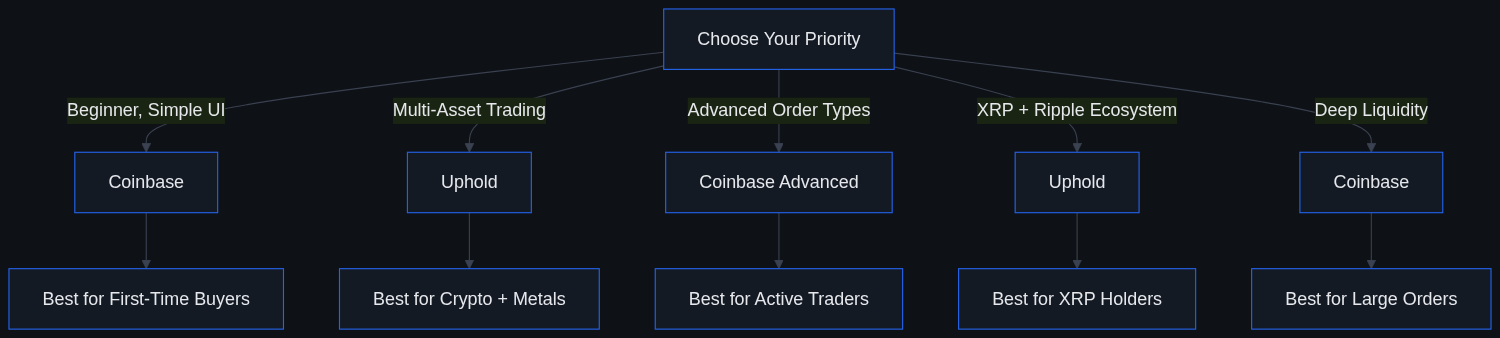
Choosing between the two largely comes down to trading style. Active traders who want granular order types and deep liquidity across many pairs tend to gravitate toward Coinbase’s more conventional exchange interface, while users who want to move value across crypto, metals, and fiat inside a single balance may prefer Uphold’s model.
- Best for beginners: Coinbase’s simple buy/sell flow and broad brand recognition make it a common starting point for first-time crypto buyers.
- Best for fee-sensitive traders: Active traders on either platform will find fee structures that differ by trade type and account tier. Coinbase applies tiered maker/taker pricing on its advanced platform and a spread-inclusive model on its simple app, while Uphold builds its cost into the buy/sell spread.
- Best for XRP holders: Uphold’s historical association with Ripple’s ecosystem is often cited by XRP holders, though Coinbase also lists XRP and offers standard exchange functionality (expanded below).
- Best for multi-asset diversification: Uphold’s inclusion of precious metals and other non-crypto asset classes alongside digital assets is a differentiator Coinbase does not directly replicate.
What Is Uphold? What Is Coinbase?
Uphold overview
Uphold positions itself around an “anything-to-anything” trading model, letting users convert between cryptocurrencies, select fiat currencies, and other supported asset classes such as precious metals from a single account balance, rather than routing every trade through a cash intermediary. The platform has built a reputation, discussed in more depth in our full Uphold review, around this flexible conversion approach rather than a traditional order-book trading interface.
Coinbase overview
Coinbase is one of the most widely recognized cryptocurrency platforms in the US market, offering a standard exchange experience alongside a more advanced trading interface for active users. Our Coinbase review covers the platform’s fee tiers, custody approach, and account features in more detail.
Uphold vs Coinbase Fees Compared
Trading and spread fees
The two platforms price trades differently in structure, if not necessarily in outcome. Uphold has historically built its trading cost into the buy/sell spread rather than itemizing a separate percentage fee, while Coinbase has used a combination of maker/taker fee tiers on its advanced trading interface and a spread-inclusive model on its simpler consumer app. Both companies adjust these fee structures periodically, so this comparison does not cite a specific fee percentage for either platform.
Deposit and withdrawal fees
Bank transfers (such as ACH in the US) are generally the lowest-cost way to fund an account on either platform, while wire transfers, debit cards, and credit cards typically carry higher costs. These funding-method cost differences are common across most crypto platforms, not just Uphold and Coinbase specifically, and both providers have changed their fee terms in the past.
Card and instant-buy markups
Instant-buy transactions funded by debit or credit cards tend to carry a premium over bank-funded trades on most crypto platforms, Coinbase and Uphold included. This premium reflects card-network processing costs and the immediacy of settlement rather than a platform-specific markup alone. Readers weighing card-funded purchases should factor this premium into their total cost comparison rather than relying only on headline trading fees.
Network and withdrawal fees for moving crypto off-platform
Moving crypto assets off either platform to a self-custody wallet generally incurs a network fee tied to the blockchain being used (for example, a Bitcoin or Ethereum network fee), separate from any platform-level withdrawal charge. These network costs fluctuate with blockchain congestion and are not set by Uphold or Coinbase directly, though each platform may add its own withdrawal fee on top.
Given how frequently fee schedules change on both platforms, LakeBTC’s crypto exchange fees guide offers a broader framework for comparing cost structures across providers.
Supported Assets and Trading Pairs
Cryptocurrencies supported
Both platforms support a broad range of cryptocurrencies, with Coinbase generally recognized as having one of the larger listed-asset catalogs among US-facing exchanges and Uphold also supporting a wide range of coins and tokens. Because listings change as new assets are added or delisted, this comparison does not rely on a fixed count for either platform.
Beyond crypto: Uphold’s multi-asset trading
Uphold’s inclusion of precious metals and other non-crypto asset classes alongside its cryptocurrency offering is one of its clearest differentiators from Coinbase, which focuses on digital assets. This matters most for users who want to hold and convert between crypto and other asset types without moving funds to a separate brokerage.
Staking, rewards, and yield products
Both platforms have offered staking or reward-earning features on select proof-of-stake assets at various points, letting eligible holders earn yield on qualifying tokens. Availability, eligible assets, and reward rates differ by platform and jurisdiction and change periodically.
Fiat currencies and multi-currency wallets
Uphold has historically marketed support for multiple fiat currencies within a single account, which can appeal to users who transact across borders. Coinbase’s fiat support in the US centers primarily on the US dollar, with broader currency support available in some international markets through its regional products.
Uphold or Coinbase for XRP?
XRP availability and liquidity
XRP is listed and tradable on both Uphold and Coinbase in the US, though liquidity and the specific trading pairs available can differ. Traders focused specifically on XRP will typically find deeper order-book depth on Coinbase’s advanced interface, compared with Uphold’s spread-based quotes for XRP conversions.
Uphold’s relationship with Ripple and RLUSD
Uphold has long been associated, within the XRP community, with the broader Ripple ecosystem. Reportedly, this has at times included ties to RippleNet-related infrastructure and a listing for Ripple’s RLUSD stablecoin, though these specifics are not confirmed here and can change over time. Readers who want current, exact details on any Ripple-related integration should check Uphold’s own product pages directly rather than assume a past association still holds.
Coinbase’s XRP history
Coinbase’s handling of XRP has, at various points, been discussed in connection with the broader SEC v. Ripple litigation, which reportedly influenced exchange listing decisions for XRP industry-wide for a period. The precise effect on Coinbase’s own listing decisions is not confirmed here, and the underlying case history has continued to evolve since then.
XRP custody safety on Uphold
Custody safety on any centralized platform depends on the provider’s security practices, licensing, and insurance arrangements rather than on the asset itself. Uphold has published information about its own custody and security practices on its site, and custody terms and any insurance coverage can change over time. The same due-diligence approach applies to Coinbase or any other custodial platform, no centralized exchange can offer a guarantee against all risk.
Verdict for XRP holders
XRP holders drawn to Uphold’s Ripple-adjacent reputation may prefer that platform for XRP-specific activity, while those who want deeper order-book liquidity and a more conventional trading interface may lean toward Coinbase. Readers researching XRP more broadly may also find our XRP investment analysis and how to buy XRP guide useful next steps, alongside our Bitcoin vs XRP comparison for broader context.
Security and Regulation
Licensing footprint
Both Uphold and Coinbase operate under US money transmitter licensing frameworks and other applicable state and federal registrations, though the specific list of states and license types each holds changes as regulatory relationships evolve. Neither company maintains a permanently fixed list of licensed states, since these registrations are updated periodically.
Proof of reserves and custody practices
Custodial platforms vary in how transparently they disclose reserve backing and cold-storage practices. Both Uphold and Coinbase have published information about their own custody approaches at different points, and neither company’s disclosures should be assumed to remain identical to past statements.
Insurance coverage
Crypto assets held on custodial platforms are generally not covered by FDIC insurance, since that protection applies to certain bank deposits rather than digital assets themselves. Any crime or custody insurance a platform carries for digital assets typically has defined limits and conditions that vary by provider.
Track record
Both platforms have operated for a number of years in a regulatory environment that has included enforcement actions against various crypto businesses industry-wide. This comparison does not attempt to catalog every regulatory action, security incident, or enforcement matter specific to either company, since that history is extensive and continues to evolve.
Assessing Uphold’s trustworthiness
Uphold states that it is registered as a money transmitter in the US and publishes its own security and licensing disclosures. As with any custodial platform, readers should weigh that disclosed information, along with the platform’s licensing status and any public regulatory history, before deciding how much to hold there, no single company disclosure is a substitute for that individual due diligence.
Ease of Use and Platform Features
Mobile app experience
Both Uphold and Coinbase offer mobile apps on iOS and Android with app store ratings that fluctuate over time based on user feedback and recent updates. These ratings shift with each release cycle on both platforms.
Supported payment methods
Bank transfers and card funding are supported on both platforms, and both have at various points supported additional payment rails depending on region. Exact payment method availability can vary by country and by account verification tier.
Customer support
Both companies offer support channels that typically include in-app help centers, email-based ticketing, and in some cases live chat, though response times can vary based on account tier and support volume. Neither platform’s current support responsiveness is something this comparison quantifies.
Advanced trading tools
Coinbase offers a separate advanced trading interface aimed at more active traders, with order types and charting tools that go beyond its simple consumer app. Uphold’s interface is generally built around its conversion-style trading model rather than a traditional order book, which may feel less familiar to traders coming from conventional exchanges.
Pros and Cons
Uphold
- Pros: Multi-asset trading across crypto, metals, and other asset classes; direct any-to-any conversions; a longstanding association with the Ripple/XRP ecosystem that some XRP holders find appealing.
- Cons: Interface may feel less familiar to traders used to conventional order books; fee structure is spread-based rather than itemized, which can make direct cost comparison harder.
Coinbase
- Pros: Widely recognized brand with a large asset catalog; separate advanced trading interface for active users; established presence in the US market.
- Cons: No multi-asset (metals/equities-linked) trading beyond digital assets; fee tiers and instant-buy spreads add complexity to understanding total cost.
Who Should Choose Uphold vs Coinbase?
- Long-term holder: Either platform can serve as a starting point, though holders planning to move assets to self-custody long-term should weigh each platform’s withdrawal process and network fees.
- Active trader: Coinbase’s advanced interface is generally better suited to order-type-driven strategies.
- Multi-asset diversifier: Uphold’s inclusion of metals and other asset classes is a clear differentiator for users who want that exposure in one account.
- XRP-focused investor: Uphold’s Ripple-adjacent reputation may be relevant to some XRP holders; Coinbase offers standard XRP trading with potentially deeper liquidity.
- Beginner buying first crypto: Coinbase’s simple buy/sell flow is often cited as easier for first-time users, though Uphold’s app is also designed for non-technical users.
For a broader look at how these two stack up against other providers, LakeBTC’s best crypto exchanges guide puts this comparison in the context of the wider market.
Weighing Alternatives to Coinbase
Whether a “better” platform than Coinbase exists depends entirely on what a given user needs. Multi-asset apps like Uphold may suit users who want crypto and non-crypto exposure in one place, while other exchanges may offer different fee structures or asset catalogs better suited to specific trading styles. This is a comparison exercise, not an endorsement of one platform over another, readers should do their own research before choosing where to hold or trade assets.
How This Comparison Was Put Together
This comparison is based on publicly available information about how Uphold and Coinbase generally structure fees, list assets, and describe their custody and licensing practices. Because fee percentages, supported-state lists, and licensing details change frequently on both platforms, this piece describes how each platform’s structure works rather than citing specific figures that may no longer hold by the time this is read.
FAQ
Is my XRP safe on Uphold?
Uphold publishes its own custody and security disclosures, which is the most reliable place to check current safeguards for XRP or any other asset held there. As with any custodial platform, safety depends on the provider’s licensing, security practices, and any applicable insurance, none of which amounts to a guarantee against loss.
Is there a better platform than Coinbase?
Whether another platform beats Coinbase depends on the reader’s priorities, Uphold’s multi-asset flexibility appeals to some users, while others may value Coinbase’s broader liquidity or advanced trading tools more. Weighing platforms against a specific use case, rather than looking for one universal winner, tends to produce a better answer.
Is Uphold trustworthy?
Uphold states that it operates as a registered money transmitter and publishes its own security and licensing information, which readers can review directly. As with any custodial crypto platform, trustworthiness should be assessed against current disclosures and licensing status rather than assumed.
Which has lower fees: Uphold or Coinbase?
Fee comparisons depend on the specific trade type, funding method, and account tier used, since both platforms price transactions differently, Uphold builds cost into its spread, while Coinbase separates maker/taker fees on its advanced platform from spread-inclusive pricing on its simple app. Because of that structural difference, a single headline number does not capture total cost for every trade type.
Can I transfer funds directly between Uphold and Coinbase?
Crypto assets can generally be sent from one platform to the other via on-chain transfer to a supported wallet address, subject to each platform’s withdrawal and deposit processes and any applicable network fees. Direct fiat transfers between the two platforms typically are not supported and would instead route through a linked bank account.