Bitcoin vs XRP: Key Differences and Which to Buy

Bitcoin and XRP have coexisted since the early 2010s, but regulatory clarity for both assets shifted meaningfully in 2026 after the SEC and CFTC jointly classified a group of tokens, including BTC and XRP, as digital commodities rather than securities. That reclassification, combined with the arrival of spot ETFs for both assets, has renewed interest in how the two networks actually compare on technology, use case, and investment profile.
Quick answer: Bitcoin is a capped-supply, proof-of-work network best known as a store-of-value and institutional treasury asset, while XRP is a validator-based ledger optimized for fast, low-cost settlement and cross-border liquidity. Neither is objectively “better”, the right choice depends on whether an investor prioritizes scarcity and institutional adoption or speed and payments utility.
In this article
- Bitcoin vs XRP At a Glance
- What Is Bitcoin (BTC)?
- What Is XRP and the XRP Ledger?
- Bitcoin vs XRP: Key Technical Differences
- Historical Price Performance and Volatility (2017-2026)
- Regulatory and Legal Status
- Institutional Adoption and ETF space
- Use Case Comparison: Store of Value vs Payments Network
- Security Comparison
- Pros and Cons
- Fee and Speed Breakdown for Real Transactions
- BTC vs XRP as an Investment: Bull Case, Bear Case, Neutral Takeaway
- Which Should You Buy: Bitcoin or XRP?
- FAQ
Bitcoin vs XRP At a Glance
| Metric | Bitcoin (BTC) | XRP |
|---|---|---|
| Launch year | 2009 | 2012 |
| Founder(s) | Satoshi Nakamoto (pseudonymous) | Jed McCaleb, Arthur Britto, David Schwartz |
| Consensus mechanism | Proof-of-Work | XRP Ledger Consensus Protocol (validator-based) |
| Max supply | 21 million BTC | 100 billion XRP (pre-mined) |
| Approx. price / market cap | ~$63,203.89; market cap surpassed $1T in 2021 | ~$1.14; ~$70.69B market cap, rank #6 |
| Avg. block/settlement time | ~10 minutes | 3-5 seconds |
| Avg. transaction cost | Variable, check mempool.space for current fees | Minimum 0.00001 XRP (10 drops), burned |
| Throughput | ~7 transactions/sec (base layer) | ~1,500 transactions/sec |
| Primary use case | Store of value / digital gold | Cross-border payments & liquidity |
Fees and availability verified as of July 5, 2026.
Price and market-cap figures move constantly; readers should confirm current numbers via CoinMarketCap or CoinGecko before making decisions based on this table.
What Is Bitcoin (BTC)?
Bitcoin originated from a 2008 whitepaper published under the pseudonym Satoshi Nakamoto, describing a peer-to-peer electronic cash system that did not require a trusted intermediary. The network launched in 2009 and remains documented at bitcoin.org. Bitcoin secures transactions through proof-of-work mining, in which competing miners expend computational energy to validate blocks approximately every 10 minutes. Network security is often measured in hashrate; Bitcoin’s hashrate reached an all-time high near 1.08 ZH/s in January 2026 and has since eased to roughly 900-950 EH/s (0.9-0.95 ZH/s) as of early July 2026, per CoinWarz, still reflecting an enormous scale of computing power protecting the chain.
Bitcoin’s supply is fixed at 21 million coins, released on a diminishing schedule through periodic “halving” events that cut miner rewards. This programmed scarcity underpins the “digital gold” narrative that has attracted institutional treasuries and, more recently, spot ETF issuers. Decentralization is also visible at the node level: Bitnodes reported 22,992 reachable Bitcoin nodes as of April 27, 2026 (the most recent snapshot available), spread across a wide geographic base.
What Is XRP and the XRP Ledger?
XRP is the native digital asset of the XRP Ledger (XRPL), an open-source blockchain that predates and is technically distinct from Ripple, the company that has historically promoted its use in payments infrastructure. The ledger relies on a Unique Node List (UNL), a set of validators whose votes determine transaction ordering, rather than energy-intensive mining, a design documented at xrpl.org.
All 100 billion XRP were created at the network’s genesis; a large portion sits in escrow contracts that release tokens on a scheduled basis, a mechanism intended to introduce predictability into circulating supply. XRP’s primary use case is cross-border settlement and liquidity provisioning, for example, through Ripple’s On-Demand Liquidity (ODL) service, which has been used in partnerships such as the one with payments firm Tranglo to move value between currency corridors without pre-funded nostro accounts.
Bitcoin vs XRP: Key Technical Differences
Consensus Mechanism
Bitcoin’s proof-of-work model ties security to real-world energy expenditure, which critics cite as an environmental cost and supporters describe as the source of its tamper-resistance. The XRP Ledger’s validator-voting approach consumes comparatively negligible energy, since there is no competitive mining race, a structural difference that also drives the two networks’ speed gap.
Transaction Speed and Throughput (bitcoin vs xrp speed and fees)
Bitcoin’s base layer confirms blocks roughly every 10 minutes and processes on the order of 7 transactions per second, though the Lightning Network layer-2 solution can settle payments near-instantly for a fraction of a cent when channels are already open. XRPL settlement finalizes in 3-5 seconds natively, with throughput benchmarks cited by xrpl.org around 1,500 transactions per second, without requiring an additional layer.
Transaction Fees
XRPL charges a minimum transaction cost of 0.00001 XRP (10 drops), which is destroyed rather than paid to any validator, per XRPL documentation; this fee can rise temporarily under load but remains a fixed, protocol-level parameter. Bitcoin’s on-chain fee market is instead demand-driven and fluctuates with mempool congestion, figures should be checked live at mempool.space rather than assumed, since fees have ranged from near-zero to double-digit dollar amounts during peak demand periods.
Decentralization and Governance
Bitcoin’s tens of thousands of reachable nodes and globally distributed mining pools represent one model of decentralization, though mining power itself can concentrate among a handful of large pools. XRPL’s UNL structure has drawn scrutiny because a meaningful share of trusted validators has historical ties to Ripple, even though anyone can operate a validator and node operators choose their own trusted lists.
Supply Model and Inflation
Bitcoin’s 21 million hard cap and halving schedule make it strictly disinflationary over time. XRP’s 100 billion supply was fixed at launch, with Ripple’s escrow releases governing how much enters circulation monthly, a model that avoids new issuance but still introduces scheduled supply increases that some investors watch closely.
Programmability
Bitcoin Script is intentionally limited, prioritizing security over flexibility, though sidechains and layer-2 protocols extend functionality. The XRP Ledger has added a native decentralized exchange and tokenization features, along with amendments such as Hooks-style smart contract functionality, expanding its programmability beyond simple payments.
Historical Price Performance and Volatility (2017-2026)
Independent backtests, including one published by Curvo.eu, compare annualized returns, volatility, and drawdowns for Bitcoin and XRP across the 2017-2026 period. Because these figures update continuously and can shift materially with each new market cycle, readers should consult the source directly for current annualized-return and risk-adjusted figures rather than relying on any single snapshot. Broadly, both assets have historically shown high volatility relative to traditional asset classes, with XRP’s price action tending to exhibit sharper drawdowns during broad crypto market corrections and larger rallies during altcoin-led upswings, while Bitcoin has generally shown somewhat lower relative volatility as the market’s largest and most liquid digital asset.
Regulatory and Legal Status
Regulatory treatment is one of the clearest differentiators between the two assets historically. Bitcoin has long been treated by the CFTC as a commodity, and SEC officials have repeatedly stated it is not a security. XRP’s path was more contested: the SEC’s suit against Ripple Labs concluded with a determination that institutional XRP sales constituted unregistered securities offerings under Section 5, while programmatic sales, exchange sales, and other distributions were not classified as securities transactions. Ripple in the end paid a civil penalty of approximately $125 million tied to the institutional-sales violation, according to a statement from SEC Commissioner Crenshaw.
More recently, on March 17, 2026, the SEC and CFTC jointly named 16 tokens, including both Bitcoin and XRP, as digital commodities, a development that clarified oversight lines and reduced some of the legal ambiguity that had previously constrained exchange listings and institutional participation in XRP specifically.
Institutional Adoption and ETF space
Bitcoin’s institutional footprint expanded significantly after the SEC approved 11 spot Bitcoin ETF filings on January 10, 2024, including BlackRock’s IBIT and Fidelity’s FBTC, with trading beginning the next day. BlackRock’s IBIT alone held roughly $50 billion in Bitcoin, equivalent to approximately 811,291 BTC, as of June 2026. On the corporate treasury side, Strategy Inc. (formerly MicroStrategy) has accumulated 847,363 BTC at a total cost of approximately $64.10 billion, an average of roughly $75,646 per coin, according to its SEC filings (as of early July 2026).
XRP’s institutional products arrived later but have since launched: the Bitwise XRP ETF (ticker XRP) began trading November 20, 2025, the Canary Capital XRP ETF (XRPC) launched November 13, 2025, and the 21Shares XRP ETF (TOXR) followed shortly after. Rather than corporate treasury accumulation, XRP’s institutional narrative centers on banking and payments partnerships built through RippleNet and ODL corridors.
Use Case Comparison: Store of Value vs Payments Network
Bitcoin’s core value proposition is scarcity-driven: a fixed supply positioned as a hedge against currency debasement, held by long-term investors and, increasingly, corporate balance sheets and ETF vehicles. XRP’s value proposition is functional: it is designed to act as a liquidity bridge that lets financial institutions settle cross-border payments without pre-funding accounts in every destination currency. Each network arguably solves a different problem, Bitcoin for long-duration value storage, XRP for transactional efficiency, rather than competing head-to-head for the same use case.
Security Comparison
Bitcoin’s proof-of-work security model makes a 51% attack economically implausible for a network running roughly 900-950 EH/s of hashrate, since an attacker would need to acquire and operate a comparable share of global mining capacity. XRPL’s validator-based model instead depends on the trustworthiness and diversity of its UNL; if a supermajority of trusted validators colluded, ledger integrity could theoretically be compromised, though the network has not experienced such an event. Both assets can be secured in cold storage using hardware wallets from providers such as Ledger and Trezor, and both have been targeted historically by exchange-level breaches rather than protocol-level failures, underscoring that custody choice matters as much as the underlying network’s design.
Pros and Cons
Bitcoin Pros and Cons
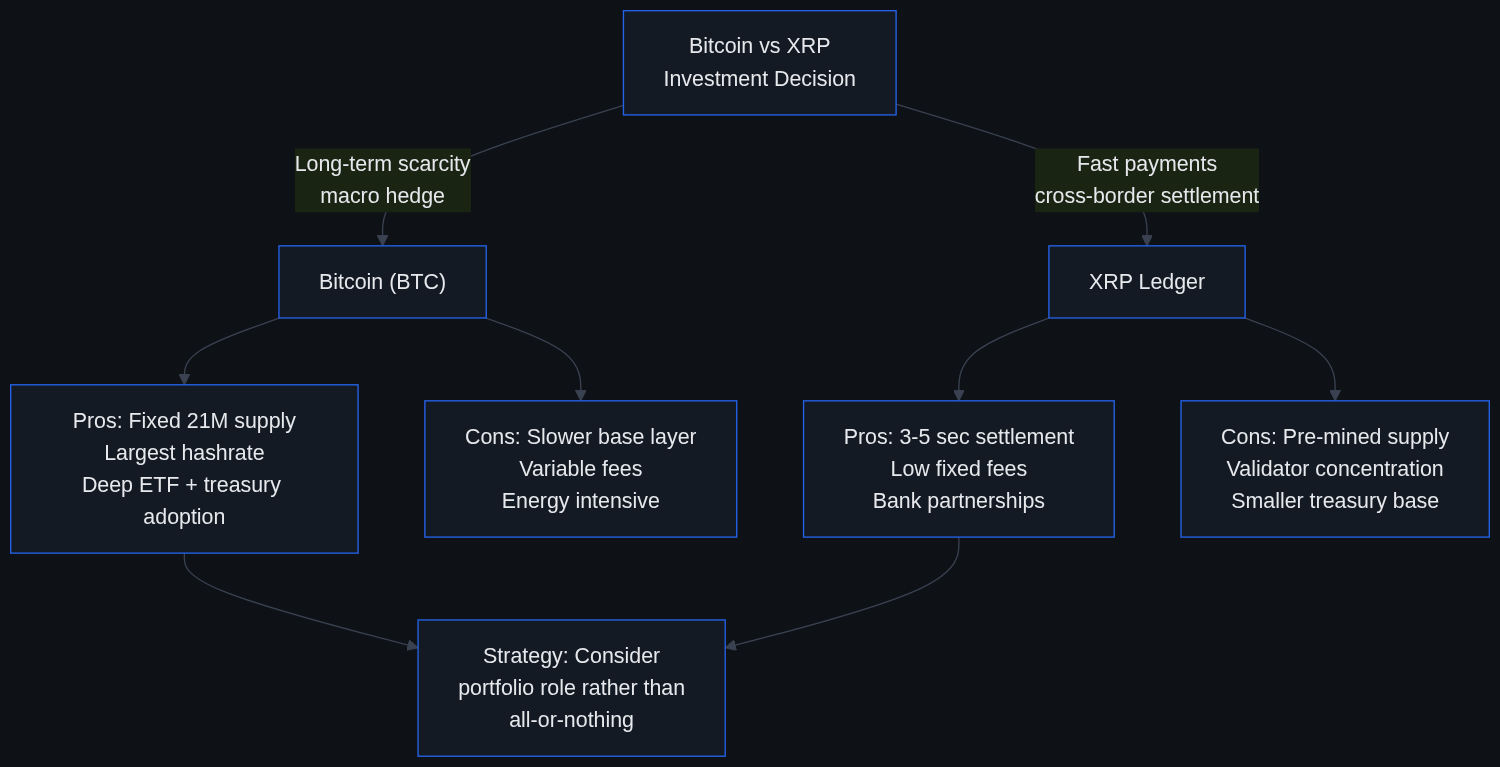
- Pros: Fixed 21 million supply, largest hashrate and node distribution, deep institutional ETF and treasury adoption, longest track record.
- Cons: Slower base-layer settlement, variable on-chain fees during congestion, limited native programmability, energy-intensive mining criticized on environmental grounds.
XRP Pros and Cons
- Pros: Fast 3-5 second settlement, minimal fixed transaction cost, low energy footprint, growing bank and payments partnerships, recent regulatory clarity and ETF launches.
- Cons: Large pre-mined supply with ongoing escrow releases, validator list concentration concerns, historical dependence on Ripple’s commercial strategy, smaller institutional treasury footprint than Bitcoin.
Fee and Speed Breakdown for Real Transactions
| Transaction size | Bitcoin (on-chain) | XRP Ledger |
|---|---|---|
| $100 | Fee varies with mempool congestion, check mempool.space; confirmation typically ~10-60 min | ~0.00001 XRP fee; settles in 3-5 seconds |
| $1,000 | Same fee structure regardless of amount sent; fee is set by data size, not value | Same fixed micro-fee; settlement time unchanged |
| $10,000 | Same fee structure; larger amounts do not raise on-chain fees | Same fixed micro-fee; settlement time unchanged |
Fees and availability verified as of July 5, 2026.
It’s worth noting that Bitcoin’s on-chain fees are priced by transaction data size in bytes, not by the dollar value transferred, so sending $10,000 does not inherently cost more than sending $100. For smaller, faster Bitcoin payments, the Lightning Network offers sub-cent fees and near-instant settlement, functioning as a speed and cost counterargument to base-layer limitations.
BTC vs XRP as an Investment: Bull Case, Bear Case, Neutral Takeaway
Bitcoin Bull Case
Supporters point to fixed scarcity, growing spot ETF inflows, and corporate treasury adoption exemplified by Strategy Inc.’s multibillion-dollar position as structural demand drivers.
Bitcoin Bear Case
Skeptics note that regulatory frameworks can still shift, that energy consumption remains a recurring criticism, and that Bitcoin’s base-layer technology evolves more conservatively than newer networks.
XRP Bull Case
Advocates cite growing utility adoption in cross-border payments, improved legal clarity following the SEC’s classification of digital commodities, and low, predictable fees and settlement times.
XRP Bear Case
Critics raise concerns about validator concentration, the dilution effect of scheduled escrow token releases, and XRP’s continued commercial association with Ripple’s corporate decisions.
Neutral Takeaway
Rather than framing this as a single “better” choice, some analysts suggest thinking in terms of portfolio role: Bitcoin as a long-duration store-of-value allocation, XRP as exposure to payments-infrastructure utility. This is educational context, not investment advice, and allocation decisions should reflect individual risk tolerance and financial circumstances.
Which Should You Buy: Bitcoin or XRP?
Investor profile matters more than headline price action. A long-term holder focused on scarcity and macro hedging may lean toward Bitcoin, particularly given its ETF infrastructure and institutional treasury precedent. An investor more interested in payments-network utility and lower transaction costs may find XRP’s use case more directly aligned with their thesis. Some investors choose to dollar-cost average into both, for example, splitting a fixed monthly amount, such as an illustrative figure of approximately $5,000, across BTC and XRP over time, rather than making an all-or-nothing decision, though this approach still carries full market risk for both assets.
Wherever an investor decides to transact, exchange due diligence matters: check licensing, custody practices, insurance coverage, and fee transparency before funding an account. Readers comparing platforms can review LakeBTC’s guide to the best crypto exchanges for a broader due-diligence framework, and related coverage on whether XRP is a good investment or how to buy XRP in the US for platform-specific steps.
FAQ
Is XRP faster and cheaper than Bitcoin?
On a per-transaction basis, yes, XRPL settles in roughly 3-5 seconds for a fixed micro-fee of about 0.00001 XRP, while Bitcoin’s base-layer confirmation times and fees vary with network congestion. Bitcoin’s Lightning Network narrows this gap for smaller, frequent payments.
Which is a better long-term investment, Bitcoin or XRP?
Neither asset carries a guaranteed outcome, and past performance does not predict future returns. Bitcoin has a longer track record, larger institutional ETF and treasury base, and fixed scarcity; XRP offers lower fees, faster settlement, and a specific payments use case. The better fit depends on an investor’s goals and risk tolerance rather than a universal answer.
Why did the SEC sue Ripple over XRP, and how does it affect the price?
The SEC alleged that Ripple’s institutional XRP sales were unregistered securities offerings. Courts in the end agreed with respect to institutional sales specifically, while ruling that programmatic and exchange-based sales did not constitute securities transactions. Ripple paid a civil penalty of approximately $125 million tied to the institutional violation, according to SEC filings. The case’s resolution, along with the 2026 SEC/CFTC digital-commodity classification, has generally reduced regulatory uncertainty that had previously weighed on exchange listings and institutional access to XRP.
Can XRP ever overtake Bitcoin in market cap?
As of current data, Bitcoin’s market capitalization vastly exceeds XRP’s (roughly $1 trillion-plus versus XRP’s approximate $70.69 billion). A reversal would require an extraordinary shift in adoption, supply dynamics, or capital flows; no analyst projection should be treated as a guaranteed outcome, and figures should always be checked live via CoinMarketCap or CoinGecko.
Is Bitcoin or XRP more decentralized?
Bitcoin’s tens of thousands of globally distributed nodes and broad mining pool participation are generally viewed as more decentralized than XRPL’s validator model, which relies on Unique Node Lists that have historically included validators associated with Ripple. XRPL’s design still allows independent validators and node operators to choose their own trusted lists, but the concentration profile differs meaningfully from Bitcoin’s.