Is Hedera (HBAR) a Good Investment?

In this article
- At a Glance: HBAR Investment Snapshot
- What Is Hedera (HBAR)? Fast Primer
- Hedera Use Cases Driving Real-World Adoption
- Bull Case: Why HBAR Could Be a Good Investment
- Bear Case: HBAR Risks Investors Must Weigh
- On-Chain & Network Health Scorecard
- Regulatory & Legal Risk Profile
- HBAR Price Prediction: What Analysts and Data Suggest
- Is Hedera a Good Investment? Comparing HBAR to Alternatives
- Portfolio Fit & Risk-Management Framework
- How and Where to Buy/Store HBAR Safely
- Pros and Cons Summary
- Neutral Takeaway: Does HBAR Have a Future?
- FAQ
At a Glance: HBAR Investment Snapshot
Hedera trades in a market where enterprise-grade distributed ledger networks compete for both developer mindshare and regulatory clarity. As of the latest check, HBAR ranks among the top 30 digital assets by market capitalization, and recent regulatory and product developments, including a joint federal interpretive release and a Nasdaq-listed exchange-traded product, have added new context to how the asset is classified and accessed.
Quick-Stat Box
- Price: $0.066690 USD
- Market cap: ~$2.92 billion
- CoinMarketCap rank: #26
- Circulating supply: ~43.79 billion HBAR
- Maximum supply: 50 billion HBAR (fixed, pre-minted at genesis)
- All-time high: $0.5701 (Sep 16, 2021)
- All-time low: $0.01001 (Jan 2, 2020)
Fees and availability verified as of 2026-07-19.
One-Line Verdict
HBAR is best characterized as a higher-risk, enterprise-adoption bet: its investment case leans on institutional partnerships and tokenization infrastructure rather than retail speculation alone, and outcomes remain uncertain like any digital asset.
What Is Hedera (HBAR)? Fast Primer
Hedera is a public distributed ledger that does not use a traditional blockchain structure. Instead, it relies on a hashgraph consensus mechanism, sometimes described as “gossip about gossip” combined with virtual voting, which the network’s documentation presents as an alternative path to achieving distributed agreement without sequential block production.
Governance Model
Hedera’s network is overseen by the Hedera Governing Council, a body that began with five founding members alongside creator Swirlds, each holding an equal vote and equal share of oversight responsibilities. Current council members include Google, Dell, IBM, LG, EDF, and Arrow Electronics (NYSE: ARW), among others, according to the Hedera Governing Council’s official site. This structure is a defining and often-debated feature of the network, discussed further below.
HBAR Token Utility
HBAR is used to pay for network transaction and query fees, and it factors into consensus weighting rather than functioning through a conventional proof-of-stake rewards structure. Fee levels are published directly by Hedera; for example, the cost of a ConsensusSubmitMessage transaction rose from $0.0001 to $0.0008 in January 2026 with the network’s v0.69 mainnet release, according to Hedera’s official fee schedule.
Hedera Use Cases Driving Real-World Adoption
Beyond price speculation, Hedera’s positioning rests on a handful of concrete use cases tied to enterprise and institutional infrastructure.
Enterprise & Institutional Partnerships
The presence of large corporations on the Governing Council, including Google, IBM, and Dell, is frequently cited as a differentiator versus purely community-governed layer-1 networks. These entities participate in network oversight rather than functioning as customers or vendors in a conventional sense.
Tokenization, Stablecoins, and RWA Infrastructure
Hedera Token Service allows for the creation and management of fungible and non-fungible tokens natively on the network, positioning Hedera as infrastructure for tokenized assets and stablecoin issuance. The circulating value of stablecoins on Hedera currently stands at roughly $42.0 million, according to DefiLlama, a figure that remains modest relative to larger smart-contract ecosystems.
Sustainability Positioning
Hedera markets itself as a carbon-negative network. The Governing Council states it offsets more carbon than the network produces through quarterly carbon offset purchases assessed by third-party provider Terrapass, per Hedera’s sustainability page. This is a differentiator some ESG-minded institutions may weigh when evaluating enterprise blockchain partners.
Developer Activity & dApp Ecosystem
Hedera supports smart-contract deployment alongside its native token services, and its ecosystem includes DeFi, gaming, and supply-chain pilot projects. Adoption remains smaller in scale than on leading smart-contract platforms, a point explored further in the network-health section below.

Bull Case: Why HBAR Could Be a Good Investment
Enterprise-Grade Backing
The council structure gives Hedera a form of institutional legitimacy that many decentralized networks lack, with named global corporations directly overseeing network governance rather than anonymous validators or foundations.
Fixed, Pre-Minted Supply Structure
Unlike inflationary layer-1 networks that continuously mint new tokens as validator rewards, HBAR’s total supply is capped and was pre-minted at genesis at 50 billion tokens, with council-controlled treasury releases governing circulation rather than ongoing issuance.
Tokenization Tailwind
As institutional interest in tokenized real-world assets and stablecoin rails grows, Hedera’s positioning as enterprise-friendly tokenization infrastructure could benefit from broader industry tailwinds, though this remains a thesis rather than a guaranteed outcome.
Regulatory Development
A joint interpretive release from the SEC and CFTC in March 2026 named HBAR among 16 digital assets classified as digital commodities falling under CFTC rather than SEC oversight, according to Lexology’s summary of Interpretive Release No. 33-11412. This kind of regulatory clarity can matter to institutional allocators evaluating custody and compliance frameworks.
Bear Case: HBAR Risks Investors Must Weigh
Centralization Concerns
Critics, including recurring discussion threads on community forums, argue that a permissioned council of corporations sits uneasily alongside marketing language emphasizing decentralization. Governance power concentrated among a fixed set of large enterprises is structurally different from the validator sets of many other public networks.
Competitive Pressure
Hedera competes for developer attention and institutional capital against Ethereum, Solana, the XRP Ledger, Avalanche, and Polkadot, several of which have larger developer ecosystems and deeper liquidity. Readers comparing HBAR to XRP Ledger positioning may find our XRP vs Cardano comparison useful context on enterprise-blockchain competition.
Supply and Treasury Considerations
While HBAR’s maximum supply is fixed at 50 billion, council-controlled release schedules from treasury reserves can affect circulating supply growth over time, a factor investors should monitor through Hedera’s public dashboards.
Historical Volatility
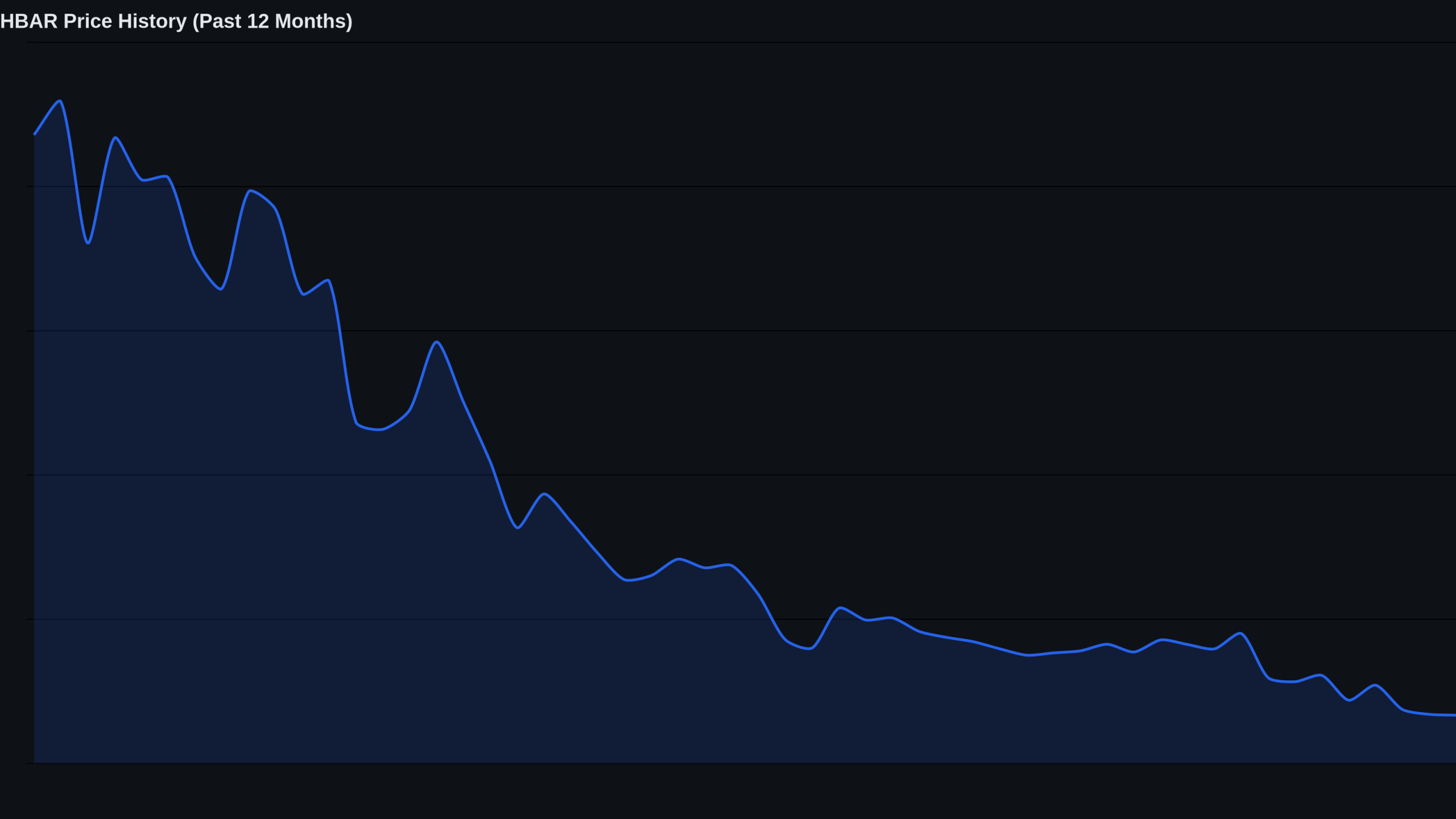
HBAR has traded as high as $0.5701 (September 2021) and as low as $0.01001 (January 2020), illustrating substantial historical price swings relative to its current level near $0.066690. Past price action does not predict future results.
Liquidity and Exchange Concentration
Liquidity for HBAR is concentrated on a limited number of major exchanges; thinner order books on smaller platforms can amplify slippage during volatile periods.
On-Chain & Network Health Scorecard
Beyond price speculation, network-health indicators offer an additional, more objective lens. Hedera’s current circulating stablecoin value of roughly $42.0 million remains modest compared with larger smart-contract chains, suggesting that DeFi activity on the network is still an emerging segment rather than a dominant use case. Transaction throughput and finality claims are frequently cited in Hedera’s own marketing materials; investors evaluating these claims independently may wish to consult Hedera’s public Mirror Node or HashScan explorer data rather than relying solely on promotional benchmarks. Developer activity, tracked through public repositories and ecosystem grant programs, provides another gauge of whether builder interest is expanding or plateauing over time.
Regulatory & Legal Risk Profile
The March 2026 joint SEC-CFTC interpretive release explicitly naming HBAR as a digital commodity under CFTC jurisdiction represents a meaningful data point for regulatory risk assessment, though it does not eliminate other forms of legal or compliance risk tied to the council’s corporate-entity structure. Because Hedera’s governance rests with a defined set of corporate members rather than a diffuse validator community, regulators may scrutinize the network differently than fully permissionless chains. Institutional inflows, including through products like the Canary HBAR ETF, a Delaware statutory trust whose shares trade on Nasdaq under the ticker “HBR” and which seeks to provide exposure to HBAR’s value, per its SEC prospectus filing, could be influenced by how this regulatory picture continues to evolve.
HBAR Price Prediction: What Analysts and Data Suggest
Short-, medium-, and long-term price forecasts for HBAR, like those for any digital asset, are inherently speculative and should be treated as scenario-based estimates rather than guarantees. Analysts weighing near-term (2026) outlooks typically point to technical momentum and broader market sentiment; medium-term (2027–2028) views often hinge on tokenization and stablecoin adoption trends; and long-term (2030 and beyond) scenarios depend heavily on whether enterprise use cases scale meaningfully beyond pilot programs.
Can HBAR Reach New Highs?
Given a circulating supply of approximately 43.79 billion HBAR, surpassing the asset’s previous all-time high of $0.5701 would imply a market capitalization far above the current ~$2.92 billion figure, a level that would require substantial growth. Whether that growth materializes depends on adoption, competitive dynamics, and macro crypto-market conditions that cannot be forecast with certainty.
Is Hedera a Good Investment? Comparing HBAR to Alternatives
HBAR vs. XRP
Both HBAR and XRP carry institutional and payments-oriented narratives, though their governance models differ substantially: XRP Ledger validators are not structured as a corporate council in the way Hedera’s are. Readers weighing this comparison directly may find our XRP investment analysis a useful companion piece.
HBAR vs. Other Enterprise-Focused Layer-1s
Cardano is another network frequently compared to Hedera on the basis of formal governance and enterprise messaging; our Ethereum vs Cardano comparison covers related governance and ecosystem trade-offs.
Portfolio Fit
Within a diversified crypto allocation, HBAR may fit as a smaller, higher-risk satellite position tied to an enterprise-adoption thesis rather than a core holding, given its still-developing DeFi ecosystem and concentrated governance.
Portfolio Fit & Risk-Management Framework
Investors considering any volatile, single-asset position, HBAR included, commonly weigh position sizing relative to overall portfolio risk tolerance, rather than allocating outsized shares to any one speculative asset. Dollar-cost averaging can help smooth entry points across volatile price cycles compared with a single lump-sum purchase, though neither approach eliminates downside risk. Setting predefined rebalancing or exit triggers ahead of time, rather than reacting emotionally to price swings, is a commonly cited risk-management practice, though this is educational framing rather than personalized financial advice.
How and Where to Buy/Store HBAR Safely
HBAR is available to US retail investors through several regulated platforms, including Coinbase, a NYDFS BitLicensed exchange, according to Coinbase’s own product page. When comparing platforms, factors such as liquidity, regulatory standing, and fee transparency matter more than promotional offers. Our guide to the best crypto exchanges and our how to buy crypto walkthrough outline broader considerations for choosing a platform and setting up secure custody. For storage, hardware wallets generally offer stronger security than leaving assets on an exchange, and best practices include enabling two-factor authentication, safeguarding seed phrases offline, and remaining alert to phishing attempts targeting crypto holders.
Pros and Cons Summary
Pros
- Governing Council includes globally recognized enterprises such as Google, IBM, and Dell
- Fixed, pre-minted maximum supply of 50 billion HBAR
- Recent regulatory clarity via the joint SEC-CFTC digital-commodity classification
- Nasdaq-listed ETF product (Canary HBAR ETF, ticker HBR) expanding access
- Carbon-negative network positioning as an ESG differentiator
Cons
- Permissioned council governance raises recurring decentralization critiques
- Modest circulating stablecoin value (~$42.0 million) relative to larger ecosystems
- Significant historical volatility, from a $0.01001 low to a $0.5701 high
- Intense competition from Ethereum, Solana, XRP Ledger, and others
- Rising network fees for some transaction types starting January 2026
Neutral Takeaway: Does HBAR Have a Future?
Whether Hedera has a durable future likely depends on whether its enterprise partnerships translate into sustained on-chain activity beyond pilot programs, and whether regulatory clarity continues to support institutional participation such as the Nasdaq-listed HBR ETF. Risk-tolerant investors specifically interested in enterprise blockchain infrastructure and tokenization narratives may find HBAR worth researching further as part of a diversified position; investors seeking lower volatility or more mature DeFi ecosystems may prefer to look elsewhere.
FAQ
Is HBAR still worth buying today?
That depends on individual risk tolerance and investment goals. HBAR carries both an enterprise-adoption thesis and notable volatility and governance-centralization risks, so it warrants independent research rather than a blanket answer.
Does HBAR have a future in enterprise blockchain?
Hedera’s Governing Council includes major global corporations, and recent regulatory developments have added clarity to its classification, but sustained network usage and developer growth will ultimately determine its longer-term relevance.
Is HBAR better than XRP for long-term holding?
HBAR and XRP differ in governance structure and technical design, and neither is inherently “better”, the comparison depends on an investor’s views on centralized council governance versus XRP Ledger’s validator model. See our XRP analysis for a deeper look.
Can HBAR realistically surpass its all-time high?
Surpassing HBAR’s all-time high of $0.5701 would require its market capitalization to grow substantially beyond its current ~$2.92 billion level, given its circulating supply of roughly 43.79 billion tokens. This remains a speculative scenario, not a guaranteed outcome.
What are the biggest risks of investing in HBAR right now?
Key risks include centralized council governance, competitive pressure from larger smart-contract ecosystems, historically high volatility, and concentrated exchange liquidity.