Ethereum vs Cardano: Which Should You Buy?

Ethereum and Cardano both run on proof-of-stake consensus, both support smart contracts, and both attract long-term holders who disagree sharply about which network will matter more a decade from now. This guide compares the two on architecture, fees, tokenomics, real-world usage, and regulatory footing, then lays out a scenario-based framework for weighing ETH against ADA rather than declaring a single winner.
In this article
- At a Glance: Ethereum vs Cardano Snapshot
- Ethereum vs Cardano: The Core Philosophical Divide
- Origins and Founding Teams
- Technical Architecture Compared
- Tokenomics: ETH vs ADA
- Use Cases: DeFi, NFTs, and Real-World Adoption
- Security Track Record
- Pros and Cons
- Which Coin Will “Replace” Ethereum? (Addressing the Narrative)
- Bull Case, Bear Case, Neutral Takeaway
- Regulatory & ETF space Comparison
- On-Chain Health Metrics
- Verdict: Which Should You Buy?
- FAQ
At a Glance: Ethereum vs Cardano Snapshot
Ethereum and Cardano launched two years apart and took different roads to proof-of-stake, Ethereum arrived at it through The Merge in 2022, while Cardano built its Ouroboros protocol as proof-of-stake from day one. The table below summarizes where each network stands today.
| Metric | Ethereum (ETH) | Cardano (ADA) |
|---|---|---|
| Mainnet launch | July 30, 2015 | September 29, 2017 |
| Founder(s) | Vitalik Buterin, Gavin Wood, Charles Hoskinson, Anthony Di Iorio, Joseph Lubin | Charles Hoskinson & Jeremy Wood (IOHK) |
| Consensus mechanism | Proof-of-stake (post-Merge, since Sept. 15, 2022) | Ouroboros proof-of-stake (since genesis) |
| Market capitalization | ~$217.6 billion (#2), per CoinGecko, July 10, 2026 | ~$6.28 billion (#18), per CoinGecko, July 10, 2026 |
| Circulating supply | ~120 million ETH | ~37 billion ADA (45B max) |
| Smart contract language | Solidity (EVM) | Plutus / Haskell |
| Gas price (Etherscan, Oct 13, 2026) | Avg. 0.348 Gwei | Fee = a × size(tx) + b (protocol formula) |
| Staking yield range | ~2-4% APY (solo, 32 ETH) | ~1-3% APY (delegation) |
Market data per CoinGecko; fees and availability verified as of July 10, 2026.
Sources: CoinGecko (ETH), CoinGecko (ADA), Etherscan Gas Tracker, Cardano Docs.
Ethereum vs Cardano: The Core Philosophical Divide
Ethereum’s iterate-in-production approach
Ethereum’s developer culture has historically favored shipping working code and refining it live. The network’s smart contract layer, Solidity, and its EVM standard became the default for DeFi and NFTs largely because they were available early and iterated on quickly through community proposals (EIPs).
Cardano’s peer-reviewed, research-first methodology
Cardano took the opposite path. Its Ouroboros consensus protocol is described by its developers as the first peer-reviewed, provably secure proof-of-stake protocol, and its smart contract language, Plutus, is built on Haskell, a functional language chosen for its suitability to formal verification.
Why this shapes everything downstream
These founding philosophies explain much of what follows in this comparison: Ethereum’s larger, faster-moving ecosystem versus Cardano’s slower, more methodical rollout of features. Neither approach is inherently superior, they represent different trade-offs between development speed and formal assurance.
Origins and Founding Teams
Ethereum’s mainnet genesis block was mined on July 30, 2015, following a whitepaper published by Vitalik Buterin in late 2013. Its founding group, per the Ethereum Foundation’s own history page, included Buterin, Gavin Wood, Charles Hoskinson, Anthony Di Iorio, and Joseph Lubin.
Notably, Hoskinson left the Ethereum project and later co-founded IOHK (Input Output Hong Kong, now IOG) with Jeremy Wood, which built Cardano. Cardano’s mainnet launched on September 29, 2017, beginning with the Byron era. Cardano’s development and governance are split among three organizations: IOG (engineering), the Cardano Foundation (standards and stewardship), and Emurgo (commercial development), a tripartite structure distinct from Ethereum’s single-foundation model.
Technical Architecture Compared
Consensus mechanisms
Ethereum ran on proof-of-work for its first seven years before completing The Merge on September 15, 2022, a transition the Ethereum Foundation says cut network energy consumption by roughly 99.95%. Cardano’s Ouroboros protocol, by contrast, has run proof-of-stake since its 2017 genesis block, with academic peer review built into its original design process.
Network layers and scaling
Ethereum scales primarily through a Layer-2 rollup ecosystem, networks like Arbitrum, Optimism, and Base process transactions off the main chain and settle back to Ethereum’s base layer. Cardano’s original design describes a dual-layer structure: a settlement layer for ADA transactions and a computation layer intended for smart contract logic.
Smart contract languages
Ethereum uses Solidity on the EVM, which remains the most widely adopted smart contract environment and has the largest developer tooling ecosystem. Cardano uses Plutus, built on Haskell, prioritizing formal verification, a method of mathematically proving code behaves as intended before deployment.
Throughput and fees
Ethereum’s gas fees are paid in ETH, denominated in Gwei, and fluctuate with network demand; Etherscan’s gas tracker snapshot of October 13, 2026 showed an average gas price of 0.348 Gwei, though congestion can push costs meaningfully higher. Cardano’s fee model is a fixed formula, minimum fee equals a size-based coefficient plus a base constant, both adjustable via hard fork, per Cardano’s official documentation, which tends to produce more predictable per-transaction costs.
Ethereum’s Pectra upgrade went live on May 7, 2025, raising the validator effective balance cap from 32 ETH to 2048 ETH (EIP-7251) and reducing initial slashing penalties for validators, changes aimed at making staking more efficient at scale.
Tokenomics: ETH vs ADA
Supply mechanics
Ethereum introduced base-fee burning through EIP-1559 on August 5, 2021. Since then, an estimated 4.62 million ETH has been burned, worth over $9 billion, according to available tracking data, a mechanism that can make ETH’s net issuance negative during periods of high network activity. Cardano, by comparison, has a fixed maximum supply of 45 billion ADA, with roughly 37 billion currently circulating, per CoinGecko.
Staking economics
Ethereum solo staking requires 32 ETH (or participation in pooled/liquid staking services for smaller amounts) and currently yields roughly 2-4% APY, according to Ledger’s staking data. Cardano uses delegation-based staking with no lock-up period, where ADA holders delegate to stake pools without transferring custody, yielding roughly 1-3% APY per Ledger.
Use Cases: DeFi, NFTs, and Real-World Adoption
This is where the two networks diverge most sharply in practice. Ethereum’s DeFi ecosystem carries far more total value locked relative to its market cap than Cardano’s does. Data from DeFiLlama’s Ethereum chain page shows roughly $37.5 billion in Ethereum DeFi TVL (down from about $41.6 billion a month earlier as stablecoin balances declined), still reflecting its dominant position in decentralized finance, NFT marketplaces, and the broadest count of active decentralized applications of any smart contract chain.
Cardano’s DeFi footprint is considerably smaller: DeFiLlama data shows roughly $437.5 million in total value locked (up sharply from about $132 million in early 2026) against a market cap of roughly $6.28 billion, though on-chain fee revenue remains modest compared with Ethereum’s. Cardano’s narrative has instead leaned on pilot programs and partnerships in emerging markets, including education-record and supply-chain initiatives that Hoskinson and IOG have publicized, though these remain smaller in scale than Ethereum’s DeFi activity.
Security Track Record
Ethereum’s larger attack surface has produced a longer history of high-profile incidents, most famously the 2016 DAO hack, but that same decade-long history has also generated extensive third-party audits, bug bounty programs, and battle-tested infrastructure across thousands of live smart contracts. Cardano’s formal-verification approach via Haskell and Plutus is designed to reduce smart contract bug risk at the design stage, but its comparatively smaller number of high-value live dApps means it has faced less real-world adversarial stress-testing than Ethereum’s ecosystem.
Pros and Cons
Ethereum
- Pros: Deepest liquidity and network effects, mature Layer-2 scaling stack, largest developer base, spot ETF products already trading.
- Cons: Base-layer fees can spike during congestion, protocol complexity, growing competition from rival Layer-1s.
Cardano
- Pros: Predictable, generally low transaction fees, energy-efficient proof-of-stake since inception, fixed maximum supply, academic rigor in protocol design.
- Cons: Slower feature rollout historically, smaller DeFi/dApp ecosystem relative to market cap, has lagged Ethereum in total value locked growth.
Which Coin Will “Replace” Ethereum? (Addressing the Narrative)
Cardano has often been framed in crypto media and forums as an “Ethereum killer,” largely on the strength of its academic design process and lower average fees. That framing deserves scrutiny: DeFiLlama’s own TVL figures show Ethereum retaining a dramatically larger share of on-chain financial activity, and network effects in DeFi and NFTs are notoriously sticky, liquidity, tooling, and developer familiarity tend to reinforce incumbents rather than dislodge them quickly. Cardano is not the only network positioned this way; Solana, Polkadot, and Avalanche are also frequently discussed as Ethereum alternatives, each with different trade-offs in speed, decentralization, and ecosystem maturity. Full replacement of Ethereum by any single competitor in the near term appears unlikely given current on-chain data, though the smart contract space continues to evolve.
Bull Case, Bear Case, Neutral Takeaway
Bull case for Ethereum
Continued Layer-2 scaling success, sustained ETF inflows, growing staking participation, and EIP-1559’s burn mechanism creating periods of deflationary supply pressure.
Bull case for Cardano
Low, predictable fees, an energy-efficiency narrative that may appeal to ESG-conscious holders, emerging-market partnership pilots, and continued execution of IOG’s governance roadmap (the “Voltaire” phase).
Bear case for Ethereum
Intensifying fee competition from Layer-1 rivals and Layer-2 fragmentation, plus execution risk on an ambitious multi-year scaling roadmap.
Bear case for Cardano
Persistently slower dApp and TVL growth relative to competitors, a smaller developer mindshare, and governance execution risk as decision-making decentralizes further.
Neutral takeaway
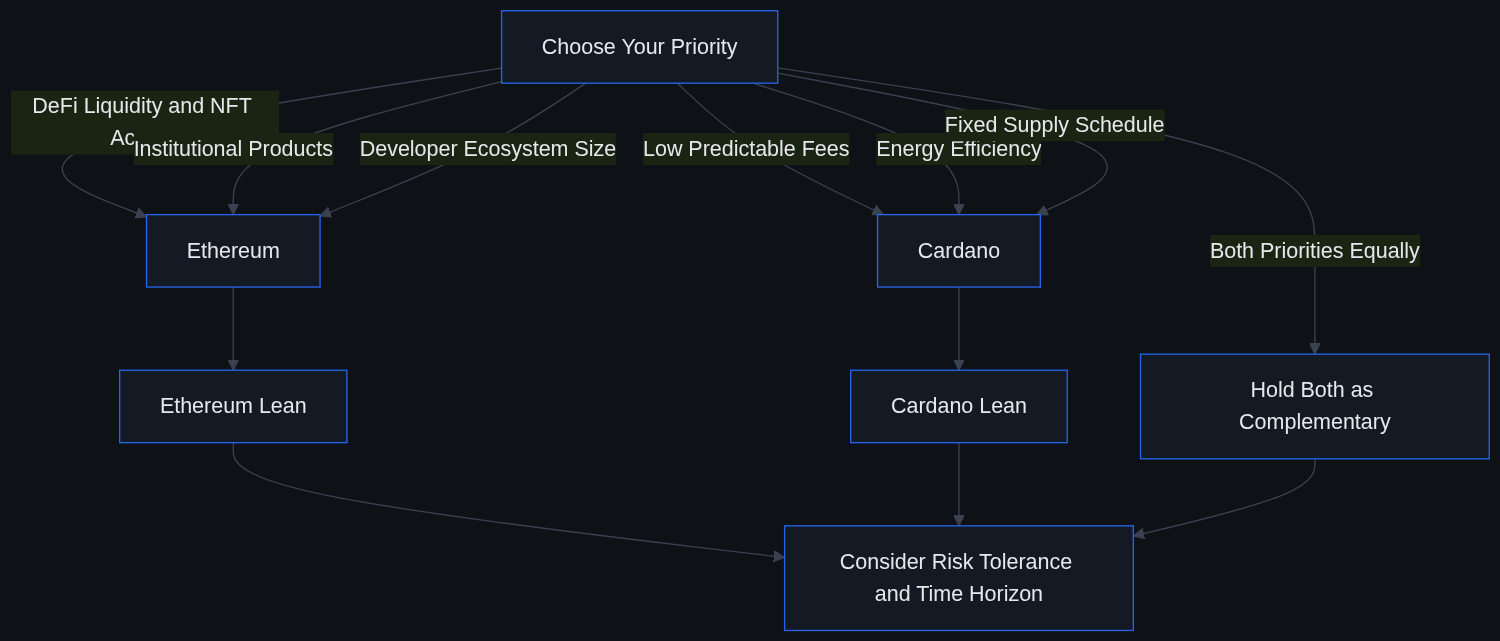
Some market participants hold both assets as complementary exposures, ETH for liquidity and DeFi/NFT exposure, ADA for a lower-fee, energy-efficient alternative, rather than treating the choice as strictly binary. Risk tolerance, time horizon, and conviction in each project’s roadmap should inform any allocation decision.
Regulatory & ETF space Comparison
Ethereum has spot ETF products trading in US markets as of 2024, a milestone that has drawn institutional flows into the asset. Cardano has no spot ETF trading as of our September 2026 review, although Grayscale has a spot Cardano ETF (proposed ticker GADA) on file with the SEC. On classification, the March 17, 2026 joint SEC–CFTC interpretive release (Release Nos. 33-11412 and 34-105020) names both Ether and Cardano as digital commodities. The release is agency guidance rather than statute, so readers should still consult SEC.gov and CFTC.gov directly for the current official position on ETH and ADA. Likewise, state-level availability, including New York’s Greenlist process, should be verified at dfs.ny.gov, since both tokens are widely available on US-licensed exchanges but coin-approval status varies by state.
On-Chain Health Metrics
Beyond price and TVL, on-chain data offers another lens for comparison. Ethereum’s validator set has grown substantially post-Merge, with staking participation and average yields tracked by sources like Ledger showing roughly 897,000 active validators as of recent snapshots. Cardano’s stake pool model distributes delegation across a large number of independent pools, a structure IOG has cited as supporting decentralization. Developer activity, as tracked by resources like the Electric Capital Developer Report, has historically shown Ethereum maintaining a larger base of active contributors than Cardano, though both ecosystems continue to publish regular protocol updates and open-source commits.
Verdict: Which Should You Buy?
The right answer depends heavily on what an investor is optimizing for. Those prioritizing DeFi and NFT market depth, Layer-2 scaling, and existing ETF access may lean toward Ethereum’s larger, more liquid ecosystem. Those prioritizing low, predictable fees, energy efficiency, and a fixed-supply monetary policy may find Cardano’s design philosophy more aligned with their goals. Long-term conviction holders in either project should weigh each network’s roadmap execution history, while investors building diversified crypto portfolios may choose to hold both as distinct bets on competing visions of smart contract infrastructure. As with any allocation decision, position sizing should reflect individual risk tolerance and research, not narrative alone. Readers comparing exchanges to buy either asset can review our best crypto exchanges guide for platform-specific fee and security details.
FAQ
Is Cardano or Ethereum a better investment?
Neither asset is definitively “better” in a way that applies to every investor. Ethereum has a larger market cap, deeper DeFi liquidity, and existing spot ETF access; Cardano offers lower average fees and a fixed supply schedule. The better choice depends on an individual’s risk tolerance, time horizon, and which ecosystem’s trade-offs align with their goals.
Which coin will replace Ethereum?
No single competitor has demonstrated the on-chain activity needed to displace Ethereum’s DeFi and NFT dominance to date. Cardano, Solana, Polkadot, and Avalanche are each cited in different contexts as potential alternatives, but current DeFiLlama data shows Ethereum retaining a substantially larger share of locked value than any rival chain.
Why is Cardano not a good investment (according to critics)?
Critics point to Cardano’s comparatively small DeFi total value locked relative to its market cap, slower historical pace of feature deployment, and a smaller developer and dApp ecosystem than Ethereum’s. Supporters counter that its methodical, peer-reviewed approach and low fees are deliberate trade-offs rather than shortcomings, an assessment individual investors should weigh for themselves.
What is better than Cardano?
“Better” depends on the metric. Ethereum leads on DeFi liquidity, developer activity, and institutional products; other Layer-1s like Solana are frequently cited for throughput-focused use cases. Comparisons should be use-case specific rather than treating any single chain as universally superior.
Can Ethereum and Cardano coexist as long-term holdings in one portfolio?
Yes, many investors hold both as complementary rather than competing positions, since the two networks emphasize different priorities (Ethereum’s ecosystem depth versus Cardano’s fee predictability and energy efficiency). As always, allocation decisions should reflect individual research and risk tolerance rather than a single comparative framework.
Update history 1
- Updated the Ethereum gas price to Etherscan's October 13, 2026 snapshot (average 0.348 gwei).