XRP vs Cardano: Key Differences and Which to Buy

Regulatory clarity and network fundamentals shape how investors weigh payment-focused tokens against smart-contract platforms. XRP and Cardano (ADA) are frequently mentioned together because both rank among the longest-running large-cap digital assets, yet they pursue distinct technical roadmaps and now sit in different regulatory postures following years of SEC litigation involving Ripple Labs. This comparison looks at consensus design, fees, governance, and legal history to frame how each asset fits different portfolio goals.
In this article
- At a Glance: XRP vs Cardano
- Quick Verdict
- Origins and Founding Philosophy
- Technology and Consensus Mechanism Compared
- Speed, Scalability, and Transaction Cost
- Decentralization and Network Governance
- Tokenomics and Supply Dynamics
- Use Cases and Real-World Adoption
- Regulatory and Legal Risk Comparison
- Fee Comparison: Network and Exchange Costs
- Pros and Cons
- Security Considerations
- Portfolio Fit: Which Should You Buy?
- FAQ
At a Glance: XRP vs Cardano
| Metric | XRP | Cardano (ADA) |
|---|---|---|
| Launched | 2012 (as OpenCoin, later Ripple Labs) | September 29, 2017 |
| Founders | Chris Larsen, Jed McCaleb, Arthur Britto | Charles Hoskinson and Jeremy Wood, via IOHK |
| Consensus mechanism | Ripple Protocol Consensus Algorithm (a form of Federated Byzantine Agreement) | Ouroboros Proof-of-Stake |
| Circulating / max supply | ~62.24 billion / 100 billion XRP (about 62%) | ~36.4 billion / 45 billion ADA (about 81%) |
| Primary use case | Cross-border settlement and liquidity | Smart contracts and dApp infrastructure |
Fees and availability verified as of July 3, 2026.
Supply figures are sourced from Coinbase’s XRP market page and Coinbase’s Cardano market page, as of July 3, 2026; circulating figures shift continuously and should be re-verified before making decisions.
Quick Verdict
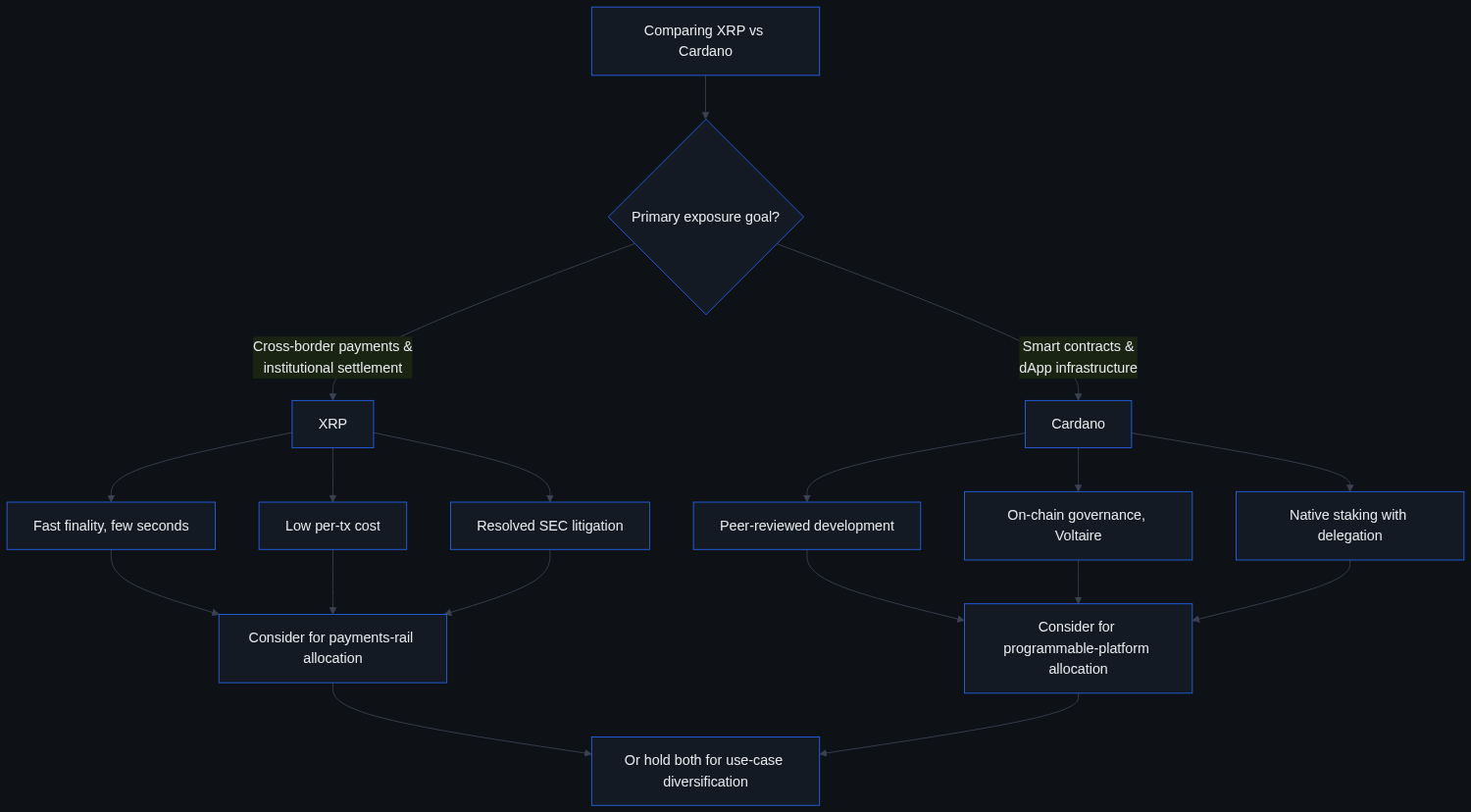
Neither asset is objectively “better” in every sense, the answer depends on what an investor is trying to gain exposure to. XRP is built around payment settlement and liquidity provisioning for financial institutions, and its recent legal resolution with the SEC removes some, though not all, of the regulatory overhang that weighed on it for years. Cardano is a peer-reviewed smart-contract platform whose value proposition rests on developer adoption, staking participation, and its formal on-chain governance process. Investors interested in payments-rail exposure may lean toward XRP; those seeking programmable-blockchain exposure with active governance tend to look at ADA. This is general market information, not a personalized recommendation.
Origins and Founding Philosophy
Ripple/XRP’s Banking-and-Payments Origin
XRP originated in 2012 through OpenCoin, founded by Chris Larsen, Jed McCaleb, and Arthur Britto, before the company rebranded as Ripple Labs in 2013. From the outset, the project targeted correspondent banking inefficiencies, aiming to let financial institutions settle cross-border transfers faster and more cheaply than legacy rails such as SWIFT. That commercial orientation continues to define Ripple’s product suite, including RippleNet and On-Demand Liquidity services built around the XRP Ledger.
Cardano’s Academic, Peer-Reviewed Model
Cardano launched later, on September 29, 2017, developed by Input Output (IOHK), the company co-founded by Ethereum co-founder Charles Hoskinson and Jeremy Wood. Its development process leans on academic peer review, with protocol upgrades typically grounded in published research before implementation, a slower but more methodical cadence than many competing smart-contract chains.
Why Philosophy Shapes the Roadmap
These founding philosophies still explain each network’s roadmap emphasis: Ripple prioritizes institutional partnerships and liquidity corridors, while Cardano prioritizes protocol formalism, staking decentralization, and a structured governance process now entering its “Voltaire” phase.
Technology and Consensus Mechanism Compared
XRP Ledger: Federated Byzantine Agreement
The XRP Ledger does not use mining or staking. Instead, validators reach agreement through a consensus process built on a Unique Node List (UNL) of trusted validators, as documented at xrpl.org. This design allows fast transaction finality without the energy overhead of proof-of-work mining.
Cardano: Ouroboros Proof-of-Stake
Cardano uses Ouroboros, a proof-of-stake protocol that is generally described as organizing the chain into epochs subdivided into time slots, with a slot leader elected to produce each block; readers should confirm current technical specifics directly at cardano.org/ouroboros, since implementation details evolve with protocol upgrades.
Smart Contract Capability
Cardano supports native smart contracts through Plutus and the Marlowe domain-specific language, giving it a broader base for decentralized finance and tokenized applications. The XRP Ledger’s native scripting is comparatively limited, though functionality such as Hooks and EVM-compatible sidechains has been proposed or piloted to extend programmability, a gap that remains a key technical differentiator between the two chains.
Speed, Scalability, and Transaction Cost
XRP vs Cardano Speed
The XRP Ledger is generally cited for transaction finality in the range of a few seconds, reflecting its consensus design rather than block-mining intervals. Cardano’s Ouroboros protocol operates on a slot-and-epoch structure with block production intervals typically measured in tens of seconds. Layer-2 scaling proposals such as Hydra aim to increase Cardano’s effective throughput, though real-world performance depends on network conditions and adoption of those layers rather than marketing benchmarks alone.
Transaction Cost
Network-level fees differ meaningfully. The XRP Ledger’s minimum transaction cost is 0.00001 XRP (10 drops), though this can rise under network load, per XRPL’s transaction cost documentation. Cardano calculates minimum fees using the formula a × size(tx) + b, with protocol parameters commonly cited near a ≈ 0.155381 ADA and b ≈ 0.000043946 ADA per byte, according to Cardano’s official fee-structure documentation. In both cases, actual fees at the exchange or wallet level depend on the platform used.
Why Raw Throughput Numbers Can Mislead
Theoretical transactions-per-second figures rarely reflect sustained real-world load, and higher throughput claims often involve tradeoffs in validator count or decentralization. Comparing networks on a single speed metric without considering finality guarantees, validator distribution, and fee stability can overstate practical differences.
Decentralization and Network Governance
XRPL Validator Concentration
Critics have long pointed to Ripple’s influence over the default Unique Node List as a decentralization concern, since the company historically curated a significant share of trusted validators, even though independent validators can and do operate on the network.
Cardano’s On-Chain Governance (Voltaire)
Cardano has moved toward formal on-chain governance through its Voltaire era, incorporating a Constitutional Committee, Delegated Representatives (DReps), and a Cardano Improvement Proposal (CIP) process for protocol changes, a structure aimed at reducing reliance on any single steward.
Community Sentiment
Discussion threads on forums such as r/cardano and r/CryptoMarkets frequently center on this decentralization contrast, with Cardano proponents citing algorithmic issuance and staking distribution, and XRP proponents pointing to settlement speed and institutional traction.
Tokenomics and Supply Dynamics
XRP: Fixed Supply and Escrow Releases
XRP has a fixed maximum supply of 100 billion tokens, with roughly 62.24 billion currently circulating. Ripple periodically releases XRP from escrow, currently around 1 billion XRP per month; the fiat value of these releases fluctuates with XRP’s prevailing price and should be checked at the time of reading, per reporting from Cryptoboom. These scheduled unlocks, combined with Ripple’s substantial token holdings, represent a supply-side factor some investors weigh when assessing XRP.
ADA: Algorithmic Issuance and Staking
Cardano’s supply is capped at 45 billion ADA, with roughly 36.4 billion in circulation, about 81% of maximum supply. ADA holders can delegate tokens to staking pools to earn rewards; actual annual percentage yield varies by pool and protocol parameters, so current figures should be checked on a live staking dashboard rather than assumed static.
Supply-Side Risk Factors
For XRP, concentrated corporate holdings and scheduled escrow releases are the primary supply overhang discussed by analysts. For ADA, the larger share of supply already circulating reduces future dilution risk but places more emphasis on staking participation and governance turnout as adoption indicators.
Use Cases and Real-World Adoption
XRP: RippleNet and Liquidity Corridors
Ripple markets XRP primarily through RippleNet and On-Demand Liquidity products aimed at banks and payment providers seeking to bypass pre-funded nostro accounts for cross-border transfers.
Cardano: DeFi and Institutional Pilots
Cardano’s ecosystem centers on decentralized finance applications and dApps built with Plutus, along with publicized identity and supply-chain pilot programs in various regions. Total value locked and developer activity figures fluctuate and are best checked on aggregators such as DefiLlama rather than cited as fixed numbers.
Tokenization and Stablecoins
Both networks have positioned themselves within the broader real-world-asset tokenization trend, though neither currently dominates that category the way some newer chains claim to. Investors researching this angle should track official chain announcements rather than promotional coverage.
Regulatory and Legal Risk Comparison
SEC v. Ripple Labs: Case History
The SEC’s case against Ripple Labs, filed in 2020, concluded with a final judgment on August 7, 2024, ordering Ripple to pay a civil penalty of $125,035,150, according to SEC Litigation Release 26306. Under a 2025 settlement, $50 million of the escrowed penalty was paid to the Commission in full satisfaction, with the remainder returned to Ripple. The SEC and Ripple later jointly dismissed their respective appeals before the Second Circuit, formally closing the roughly five-year litigation, per reporting from The Defiant.
Current Legal Status
The district court’s underlying ruling, that XRP is not a security when sold to the general public on exchanges, while certain institutional sales constituted unregistered securities offerings, remains in place following the settlement, according to an SEC commissioner statement on the Ripple matter. This bifurcated outcome continues to shape how exchanges classify XRP for listing purposes.
Cardano’s Regulatory Footprint
Cardano has not faced comparable SEC litigation, though ADA was named in some exchange-related enforcement actions affecting several tokens broadly and has seen delisting activity on select platforms in the past. Neither XRP nor ADA trades as a listed corporate equity; readers seeking current corporate or governance-structure details for Ripple Labs or the Cardano Foundation should consult ripple.com and cardanofoundation.org directly, since ownership and structural details can change over time.
Fee Comparison: Network and Exchange Costs
| Cost Type | XRP | Cardano (ADA) |
|---|---|---|
| Minimum network transaction fee | 0.00001 XRP (10 drops), can rise with network load | Formula-based: a × size(tx) + b (≈0.155381 ADA + ≈0.000043946 ADA/byte) |
| Native staking rewards | Not applicable, XRPL has no native staking mechanism | Available via delegation to staking pools; APY varies by pool and protocol parameters |
Fees and availability verified as of July 3, 2026.
Exchange-level trading and withdrawal fees differ across platforms and change frequently; compare current schedules on our best crypto exchanges guide before choosing a venue, and consult individual exchange fee pages directly for the most current figures.
Pros and Cons
XRP
- Pros: Fast settlement finality, very low per-transaction network cost, resolved core SEC litigation, established institutional payment partnerships.
- Cons: Limited native smart-contract functionality, validator influence historically tied to Ripple, scheduled escrow releases add supply to circulation monthly.
Cardano
- Pros: Peer-reviewed protocol development, formal on-chain governance (Voltaire), native staking with no lockup requirement on most pools, broader smart-contract ecosystem.
- Cons: Slower historical developer-to-user conversion versus some competing smart-contract chains, block times longer than XRPL’s consensus finality, DeFi TVL comparatively smaller than top competitors.
Security Considerations
Cardano Smart Contract Risk
As with any smart-contract platform, Cardano-based dApps carry code-level risk; users should review audit history for any protocol before interacting with it and treat third-party dApp security as separate from base-layer protocol security.
XRPL Validator Security
The XRP Ledger’s validator-based consensus model has operated without a base-layer consensus failure to date, though users should still evaluate custodial risk at exchanges and wallets rather than assuming network-level security equates to platform-level safety.
Custody Best Practices
Regardless of which asset an investor holds, using a hardware wallet or another form of self-custody for long-term holdings, and enabling two-factor authentication on any exchange account, are commonly recommended baseline security practices. This is general security information, not a guarantee against loss.
Portfolio Fit: Which Should You Buy?
Risk-Adjusted Allocation Framework
Investors weighing “XRP vs Cardano which is better” for their own allocation often frame it as payments-network exposure (XRP) versus programmable-platform exposure (ADA). Some choose to hold both as a way to diversify across use cases rather than concentrating in one narrative.
Dollar-Cost Averaging vs Lump-Sum
Given the historical volatility of both assets, a number of market participants use dollar-cost averaging to reduce timing risk rather than deploying capital in a single transaction, though the approach that fits any individual depends on time horizon and risk tolerance.
Diversification Note
Because XRP and ADA serve different technical niches, holding a blend may reduce single-narrative concentration compared with holding only one. As always, position sizing should reflect an individual’s broader portfolio and risk capacity.
For related reading, see our comparisons of Ethereum vs XRP and Solana vs Cardano, or our standalone analysis on whether XRP is a good investment.
Regulatory status (updated September 2026): on March 17, 2026, the SEC and CFTC issued a joint interpretive release (Release Nos. 33-11412 and 34-105020) that names both XRP and Cardano as digital commodities, placing them under CFTC rather than SEC oversight. The release is agency guidance rather than statute, so pending market-structure legislation could still change the framework.
FAQ
Is XRP faster than Cardano?
The XRP Ledger’s consensus mechanism generally achieves transaction finality within a few seconds, while Cardano’s Ouroboros protocol operates on a longer block-production cadence measured in tens of seconds. Actual performance depends on network conditions rather than marketing benchmarks alone.
Which is more decentralized, XRP or Cardano?
Cardano’s on-chain governance structure (Voltaire) and staking-pool distribution are frequently cited as more formally decentralized than the XRP Ledger’s Unique Node List, which has historically drawn scrutiny for Ripple’s influence over trusted validator selection.
Is Cardano a good investment compared to XRP in 2026?
Neither asset carries a guaranteed outcome; suitability depends on an investor’s view of payments-network adoption versus smart-contract-platform adoption, along with individual risk tolerance. Consult current market data and a licensed financial advisor before deciding.
Can Cardano do what XRP does (smart contracts vs payments)?
Cardano can technically support payment-style transfers through its ledger, and developers can build payment applications atop its smart-contract layer, but it was not purpose-built around institutional cross-border settlement the way the XRP Ledger and RippleNet were.
What is the safest way to buy and store XRP or ADA?
Purchasing through a reputable, licensed exchange and then transferring holdings to self-custody, such as a hardware wallet, is a commonly cited baseline practice. Compare current platform options on our best crypto exchanges page and review each exchange’s security disclosures before funding an account.