Solana vs XRP: Which Crypto Is the Better Buy?

Solana and XRP frequently trade places in the top ten cryptocurrencies by market capitalization, and both are pitched as “fast and cheap” alternatives to older blockchains. But the resemblance mostly stops there. Solana was built as a high-throughput platform for decentralized applications, DeFi, and NFTs, while XRP and the XRP Ledger were designed around cross-border payments and settlement. This guide compares their technology, fees, tokenomics, regulatory standing, and investment case so you can judge which one fits your thesis.
In this article
- At a Glance: Solana vs XRP Comparison
- What Is Solana? A Quick Primer
- What Is XRP? A Quick Primer
- Technology and Consensus Mechanism Compared
- Speed and Fees Head-to-Head
- Tokenomics and Supply Structure
- Use Cases and Ecosystem Strength
- Regulatory and Institutional space
- Investment Case: Bull, Bear, and Neutral Takeaways
- SOL vs XRP Price Prediction: What Analysts Are Watching
- Security Considerations
- Pros and Cons
- Which Is Better: Solana or XRP?
- How to Buy Solana or XRP Safely
- FAQ
At a Glance: Solana vs XRP Comparison
| Metric | Solana (SOL) | XRP |
|---|---|---|
| Launched | 2020 mainnet beta | XRP Ledger launched 2012 |
| Consensus | Proof of History + Proof of Stake (Tower BFT) | XRP Ledger Consensus Protocol (federated agreement among validators) |
| Market cap (approx.) | ~$47.1B | ~$67.5B |
| Circulating supply | ~581,014,234 SOL | ~62.24B XRP |
| Max supply | No fixed cap; disinflationary issuance | Fixed at 100B XRP |
| Typical fee | ~0.000078550 SOL average non-vote fee | ~0.00001 XRP (10 drops) base fee |
| Primary use case | Smart contracts, DeFi, NFTs, consumer apps | Cross-border payments, liquidity bridging, settlement |
Fees and availability verified as of July 3, 2026.
Market cap and supply figures fluctuate constantly; see CoinMarketCap’s Solana page and CoinMarketCap’s XRP page for live data.
What Is Solana? A Quick Primer
Solana pairs a cryptographic timestamping method called Proof of History with a Proof of Stake validator set running a variant of Tower BFT. In plain terms, Proof of History lets the network order transactions before consensus is finalized, which is part of why Solana can process transactions in parallel rather than one at a time. That architecture has attracted a large developer and application base spanning decentralized exchanges such as Jupiter and Raydium, NFT marketplaces, DePIN (decentralized physical infrastructure) projects, and, more recently, memecoin launchpads like Pump.fun. Developer activity trackers such as the Electric Capital Developer Report have repeatedly ranked Solana among the most active ecosystems by monthly active developers, though exact rankings shift release to release.
What Is XRP? A Quick Primer
XRP is the native digital asset of the XRP Ledger, an open-source blockchain that predates Bitcoin’s mainstream adoption by several years. Ripple, the company, is a major contributor to the ledger and a distinct commercial entity from the token itself, a distinction that became legally significant during the SEC’s multi-year enforcement action against Ripple Labs. XRP is most commonly associated with On-Demand Liquidity (ODL), a service that lets financial institutions use XRP as a bridge asset for cross-border settlement instead of pre-funding accounts in destination currencies.
The SEC v. Ripple case concluded with a final judgment that included a civil penalty of $125,035,150 against Ripple Labs, according to SEC.gov Litigation Release LR-26369. Both the SEC and Ripple subsequently dropped their cross-appeals in 2025, leaving that judgment as the final word on the matter.
Technology and Consensus Mechanism Compared
Solana’s Sealevel runtime allows non-overlapping transactions to be processed simultaneously across validator hardware, which is the core engineering bet behind its throughput claims. The XRP Ledger instead relies on a federated consensus model in which a set of independent validators agree on transaction ordering roughly every few seconds, without competitive mining or the heavy staking-weighted voting Solana uses.
Decentralization trade-offs differ meaningfully. The XRP Ledger currently has more than 150 validators, with 35 or more included on the default Unique Node List, according to XRPL.org’s FAQ. Solana’s Nakamoto coefficient, the minimum number of validators that would need to collude to control the network, has fallen to roughly 19-20 as of 2026, down from the low-30s in prior years, following a sharp contraction in Solana’s active validator count, according to Chainspect’s decentralization tracker (third-party trackers compute this metric; Solana does not publish it directly). Neither network is maximally decentralized by Bitcoin’s standards, but the comparison is closer than headlines sometimes suggest.
Reliability is where the two diverge more sharply. Solana has a documented history of mainnet outages and degraded performance, including a September 2021 congestion event, a January 2022 incident, and further disruptions through 2022, with the last officially acknowledged outage occurring in February 2024, according to Helius’s outage history. The XRP Ledger has not experienced comparable network-wide halts in its public track record, which is one reason payments-focused institutions have gravitated toward it for settlement use cases.
Speed and Fees Head-to-Head
Solana’s architecture targets sub-second block production and is frequently cited as capable of tens of thousands of transactions per second in theoretical throughput, though sustained real-world usage typically runs lower depending on network conditions. The XRP Ledger settles transactions in roughly three to five seconds and has historically supported throughput in the range of roughly 1,500 transactions per second, per network documentation. Both figures should be treated as approximate rather than fixed ceilings, since real-world throughput depends on validator hardware, network congestion, and client software versions.
| Network | Typical Fee | Fee Mechanism | Typical Settlement |
|---|---|---|---|
| Solana | ~0.000078550 SOL average (non-vote transactions) | Base fee + optional priority fee | Sub-second block times |
| XRP Ledger | ~0.00001 XRP (10 drops) minimum | Tiny amount burned per transaction; scales with load | ~3-5 seconds |
Fees and availability verified as of July 3, 2026.
For everyday retail transfers, both networks are inexpensive relative to Ethereum’s base layer, where fees have historically run far higher. For institutional settlement, XRP’s design emphasizes predictable low-cost bridging between currency pairs, while Solana’s fee model is more geared toward supporting high-frequency application activity, including DeFi trading and NFT minting.
Tokenomics and Supply Structure
Solana has no hard supply cap. Issuance follows a staking-based inflation schedule that began around 8% annually and disinflates by roughly 15% per year toward a long-term stable rate of about 1.5%, according to Solana’s staking documentation. Stakers who delegate SOL to validators can earn a share of this issuance, but non-staking holders effectively face dilution over time as new supply enters circulation.
XRP’s supply is fixed at 100 billion tokens, all created at genesis. A large portion remains held in Ripple-controlled escrow, with roughly 1 billion XRP released monthly on a set schedule, for example, the July 2025 release was valued at approximately $1.04 billion at then-current prices, according to KuCoin’s coverage of the escrow release. Unused escrowed XRP is typically re-locked into new escrow contracts rather than immediately entering circulation. A small amount of XRP is also destroyed as a transaction fee with every transfer, making the effective supply very slightly deflationary over time, though the effect is negligible compared with the escrow unlock schedule.
Use Cases and Ecosystem Strength
Solana’s ecosystem centers on decentralized finance, NFT marketplaces, and increasingly consumer-facing and speculative applications, including memecoin launch activity through platforms like Pump.fun. Total value locked and DeFi trading volume data is tracked by aggregators such as DefiLlama and fluctuates with market conditions.
XRP’s ecosystem strength is concentrated in payments infrastructure. Ripple has pursued banking and financial-institution partnerships over the years and, in December 2024, launched RLUSD, a US-dollar-redeemable stablecoin issued natively on both the XRP Ledger and Ethereum, according to Ripple’s official announcement. RLUSD is positioned to complement ODL corridors by giving institutions a dollar-denominated settlement rail alongside XRP itself.
Are Solana and XRP direct competitors? Largely, no. Solana competes more directly with other smart-contract platforms and Ethereum layer-2 networks, while XRP competes with correspondent banking rails and other payments-focused blockchain projects. Overlap exists only at the margins, for instance, if XRP Ledger DeFi activity expands, or if Solana-based stablecoin rails move into cross-border payment use cases.
Regulatory and Institutional space
Regulatory posture has become a meaningful differentiator for both assets. Following the resolution of SEC v. Ripple in August 2025, US spot XRP ETFs began trading in November 2025, with Canary Capital’s XRPC first and other issuers following. On March 17, 2026, a joint SEC–CFTC interpretive release (Release Nos. 33-11412 and 34-105020) named both XRP and Solana as digital commodities, placing them under CFTC rather than SEC oversight. Solana, meanwhile, saw the SEC approve new generic listing standards for spot crypto ETFs in September 2025, clearing the way for Bitwise’s BSOL to become the first US spot Solana ETF, which began trading on October 28, 2025, with 21Shares and other issuers listing their own spot Solana ETFs in the following weeks, according to Helius’s ETF coverage and Bitwise’s own launch announcement. Regulatory clarity matters because institutional allocators generally require defined legal status before committing meaningful capital, and both assets now have that status through agency guidance, though not yet through legislation.
It’s worth noting that Ripple Labs remains a privately held company not listed on any public stock exchange, and Solana Labs and the Solana Foundation are likewise private, non-public entities, in both cases, the underlying token trades on public markets even though the core development organizations do not.
Investment Case: Bull, Bear, and Neutral Takeaways
Bull Case for Solana
Proponents point to sustained developer mindshare, a large and active DeFi/NFT ecosystem, the arrival of a spot ETF, and continued retail interest in high-throughput consumer applications.
Bear Case for Solana
Skeptics cite the network’s outage history, an inflationary issuance schedule that dilutes non-staking holders, and intensifying competition from Ethereum layer-2 networks chasing similar throughput and cost improvements.
Bull Case for XRP
Supporters highlight post-litigation regulatory clarity, established banking and financial-institution relationships, a fixed supply, and the ongoing expansion of ODL corridors alongside RLUSD.
Bear Case for XRP
Critics note a comparatively thin DeFi ecosystem relative to Solana, centralization concerns tied to Ripple’s large escrow holdings, and dependence on the pace of institutional and banking adoption, which can be slow and unpredictable.
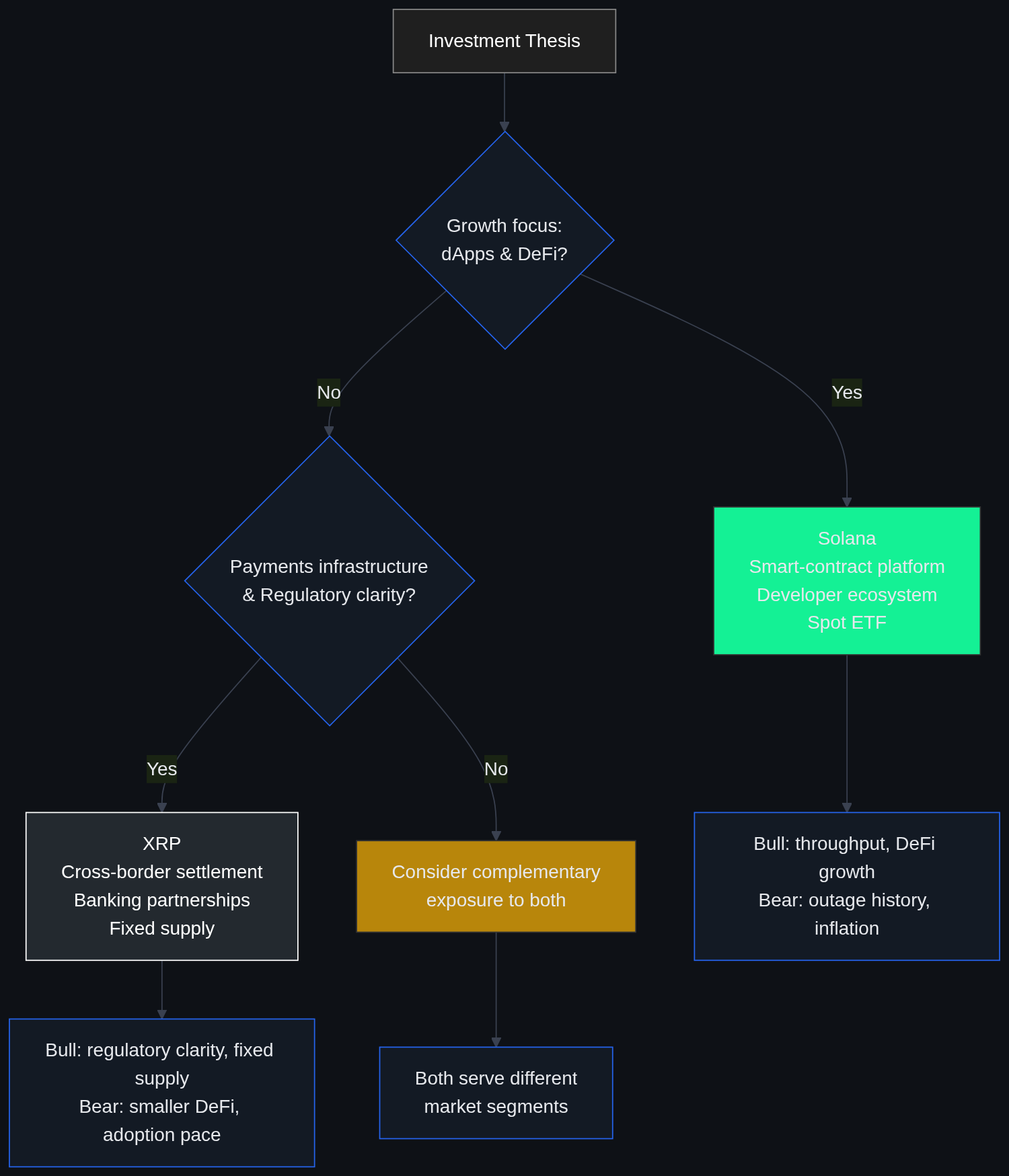
Neither case is inherently stronger; the better fit depends on whether an investor’s thesis leans toward dApp-platform growth or payments-infrastructure adoption. For a broader look at where both assets are commonly bought, see LakeBTC’s best crypto exchanges comparison, and our related coverage on whether XRP is a good investment and how to buy Solana.
SOL vs XRP Price Prediction: What Analysts Are Watching
Both assets have been through dramatic cycles, sharp 2021 highs, deep 2022 drawdowns, and partial recoveries through 2024 and 2025 tied to broader market sentiment, ETF developments, and network-specific catalysts. Analysts commonly watch ETF approval timelines, Solana’s Firedancer client rollout (a new validator client aimed at improving throughput and resilience), and RLUSD/ODL adoption metrics as forward-looking signals, rather than relying on past price action alone.
Could Solana hit $10,000 per token? Using the circulating supply figure of roughly 581 million SOL, a $10,000 unit price would imply a market capitalization in the trillions of dollars, well beyond the current total value of the entire crypto market. That doesn’t make such a scenario impossible over a very long horizon, but it does mean the math requires either an enormous reduction in circulating supply or an extraordinary expansion in total crypto market value, not simply positive sentiment.
Can XRP be worth more than Solana on a total market-cap basis? It already is, based on current figures (~$67.5B for XRP versus ~$47.1B for Solana), which illustrates an important distinction: market capitalization, not unit price, is what determines whether one asset is “worth more” than another. XRP’s much larger circulating supply (~62.24B tokens) means its per-token price will structurally look small compared with Solana’s, even when XRP’s total market cap is larger.
Price predictions of any kind are speculative and should not be treated as guarantees of future performance.
Security Considerations
Solana’s application layer has seen smart-contract exploits and wallet-drain phishing campaigns targeting users who sign malicious transactions, a risk inherent to any ecosystem with heavy DeFi and NFT activity. Validator concentration, discussed above, is also a factor some security researchers monitor. XRP holders more commonly encounter exchange-custody risk and fake-giveaway phishing scams that impersonate Ripple or prominent XRP community figures. Ripple’s large escrow holdings have also drawn centralization criticism, since a single entity controls a meaningful share of total supply release timing. In both ecosystems, standard self-custody practices, hardware wallets, careful seed-phrase storage, and verifying transaction details before signing, remain the strongest defense against theft.
Pros and Cons
Solana
- Pros: High throughput design, large developer and dApp ecosystem, spot ETF now trading, active DeFi/NFT/consumer app usage.
- Cons: Documented outage history, inflationary supply schedule, competitive pressure from Ethereum layer-2 networks.
XRP
- Pros: Post-litigation regulatory clarity, fixed supply cap, established payments and banking use case, RLUSD stablecoin expansion.
- Cons: Smaller DeFi footprint, escrow-related centralization criticism, adoption pace tied to institutional and banking timelines.
Which Is Better: Solana or XRP?
There isn’t a single universal winner, the better choice depends on the thesis an investor holds. Solana is the stronger pick for exposure to dApp growth, DeFi activity, and NFT or consumer-application speculation. XRP is the stronger pick for a payments-infrastructure and regulatory-clarity thesis built around cross-border settlement. Some investors choose to hold both as complementary exposures to different segments of the crypto market rather than picking one over the other.
How to Buy Solana or XRP Safely
- Choose a regulated, US-accessible exchange and confirm its licensing (state money-transmitter licenses or NYDFS BitLicense where applicable).
- Verify the exact asset ticker and contract details before purchasing, since scam tokens sometimes mimic legitimate names.
- Compare fee schedules, since costs vary by exchange rather than by a fixed network standard.
- Enable two-factor authentication and withdraw larger holdings to self-custody wallets rather than leaving them on an exchange indefinitely.
- Review the exchange’s custody and insurance practices, along with its published security audits, before depositing funds.
For a broader rundown of vetted platforms and their fee structures, see LakeBTC’s best crypto exchanges guide, as well as step-by-step walkthroughs on how to buy XRP and how to buy Solana in the US.
FAQ
Which is better, Solana or XRP?
It depends on the investment thesis. Solana suits investors seeking exposure to smart-contract platforms, DeFi, and NFT activity, while XRP suits those interested in payments infrastructure and regulatory-clarity-driven institutional adoption.
Can XRP be worth more than Solana?
On a total market-capitalization basis, XRP’s market cap (~$67.5B) is currently larger than Solana’s (~$47.1B), even though XRP’s per-token price is much lower due to its far larger circulating supply.
Could Solana hit $10,000?
Based on Solana’s current circulating supply of roughly 581 million tokens, a $10,000 unit price would require a market capitalization in the trillions of dollars, a scenario that would demand an extraordinary shift in the overall crypto market, not just short-term price momentum. This is not a prediction, only a math check against current supply figures.
Are Solana and XRP competitors?
Only partially. Solana primarily competes with other smart-contract platforms and Ethereum layer-2 networks, while XRP primarily competes with payments rails and correspondent banking alternatives. Overlap exists mainly at the margins, such as stablecoin and DeFi expansion on either network.
What are the transaction fees on Solana vs XRP?
Solana’s average non-vote transaction fee runs around 0.000078550 SOL, while the XRP Ledger’s base transaction cost is roughly 0.00001 XRP (10 drops), scaling upward slightly during network congestion. Both are markedly cheaper than fees historically seen on Ethereum’s base layer, though actual USD-equivalent costs vary with each token’s market price and with the specific exchange or wallet used.