Solana vs Cardano: Which Crypto Is Better?

Solana and Cardano are frequently cited as opposite bets on how a blockchain should be built: one optimized for raw throughput and consumer-facing applications, the other built around peer-reviewed research and formal verification. This comparison walks through architecture, real-world speed, fees, staking economics, developer activity, security track record, and regulatory positioning so you can judge which network’s design philosophy fits your priorities.
In this article
- Solana vs Cardano At a Glance
- What Is Solana?
- What Is Cardano?
- Solana vs Cardano Speed & Scalability
- Fees & Transaction Costs
- Staking & Tokenomics Deep Dive
- Developer Ecosystem & Technical Design
- Security & Decentralization
- Regulatory & Institutional Positioning
- Historical Price Performance & Market Data
- Use Case Fit: Which One Wins Where
- Pros and Cons
- Verdict: Which Is Better, Solana or Cardano?
- FAQ
Solana vs Cardano At a Glance
| Metric | Solana (SOL) | Cardano (ADA) |
|---|---|---|
| Launched | Mainnet beta, March 2020 (founder Anatoly Yakovenko) | 2017 (founder Charles Hoskinson, via Input Output, rebranded from Input Output Global in late 2025) |
| Consensus | Proof of History + Tower BFT | Ouroboros Proof of Stake |
| Market cap (checked 2026-07-03) | ~$47.19B, circulating supply ~580M SOL, price ~$81.35 (CoinGecko) | ~$5.83B, CoinMarketCap rank #15, circulating supply ~36.4B ADA (CoinMarketCap) |
| Max supply | No hard cap; disinflationary issuance | 45,000,000,000 ADA hard cap (CoinGecko) |
| Smart contract language | Rust, C, C++ | Plutus, Haskell, Aiken |
| Block/slot time | ~400ms slots | ~20-second slots |
Figures above are point-in-time snapshots; both assets are volatile and market data changes continuously, so verify current numbers on the linked trackers before acting on them.
What Is Solana?
Solana’s architecture centers on Proof of History, a verifiable timestamping method that lets validators agree on transaction order before consensus finality is reached, combined with a Tower BFT voting mechanism layered on top. That design is aimed at producing high throughput and sub-second block times. According to Solana’s own documentation, the network launched mainnet beta in March 2020 and has since become a hub for DeFi protocols, NFT marketplaces, high-frequency trading applications, and consumer payment tooling such as Solana Pay (solana.com/docs).
What Is Cardano?
Cardano runs on Ouroboros, a proof-of-stake protocol developed through academic peer review, and is maintained largely through Input Output (rebranded from Input Output Global in late 2025) alongside the Cardano Foundation. Its roadmap has been organized into named eras — Byron, Shelley, Goguen (which introduced Plutus smart contracts), Basho, and Voltaire — each shipping incrementally after formal specification and review. Cardano’s use cases have leaned toward identity verification, supply-chain tracking, and enterprise or government pilot programs rather than consumer-facing speculation (docs.cardano.org).
Solana vs Cardano Speed & Scalability
On raw performance, the two networks are not close. Solana’s slot time runs roughly 400 milliseconds, while Cardano’s slots take about 20 seconds, and live throughput trackers generally show Solana processing a substantially larger volume of transactions per second than Cardano under normal network conditions. Some Cardano throughput estimates run as high as 250-300 TPS depending on methodology, while other trackers report single-digit to roughly 15 TPS in typical live conditions — the gap between theoretical and observed figures is one reason “TPS” claims should be treated cautiously and always sourced to a live dashboard rather than a marketing figure (cexplorer.io).
Cardano’s roadmap addresses scaling primarily through Hydra, an off-chain state-channel layer intended to push throughput well beyond current on-chain limits, though that scaling largely happens off the base layer rather than through raw base-layer TPS gains.
Stability is a separate question from speed. Solana has experienced multiple mainnet outages since 2020 — researchers at Helius document seven distinct incidents over five years, with the most recent major halt occurring on February 6, 2024 and lasting roughly five hours (helius.dev). Cardano has not reported a comparable network-wide halt, a track record its supporters often cite as evidence that its slower, more conservative release process trades speed for reliability.
Fees & Transaction Costs
Both networks are inexpensive relative to older proof-of-work chains, but their fee models differ structurally. Solana charges a base fee of 5,000 lamports (0.000005 SOL) per signature, plus an optional prioritization fee paid in micro-lamports per compute unit during periods of congestion (solana.com/docs/core/fees). At roughly $100 per SOL, that base fee works out to about $0.0005 per transaction, though prioritization fees can rise sharply during high-demand events such as NFT mints or memecoin trading spikes (solana.com/learn).
Cardano uses a deterministic formula — minimum fee equals a per-byte rate multiplied by transaction size, plus a fixed component (historically a rate of 44 lovelace per byte and a fixed fee of 155,381 lovelace) — which produces more predictable costs regardless of network load (docs.cardano.org).
| Network | Typical fee structure | Fee behavior under congestion | Fee token |
|---|---|---|---|
| Solana | Base fee 0.000005 SOL/signature + optional priority fee | Priority fees can spike during congestion | SOL |
| Cardano | Deterministic: a × tx size + fixed fee | Fee stays formulaic; no priority-fee auction | ADA |
Fees and availability verified as of July 3, 2026.
For microtransactions, gaming, or high-frequency dApp activity, fee predictability and low base cost both matter — Solana’s sub-cent base fee suits high-volume consumer use cases, while Cardano’s formulaic model offers cost certainty that some developers find easier to model for enterprise applications.
Staking & Tokenomics Deep Dive
Solana’s inflation schedule started at 8% annually and disinflates by 15% year over year toward a long-term fixed rate of 1.5% (solana.com/docs). Delegators stake SOL to one of roughly a thousand-plus validators and typically see staking yields that track the network’s current inflation rate, minus validator commission. SOL has no maximum supply cap.
Cardano delegators choose from thousands of stake pools without locking their ADA, and rewards are distributed on a fixed schedule tied to protocol parameters rather than a competitive validator market. ADA’s supply is capped at 45,000,000,000 tokens, a hard ceiling that contrasts with Solana’s open-ended, disinflationary issuance model (CoinGecko). Neither network requires locking funds for a fixed term to participate in staking rewards, though mechanics and unbonding periods differ by validator/pool and by wallet provider.
Developer Ecosystem & Technical Design
Solana smart contracts are typically written in Rust, C, or C++ and run on the Sealevel runtime, which parallelizes execution across non-overlapping transactions — a design intended to let throughput scale with hardware. Cardano uses an extended UTXO (eUTXO) model, with contracts written in Plutus (a Haskell-based language) or the newer Aiken language, favoring predictability and formal reasoning about contract behavior over parallel execution.
Ecosystem activity, measured by total value locked and active developer counts on trackers such as DeFiLlama and the Electric Capital Developer Report, has generally favored Solana in recent cycles, reflecting its larger DeFi and NFT footprint. Critics of Solana’s validator economics point to the hardware cost of running a competitive validator — often cited informally at tens of thousands of dollars per year — as a centralization pressure, since it can price out smaller independent operators. Cardano’s stake-pool model has a lower hardware barrier but has historically attracted a smaller base of active decentralized-application developers.
Security & Decentralization
Solana’s validator set skews toward fewer, higher-spec operators, and several of its historical outages have been traced to resource-exhaustion bugs or transaction-flooding events rather than to a security breach per se. The Solana ecosystem has responded with the Firedancer client, an independently built validator implementation designed to add client diversity and resilience. Cardano’s development process emphasizes formal verification and peer review before mainnet deployment, which has coincided with a cleaner uptime record but a slower cadence of feature releases.
Governance also differs: Solana’s direction has historically been shaped heavily by the Solana Foundation and core development teams, while Cardano has moved toward on-chain governance under its Voltaire era, using Cardano Improvement Proposals (CIPs) and the Catalyst treasury system to fund and vote on community proposals.
Regulatory & Institutional Positioning
Both SOL and ADA were named in the SEC’s 2023 complaint against Coinbase as alleged unregistered securities — a historical allegation that should not be treated as current legal status. The regulatory picture has since shifted substantially: the SEC dismissed its civil enforcement action against Coinbase, with the dismissal filed February 27, 2025 (SEC.gov press release). Separately, the SEC’s long-running case against Binance — which had at one point included allegations that SOL, ADA, and other tokens were unregistered securities — was dismissed in its entirety, with prejudice, via a joint stipulation filed May 29, 2025, meaning the agency cannot refile those claims (SEC.gov litigation release). Together, these dismissals substantially reduce the regulatory overhang tied to that specific enforcement era for both tokens, though investors should still check current dockets and any newer proceedings rather than rely on 2023-era headlines. Institutional interest in both networks continues to develop through exchange-traded product filings and enterprise pilots, though the pace and scope vary and should be checked against each issuer’s own disclosures.
Historical Price Performance & Market Data
Solana’s market capitalization has generally traded at a substantial multiple of Cardano’s in recent cycles — as of the snapshot cited above, roughly $47.19 billion versus $5.83 billion respectively — though both figures move constantly and neither past ranking nor past return guarantees future performance. Both assets have shown significant drawdowns during broader crypto bear markets, and neither should be assumed to repeat prior cycle behavior. Anyone comparing historical charts should pull live data from CoinGecko, CoinMarketCap, or a similar tracker rather than relying on cached figures.
Use Case Fit: Which One Wins Where
Solana’s low fees and high throughput have made it a default venue for consumer-facing activity: NFT marketplaces, gaming integrations, memecoin trading, and point-of-sale payment experiments through Solana Pay. Cardano’s slower, more deliberate release cycle and formal-verification emphasis have found more traction in identity systems, supply-chain pilots, and government or enterprise partnerships where compliance and auditability outweigh raw speed. NFT trading volume has historically concentrated heavily on Solana relative to Cardano, reflecting the difference in ecosystem density between the two chains.
Pros and Cons
Solana
- Pros: High throughput, very low base transaction fees, a large and active DeFi/NFT/gaming ecosystem, growing institutional attention, and resilience improvements via the Firedancer client.
- Cons: History of network outages, higher validator hardware costs that raise centralization concerns, and continued regulatory scrutiny even after the SEC’s 2025 dismissal narrowed near-term risk.
Cardano
- Pros: Rigorous, peer-reviewed development process, a clean network uptime record, structured on-chain governance, a hard-capped token supply, and multiple enterprise or government pilot programs.
- Cons: Slower feature rollout pace, a comparatively smaller DeFi/NFT ecosystem and developer base, lower total value locked than peer networks, and price performance that has lagged some competitors across recent cycles.
Verdict: Which Is Better, Solana or Cardano?
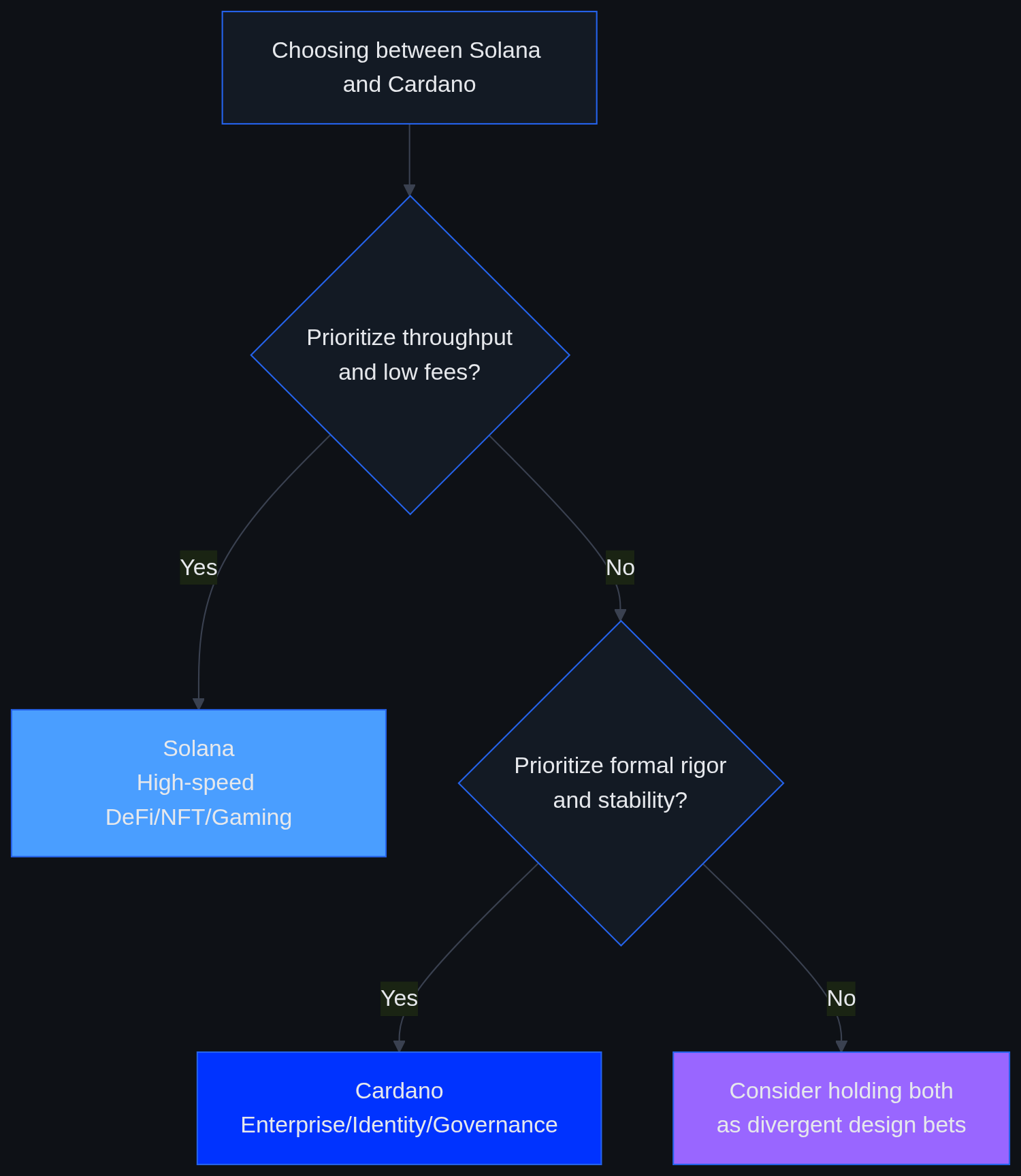
There is no single objectively “better” chain here — the answer depends on what an investor or builder is optimizing for. Solana suits use cases that prize speed, low per-transaction cost, and an active consumer app ecosystem, while Cardano appeals to those who weight formal rigor, governance structure, and network reliability more heavily than throughput. Some market participants choose to hold exposure to both as distinct bets on competing blockchain design philosophies rather than picking a single winner. For readers deciding where to acquire either asset, comparing platforms on fees, supported assets, and security practices is a reasonable first step — see our overview of the best crypto exchanges for a broader comparison framework. This analysis is educational and not financial advice; conduct independent research before making any investment decision.
Regulatory status (updated September 2026): on March 17, 2026, the SEC and CFTC issued a joint interpretive release (Release Nos. 33-11412 and 34-105020) that names both Solana and Cardano as digital commodities, placing them under CFTC rather than SEC oversight. The release is agency guidance rather than statute, so pending market-structure legislation could still change the framework.
FAQ
Which is better, Cardano or Solana?
Neither is universally “better.” Solana generally offers higher throughput and lower base fees with a larger active ecosystem, while Cardano offers a more conservative development process, a clean uptime record, and a hard-capped supply. The right choice depends on whether speed and ecosystem size or governance rigor and predictability matter more to you.
Can Cardano overtake Solana?
It’s possible but not guaranteed. Cardano’s Hydra scaling roadmap and its Voltaire governance rollout are aimed at closing gaps in throughput and developer engagement, but as of current data Solana holds a substantially larger market capitalization, developer base, and DeFi/NFT ecosystem. Any shift would depend on adoption trends that are inherently uncertain.
Why is Cardano not a good investment?
Critics point to Cardano’s slower feature-release cadence, smaller DeFi and NFT ecosystem, lower total value locked relative to competitors, and price performance that has trailed some peer networks in recent cycles. Supporters counter that the same conservative approach has produced a cleaner security and uptime record. Whether these tradeoffs make ADA unattractive depends on individual risk tolerance and investment goals — this is not a recommendation either way.
Is Solana faster than Cardano, and does it matter for everyday users?
Yes, Solana’s roughly 400-millisecond slot time and higher observed transaction throughput are faster than Cardano’s roughly 20-second slot time. For everyday transfers the practical difference may be minor, but for high-frequency trading, gaming, or NFT-minting events, Solana’s speed and low fees offer a more responsive experience.
Should I stake SOL or ADA for passive income?
Both allow staking or delegation without necessarily locking funds long-term, though mechanics vary by wallet or pool. Solana’s rewards track its disinflating issuance schedule, while Cardano’s rewards follow a fixed, formulaic rate. Staking yields, lock-up conditions, and risks vary by provider and change over time, so check current terms directly with your wallet or staking platform before delegating, and treat this information as educational rather than investment advice.