Is BNB a Good Investment?

BNB is a high-utility exchange token tied closely to the fortunes of Binance and the BNB Chain ecosystem, which makes it fundamentally different from a store-of-value asset like Bitcoin. Whether it is a “good investment” depends heavily on an individual’s risk tolerance, time horizon, and comfort with regulatory and centralization risk, there is no universal yes-or-no answer, only a set of trade-offs discussed below.
In this article
- Quick Answer: Is BNB a Good Investment Right Now?
- What Is BNB? A Quick Primer
- BNB Use Cases: What Actually Gives BNB Value
- BNB Price History and Market Context
- Bull Case: Reasons BNB Could Be a Good Investment
- Bear Case: Risks and Reasons for Caution
- BNB Price Prediction: 2026, 2027, 2030, and Beyond
- Should I Buy BNB? A Decision Framework
- How BNB Stacks Up Against Other Top Cryptocurrencies
- Security and Regulatory Considerations
- Tax and Practical Considerations for US Investors
- Common Pitfalls When Evaluating BNB as an Investment
- FAQ
Quick Answer: Is BNB a Good Investment Right Now?
BNB ranks among the largest cryptocurrencies by market capitalization, and its price, supply figures, and historical highs and lows change constantly. For current numbers, check a live data source such as CoinMarketCap’s BNB page rather than relying on any static figure quoted here. The balanced verdict: BNB has real, demonstrable utility inside one of the world’s largest exchange ecosystems, but that utility also means its long-term value is closely linked to the regulatory and business standing of a single private company.
Who BNB Is Best Suited For, and Who Should Avoid It
- May suit: investors comfortable with crypto volatility who actively use the Binance exchange or BNB Chain apps and want to capture fee discounts or ecosystem exposure.
- May not suit: conservative investors seeking a diversified, low-correlation holding, or anyone uncomfortable with concentrated exposure to a single exchange’s regulatory outcomes.
What Is BNB? A Quick Primer
BNB launched via an initial coin offering in 2017 as the native utility token of the Binance exchange, originally used to pay for reduced trading fees. Over time its role expanded well beyond the exchange.
From Beacon Chain to BNB Smart Chain
BNB’s underlying infrastructure evolved from the original BNB Beacon Chain into the BNB Smart Chain, and the ecosystem has since undergone rebranding and technical consolidation efforts documented on BNB Chain’s official site. The chain functions as an EVM-compatible network supporting decentralized applications, DeFi protocols, and token issuance.
Tokenomics and the Burn Mechanism
BNB was designed with a capped maximum supply, and Binance has run periodic and real-time token-burn mechanisms (including the BEP-95 real-time burn) intended to reduce circulating supply over time. Exact burned totals and remaining supply figures shift with each burn event, so readers should confirm current numbers directly through Binance’s official blog burn reports rather than a cached figure.
Key Background
BNB is associated with Changpeng Zhao (CZ), who founded Binance, and the token has historically ranked among the top cryptocurrencies by market capitalization. For the current rank and corporate status of Binance, consult primary sources directly, since ownership structures and executive roles in crypto can change quickly and should not be assumed from older reporting.
BNB Use Cases: What Actually Gives BNB Value
Unlike purely speculative assets, BNB has several concrete utility functions that support demand independent of price speculation.
- Trading fee discounts: Holders can historically use BNB to pay trading fees on Binance at a discounted rate; the exact discount percentage varies by exchange and promotional period, so check the official Binance fee schedule for current terms.
- Gas token: BNB is used to pay transaction (“gas”) fees on BNB Smart Chain, powering decentralized apps and smart contracts.
- Launchpad participation: Holding BNB has historically been a prerequisite for participating in Binance Launchpad and Launchpool token offerings.
- Payments: BNB is accepted by some merchants and integrated into Binance Pay and travel-booking partnerships.
- Staking and yield: BNB can be staked or deposited into yield products such as BNB Vault, though returns and terms vary and carry their own risks.
Ecosystem-level metrics, total value locked, active dApp counts, and daily transaction volume on BNB Chain, fluctuate regularly. Readers researching current adoption levels should check live dashboards such as DeFiLlama’s BNB Chain page and BscScan’s transaction charts.
BNB Price History and Market Context
BNB has passed through several distinct market cycles: rapid appreciation during the 2021 bull run, a sharp contraction during the 2022 broader crypto bear market alongside major industry stress events, and renewed rallies in subsequent cycles that pushed the token to new highs. Because exact historical price points shift with data providers and time frames, verify specific milestones through an exchange’s historical price charts rather than relying on any single quoted figure.
BNB’s volatility profile broadly tracks the wider crypto market: it tends to correlate with Bitcoin during macro risk-on and risk-off swings, while also reacting independently to Binance-specific news, regulatory developments, and burn events. Sentiment gauges such as the Crypto Fear & Greed Index can offer a rough read on prevailing market mood, though such indexes are sentiment proxies, not predictive tools.
Bull Case: Reasons BNB Could Be a Good Investment
- Deflationary design: Ongoing burn mechanisms are structured to reduce circulating supply over time, a factor some analysts view as supportive for scarcity-driven value, assuming demand holds steady or grows.
- Exchange dominance: Binance has historically maintained a large share of global spot and derivatives trading volume, and BNB’s utility is directly linked to that platform’s usage.
- Ecosystem breadth: BNB Chain hosts a wide range of DeFi, gaming, and increasingly real-world-asset tokenization projects, broadening BNB’s use beyond fee discounts.
- Real-world integrations: Payment partnerships and Binance Pay expand practical, non-speculative use cases.
- Historical resilience: BNB has recovered from past drawdowns, though past recoveries do not guarantee future outcomes.
Bear Case: Risks and Reasons for Caution
- Regulatory exposure: Binance and related entities have faced significant regulatory and legal scrutiny in the United States and elsewhere. Current status of any settlements, ongoing litigation, or enforcement actions should be confirmed directly through the Department of Justice, SEC litigation releases, and CFTC press releases, since these situations evolve.
- Centralization risk: BNB’s value is tightly coupled to a single company’s business performance and regulatory standing, unlike more decentralized networks.
- Competitive pressure: Other layer-1 networks and Ethereum layer-2 scaling solutions compete for developer activity and user transactions, which could dilute BNB Chain’s relative share over time.
- Volatility and drawdowns: Like most crypto assets, BNB has experienced steep percentage declines during past bear markets, and such drawdowns can recur.
Past performance does not guarantee future results, and any historical recovery pattern should not be treated as predictive.
BNB Price Prediction: 2026, 2027, 2030, and Beyond
Any BNB price prediction is inherently speculative and should be treated as a scenario exercise, not a forecast of certain outcomes.
Short-Term Outlook (2026)
Near-term price action will likely continue to reflect broader crypto market cycles, Binance-specific developments, and burn-driven supply changes. Analysts publishing model-based forecasts (for example, aggregator sites like Changelly’s BNB forecast page) typically present a range of outcomes rather than a single number, and such ranges should be read as illustrative, not authoritative.
Mid-Term Outlook (2027-2028)
Over a multi-year horizon, BNB’s trajectory will likely depend on continued adoption of BNB Chain applications, the pace of token burns relative to any new issuance, and how regulatory clarity around exchange tokens develops in major markets, including the US.
Long-Term Outlook (2030-2040)
Longer-term scenarios hinge on whether Binance sustains its exchange market position, whether BNB Chain continues attracting developers relative to competing ecosystems, and how global regulatory frameworks for exchange-linked tokens mature. These are structural questions, not price targets, and no one can responsibly guarantee a specific value decades out.
Can BNB Reach Roughly $1,000?
BNB has, according to public market reporting, traded above approximately $1,000 during prior rally phases; verify the exact historical figure at CoinMarketCap. Whether it sustains or revisits that level again depends on future demand, burn pace, and broader market conditions, confirm current price levels through a live source before drawing conclusions.
Could BNB Reach a Much Higher Price Level, Such as an Order of Magnitude Above Its Past Highs?
A move to a price level roughly ten times higher than BNB’s past highs (a figure sometimes floated informally in online discussion, without credible sourcing) would require an extraordinary increase in market capitalization relative to BNB’s supply, a scenario that would need to be weighed against the total addressable size of the global crypto market. This is a useful reality check: any price target should be cross-checked against implied market-cap math using a live data source such as CoinMarketCap, not just extrapolated from a chart.
What Will BNB Be Worth in 5 Years?
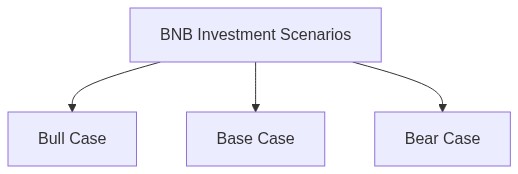
| Scenario | Underlying Assumption |
|---|---|
| Bull case | Continued Binance dominance, accelerating burns, expanding BNB Chain DeFi/RWA activity, favorable regulatory resolution |
| Base case | Binance maintains roughly current market position; BNB tracks broader crypto market cycles |
| Bear case | Adverse regulatory action, declining exchange market share, or accelerated competition from rival chains |
These scenarios are illustrative frameworks for thinking about risk, not price predictions or investment advice.
Should I Buy BNB? A Decision Framework
Rather than asking “should I buy BNB” in isolation, consider a structured set of questions.
- What is my time horizon, months, years, or a decade-plus?
- How would a significant drawdown, potentially in the range of 50-70% based on past crypto bear markets, affect my broader financial situation?
- Am I buying for utility (fee discounts, ecosystem participation) or purely for price appreciation?
- What percentage of my total portfolio would this position represent?
Some investors use dollar-cost averaging, buying fixed amounts at regular intervals, to reduce the impact of short-term volatility, while others prefer a lump-sum entry. Neither approach eliminates risk, and position sizing for any single volatile asset is a personal risk-management decision rather than a one-size-fits-all rule.
For those deciding where to buy, comparing custodial exchanges against self-custody wallet options is a useful first step; our guide to the best crypto exchanges and our how-to-buy-crypto walkthrough outline the practical steps and trade-offs involved.
How BNB Stacks Up Against Other Top Cryptocurrencies
BNB’s utility-token model differs meaningfully from Bitcoin’s store-of-value positioning and from Ethereum’s broader, more decentralized smart-contract ecosystem. Solana competes on transaction speed and low fees with its own growing developer base. Readers comparing these assets directly may find our related analyses useful, including Is Solana a Good Investment?, Is XRP a Good Investment?, and Solana vs XRP. There is no single “best coin to invest in now,” the right allocation depends on an individual’s goals, risk tolerance, and diversification strategy, and many analysts suggest evaluating multiple assets rather than concentrating in one.
Security and Regulatory Considerations
Binance, as BNB’s primary associated exchange, has a security and regulatory history that has evolved over the years, including past legal proceedings in the US. Current legal status, settlement terms, and any new enforcement actions should be verified directly at justice.gov, sec.gov/litigation, and cftc.gov, since these details can change and older summaries may be outdated.
BNB Chain has also experienced smart-contract and bridge exploits in the past, a reminder that on-chain infrastructure carries its own technical risk separate from exchange-level risk. The SEC’s lawsuit against Binance, which had alleged BNB was an unregistered security, was dismissed with prejudice in May 2025. BNB was not among the assets widely reported as named digital commodities in the March 17, 2026 joint SEC–CFTC interpretive release, so its classification is less settled than that of Bitcoin, Ether, XRP or Solana; consult SEC.gov directly for the agency’s current position rather than assuming a fixed classification.
Holding BNB on an exchange versus in a self-custody wallet involves a classic trade-off: exchange custody offers convenience and liquidity, while self-custody shifts responsibility (and risk of loss) to the individual holder.
Tax and Practical Considerations for US Investors
In the US, cryptocurrency transactions, including trades, staking rewards, and payments made with BNB, generally have tax implications. The IRS treats virtual currency as property for federal tax purposes, and specific guidance is available at IRS.gov’s digital assets page. Keeping detailed records of purchase dates, amounts, and cost basis can simplify future tax reporting. Because individual tax situations vary, consult a licensed tax professional for guidance specific to your circumstances.
Common Pitfalls When Evaluating BNB as an Investment
- Treating price predictions as guarantees rather than speculative scenarios.
- Overlooking exchange-concentration risk tied to a single company’s regulatory and business outcomes.
- Allocating an outsized share of a portfolio to one volatile asset without diversification.
- Buying purely in reaction to a price rally rather than based on a defined investment thesis.
Weighing the bull and bear cases together, BNB’s investment case rests on genuine utility, fee discounts, gas functionality, ecosystem participation, balanced against real regulatory and centralization risk tied to Binance. This analysis is educational content intended to inform independent research, not personalized financial advice.
FAQ
What will BNB be worth in 5 years?
No one can state a reliable dollar figure five years out. Outcomes depend on Binance’s continued market position, BNB Chain adoption, burn-driven supply reduction, and regulatory developments, treat any specific number you see elsewhere as speculative.
Could BNB reach a price level roughly ten times higher than its past highs?
Such a price would require an extremely large increase in implied market capitalization. It’s a useful exercise to check any bold price target, including figures sometimes cited informally without a credible source, against realistic market-cap math relative to the total crypto market using a live data source such as CoinMarketCap, rather than assuming it is achievable by default.
Which coin is best to invest now?
There is no universal answer. Bitcoin, Ethereum, BNB, Solana, and other major assets each carry different risk-and-utility profiles; many analysts favor diversification and matching an asset’s characteristics to individual risk tolerance rather than chasing a single “best” pick.
Can BNB reach approximately 1,000 dollars?
Public market reporting indicates BNB has traded above roughly $1,000 during past rally periods, verify the exact figure at CoinMarketCap. Whether it holds or returns to that level depends on future demand and market conditions, verify current pricing through a live data source before making decisions.
Is BNB a good long-term hold compared to Bitcoin and Ethereum?
BNB offers utility tied to a specific exchange ecosystem, while Bitcoin is generally viewed as a decentralized store of value and Ethereum as a broad, decentralized smart-contract platform. Each carries a distinct risk profile, and comparing them requires weighing decentralization, regulatory exposure, and use case alongside personal investment goals.