Kraken Review: Fees, Security, and Who It’s For

Kraken is one of the longest-operating centralized cryptocurrency exchanges available to US residents, founded in 2011 and still active today. Based on publicly available documentation and user-reported data, Kraken offers competitive spot and advanced trading fees, a broad asset selection, and a regulated operational structure, making it a credible option for a wide range of traders. It is not, however, without documented drawbacks, particularly around customer support wait times and geographic restrictions on certain products.
| Founded | 2011 |
| Headquarters | Cheyenne, Wyoming (relocated from San Francisco in 2025) |
| Spot Trading Maker Fee (base tier) | 0.40% (since the July 9, 2026 restructure; according to Kraken’s published fee schedule) |
| Spot Trading Taker Fee (base tier) | 0.80% |
| Instant Buy Fee (approx.) | 1% trading fee on instant and recurring buys (1.5% on custom orders), plus a variable spread |
| Supported Cryptocurrencies | 700+ (per Kraken’s asset listings page) |
| Fiat Currencies | USD, EUR, GBP, CAD, AUD, CHF, and others |
| US Availability | Available in most US states; not available in New York or Maine; some products further restricted |
| Regulatory Status (US) | FinCEN-registered Money Services Business |
| Trustpilot Rating | ~3.3/5 based on approximately 7,700 reviews (as of mid-2026, per Trustpilot) |
In this article
- What Is Kraken?
- Is Kraken Safe and Legit?
- Account Setup and Verification
- Kraken Fee Structure
- Kraken vs Coinbase (2026)
- Supported Assets and Markets
- Security Architecture
- User Experience and Customer Support
- Regulatory and Compliance Standing
- Pros and Cons
- Who Is Kraken Best Suited For?
- Frequently Asked Questions
What Is Kraken?
Kraken was established in 2011 by Jesse Powell and launched publicly in 2013, making it one of the earliest US-based crypto exchanges still in operation. The platform operates two main trading interfaces: a simplified Instant Buy flow for retail users and Kraken Pro, an advanced order-book interface that offers limit, stop-loss, and conditional orders alongside lower fee tiers. Kraken also offers margin trading and futures products, though access to these instruments varies by jurisdiction and regulatory classification.
Kraken is registered with the US Financial Crimes Enforcement Network (FinCEN) as a Money Services Business and holds various state money transmitter licenses. It has historically been considered one of the more compliance-oriented exchanges in the US market, though it is not a federally chartered bank and deposits are not FDIC-insured.
Is Kraken Safe and Legit?
Kraken is widely regarded as one of the more established and legitimate US crypto exchanges. It has operated since 2011 with no major publicized breach that lost customer funds, is registered with FinCEN as a Money Services Business, holds state money transmitter licenses, keeps the majority of customer assets in cold storage, and publishes periodic Proof of Reserves attestations. It is a real, regulated business rather than an anonymous offshore platform. That said, “legit” does not mean risk-free: like all centralized exchanges, Kraken carries counterparty risk, customer funds are not FDIC- or SIPC-insured, and the company has settled past regulatory actions (detailed below). For larger holdings, the standard security advice still applies — enable strong two-factor authentication and move coins you are not actively trading into self-custody. The sections below break down Kraken’s security architecture and regulatory record in detail.
Account Setup and Verification
Opening a Kraken account requires completing a Know Your Customer (KYC) verification process. Kraken uses a tiered verification system: a Starter tier allows limited functionality, while the Intermediate tier, which requires government-issued photo ID and proof of address, unlocks higher deposit and withdrawal limits and access to fiat funding methods. An Advanced verification tier is available for users who require higher transaction thresholds and is typically used by institutional or high-volume clients.
The verification process is conducted through Kraken’s onboarding flow and is largely automated, though manual review may be triggered in some cases. During periods of high platform traffic or increased account-opening volume, verification delays have been reported by users, a pattern reflected in negative reviews on Trustpilot and community forums. Prospective users should account for potential onboarding delays when planning first trades, particularly if time-sensitive access is required.
Once verified, users can fund their accounts via bank wire, ACH transfer (where available), and other supported fiat methods depending on their country of residence. Crypto deposits are available immediately upon account creation, even before fiat verification is complete, though withdrawal limits may apply at the Starter tier.
Kraken Fee Structure
Kraken’s fee model differs depending on which product a user accesses. For a full breakdown of how Kraken’s fees compare to competitors, see our guide to crypto exchange fees.
Spot Trading Fees (Kraken Pro)
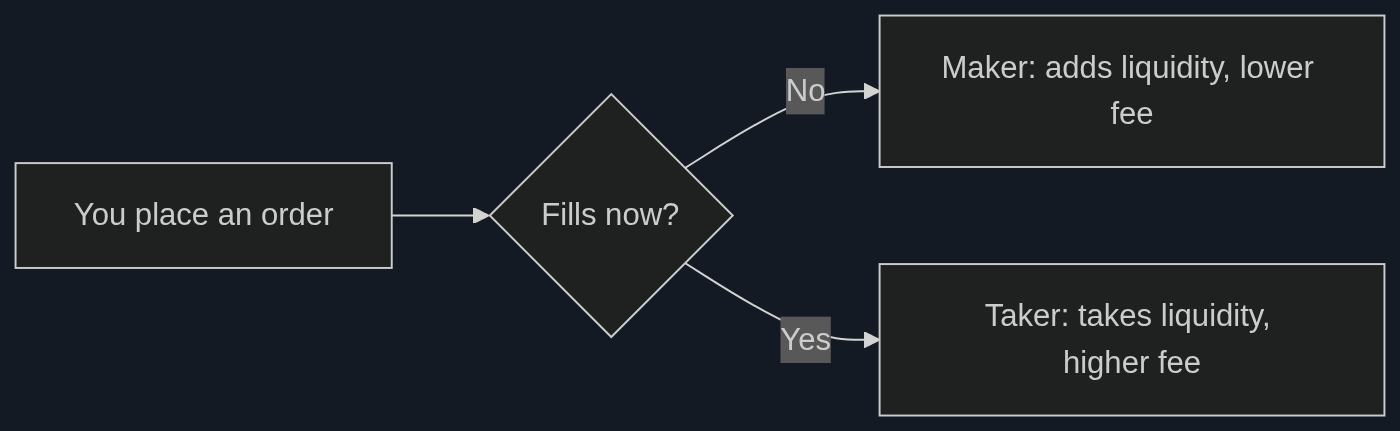
According to Kraken’s published fee schedule, spot trading fees use a maker-taker model and decrease with 30-day rolling volume. The table below summarizes the published tiers at the time of writing; verify directly with Kraken before trading, as schedules may change. Note: on July 9, 2026 Kraken restructured its tiers. Accounts now qualify through 30-day spot volume or Assets on Platform (AoP), whichever gives the better rate. For low-volume traders the change was a price increase: the entry tier moved from 0.25% maker / 0.40% taker to 0.40% / 0.80%. Fee data reviewed September 21, 2026.
| 30-Day Volume (USD) | Maker Fee | Taker Fee |
|---|---|---|
| $0+ | 0.40% | 0.80% |
| $2,500+ | 0.30% | 0.60% |
| $10,000+ (or $20,000 AoP) | 0.22% | 0.38% |
| $25,000+ (or $50,000 AoP) | 0.20% | 0.35% |
| $50,000+ (or $100,000 AoP) | 0.15% | 0.30% |
| $100,000+ (or $200,000 AoP) | 0.12% | 0.25% |
| $250,000+ (or $400,000 AoP) | 0.10% | 0.22% |
| $500,000+ (or $600,000 AoP) | 0.08% | 0.20% |
| $10,000,000+ | 0.00% | 0.10% |
Instant Buy Fees
The simplified Instant Buy interface is priced differently from Kraken Pro. Kraken charges a 1% trading fee on instant and recurring buys and 1.5% on custom orders, and the quoted price also includes a spread that varies with the asset, order size and market conditions. Card and other payment-method fees can come on top. Kraken+ members have the trading fee waived on up to $10,000 of monthly volume, but still pay the spread. Users who prioritize low costs are generally better served by limit orders on Kraken Pro.
Deposit and Withdrawal Fees
Kraken does not charge fees for crypto deposits. Fiat deposit and withdrawal fees vary by method and currency. Wire transfers in USD, for example, have historically carried a fixed fee per transaction according to Kraken’s support documentation; ACH/Plaid connections may carry different fee structures. Users should confirm the current schedule on Kraken’s deposit and withdrawal fees support page before initiating transfers.
Crypto withdrawal fees are network-dependent and set by Kraken to cover on-chain transaction costs. These fees vary by asset and network congestion and are listed per asset on Kraken’s withdrawal page. For users moving large amounts off the exchange into self-custody wallets, reviewing the current withdrawal fee for each specific asset before initiating the transfer is advisable, as fees for some tokens on congested networks can be meaningful relative to transaction size.
Kraken vs Coinbase (2026)
Kraken and Coinbase are the two US exchanges users most often weigh against each other, and they suit different priorities. The short version: Coinbase is the more beginner-friendly on-ramp and the larger, Nasdaq-listed company, while Kraken tends to be cheaper for active trading and offers a broader set of advanced tools. The table summarizes the main differences as of 2026.
| Kraken | Coinbase | |
|---|---|---|
| Founded | 2011 | 2012 |
| Best for | Active & intermediate traders | Beginners & first buys |
| Spot fees (advanced) | From 0.40% / 0.80% | From 0.60% / 1.20% |
| Simple-buy cost | 1% fee plus spread | ~1% spread + fee (up to ~3.99% on card) |
| Company | Private | Publicly traded (Nasdaq: COIN) |
| US availability | Most states (not NY or Maine) | All 50 states |
| Advanced tools | Extensive (Kraken Pro, margin, futures*) | Coinbase Advanced Trade |
*US access to crypto margin and futures is limited and varies by product and state. For most beginners making occasional buys, Coinbase’s simplicity and all-state availability are compelling despite higher costs. For cost-conscious or more active traders, Kraken Pro’s lower fees and deeper toolset usually win — provided you are not in New York or Maine, where Kraken is unavailable. Compare both alongside other platforms in our best crypto exchanges guide.
Supported Assets and Markets
Kraken lists several hundred cryptocurrencies for spot trading (700+ at the time of writing, per its current asset page), including major assets such as Bitcoin (BTC), Ether (ETH), and a broad range of altcoins and stablecoins. For example, Kraken is one of the platforms that supports XRP — see our step-by-step guide on how to buy XRP for a coin-specific walkthrough. Asset availability for US users may differ from global availability; Kraken periodically adds or removes assets in response to regulatory guidance.
Beyond spot markets, Kraken offers:
- Margin trading, available on select pairs; only available to verified users who meet Kraken’s eligibility criteria. Margin trading amplifies both gains and losses.
- Futures, Offered through a separate platform (Kraken Futures, formerly Crypto Facilities); availability for US retail customers has been subject to regulatory restrictions.
- Staking, Kraken shut down its original staking-as-a-service program for US customers under its February 2023 SEC settlement. On January 30, 2025 it relaunched a restructured on-chain (bonded) staking product for US clients, initially in 39 states and territories. Eligibility depends on state of residence, and Kraken takes a commission on staking rewards.
- API access, Kraken provides REST and WebSocket APIs for automated trading and market data; our crypto exchange API guide explains what to evaluate before building on any exchange.
Security Architecture
Kraken publishes detailed information about its security practices in its Security section. Key documented features include:
- The majority of customer funds held in cold storage (air-gapped systems).
- Two-factor authentication (2FA) available via authenticator app, hardware key (WebAuthn/FIDO2), and other methods.
- Global Settings Lock (GSL), a feature that imposes a waiting period on security-setting changes, intended to impede account takeovers.
- Proof of Reserves attestations published periodically; methodology and scope should be reviewed directly in Kraken’s disclosures.
- Regular third-party security audits, per Kraken’s claims, specific audit reports have not always been published in full.
Kraken also supports IP allowlisting and device management features, enabling users to restrict account access to pre-approved IP addresses and review recognized login devices. These controls are optional but represent a meaningful additional layer of protection for users who take the time to configure them. Enabling the highest available 2FA method, hardware key authentication via FIDO2 where possible, is generally recommended by security practitioners over SMS-based alternatives, which are susceptible to SIM-swap attacks.
It is worth noting that Kraken, like all centralized exchanges, carries counterparty risk. Funds held on an exchange are not equivalent to self-custodied assets held in a personal hardware or software wallet.
User Experience and Customer Support
Kraken offers a web platform, iOS app, and Android app. The Kraken Pro interface is more feature-dense and suited to users familiar with order-book trading. The simplified interface targets newer users but, as noted above, carries higher effective costs via the spread model.
The mobile apps have been updated regularly in recent years and offer most core trading and portfolio-management functions available on the web platform. Kraken Pro is accessible both via the dedicated web interface and through the main Kraken app, allowing users to switch between simplified and advanced views. Charting tools within Kraken Pro are powered by TradingView integration, providing access to a range of technical indicators and drawing tools familiar to traders who use TradingView independently.
Customer support has been a frequently cited pain point in user reviews. The Trustpilot listing for Kraken shows a rating of approximately 3.3 out of 5 across roughly 7,700 reviews as of mid-2026, with recurring themes in negative reviews centering on slow ticket response times and account verification delays. Positive reviews frequently cite platform reliability and breadth of available assets. Community discussions on platforms such as Reddit reflect a polarized user base, with some long-term users reporting high satisfaction with core trading functionality despite support friction.
Regulatory and Compliance Standing
Kraken operates as a FinCEN-registered Money Services Business and holds state money transmitter licenses across multiple US jurisdictions. It is one of the few exchanges to have historically pursued regulatory engagement rather than avoidance. However, it has also faced enforcement actions:
- In 2023, the SEC and Kraken reached a settlement over Kraken’s staking-as-a-service program; Kraken agreed to pay $30 million and cease offering the program to US customers, according to the SEC’s announcement.
- In November 2023 the SEC separately sued Kraken, alleging it operated as an unregistered exchange, broker and clearing agency. The SEC agreed to drop that case in March 2025 and it was dismissed with prejudice, with no penalty and no admission of wrongdoing.
- Kraken has also faced prior OFAC-related settlements regarding transactions with sanctioned jurisdictions, per US Treasury OFAC records.
These actions do not necessarily reflect ongoing operational deficiencies, but prospective users should factor regulatory history into their exchange selection process. Our guide to the best crypto exchanges provides a broader comparison framework.
Pros and Cons
Pros
- Lower Pro fees than Coinbase, Kraken Pro starts at 0.40% maker / 0.80% taker, below Coinbase Advanced at 0.60% / 1.20% for its lowest tier, and falls to 0.22% / 0.38% from $10,000 in 30-day volume or $20,000 held on the platform. It is no longer the cheapest US option: Binance.US charges 0% maker / 0.02% taker on all spot pairs.
- Longevity and track record, Founded in 2011 and operating since 2013 with no major public exchange-hack event on record.
- Broad asset selection, Several hundred assets (700+ at the time of writing), with regular additions.
- Advanced trading tools, Kraken Pro offers a full order-book environment with multiple order types.
- Multi-fiat support, USD, EUR, GBP, and other fiat pairs are available.
- Strong security architecture, Cold storage majority, FIDO2 2FA, Global Settings Lock.
- Proof of Reserves disclosures, Periodic attestations published for transparency.
Cons
- Customer support wait times, Frequently reported in negative user reviews; primarily ticket-based.
- Instant Buy spreads, Higher effective cost for users not using Kraken Pro.
- Product availability restrictions, Not available in New York or Maine; margin and futures products unavailable to some US users.
- Regulatory actions on record, Past SEC staking settlement and OFAC case worth noting.
- Verification delays, KYC processes have historically caused friction during high-traffic periods.
- No FDIC/SIPC protection, Customer funds are not insured by government deposit-protection schemes.
Who Is Kraken Best Suited For?
Based on its published feature set and fee structure, Kraken may be a strong fit for:
- Intermediate-to-advanced traders who plan to use Kraken Pro’s order-book interface and benefit from lower taker fees.
- High-volume traders whose 30-day activity qualifies for reduced fee tiers.
- Users seeking multi-fiat pairs, particularly EUR-denominated markets.
- Users prioritizing exchange longevity and documented security practices.
- Users who value compliance-oriented operations and prefer exchanges with a documented regulatory engagement history over those that have operated in a less structured manner.
- Traders requiring broad altcoin access who still want a platform with established infrastructure and published security practices, rather than relying on smaller or newer exchanges for less common assets.
It may be less suitable for users whose primary need is a fast, frictionless onboarding experience or those who require immediate, responsive live-chat support, and it is not an option at all for residents of New York or Maine. Users who are new to crypto markets may also benefit from reviewing our step-by-step guide to buying crypto before selecting an exchange.
Frequently Asked Questions
Is Kraken available in all US states?
No. Kraken is available in most US states for spot trading but is not available in New York or Maine. Certain products, including margin trading and futures, may be further restricted in some states due to licensing requirements. Verify availability in your state directly via Kraken’s support documentation before signing up.
Is Kraken regulated?
Kraken is registered with FinCEN as a Money Services Business and holds state-level money transmitter licenses in multiple US jurisdictions. It is not a federally chartered bank and customer deposits are not FDIC-insured. Past regulatory settlements with the SEC and OFAC are on public record.
How do Kraken’s fees compare to Coinbase?
Since July 9, 2026, Kraken Pro starts at 0.40% maker / 0.80% taker for accounts under $2,500 in 30-day volume. Coinbase Advanced starts at 0.60% / 1.20% for accounts under $1,000. On the simple buy screens both cost more: Kraken charges a 1% fee plus spread, Coinbase a spread plus a variable fee. See the comparison table above and our dedicated crypto exchange fees comparison for detail.
Does Kraken offer staking for US customers?
Yes, in most states. Kraken ended its original staking-as-a-service program for US customers under its 2023 SEC settlement, then relaunched on-chain bonded staking for US clients on January 30, 2025, initially in 39 states and territories. Check Kraken’s staking page for current state eligibility.
What happened with the Kraken SEC case?
In February 2023, the SEC announced a settlement with Kraken (Payward Ventures, Inc.) in which Kraken agreed to pay approximately $30 million in disgorgement, prejudgment interest, and civil penalties, and to cease offering its crypto staking-as-a-service program to US customers. Full details are available in the SEC’s press release.
Is Kraken safe to use?
No centralized exchange can be described as entirely without risk. Kraken publishes detailed security documentation, holds the majority of customer funds in cold storage, and has not suffered a major publicized exchange hack. That said, exchange-held assets carry inherent counterparty risk. Users with significant holdings may want to consider self-custody options alongside exchange storage.