What Is a Gas Fee? How Ethereum Fees Work and How to Pay Less
A gas fee is what you pay Ethereum, in ETH, to process a transaction: a base fee plus an optional tip per unit of gas. Waiting for a dip or using layer 2 cuts it.
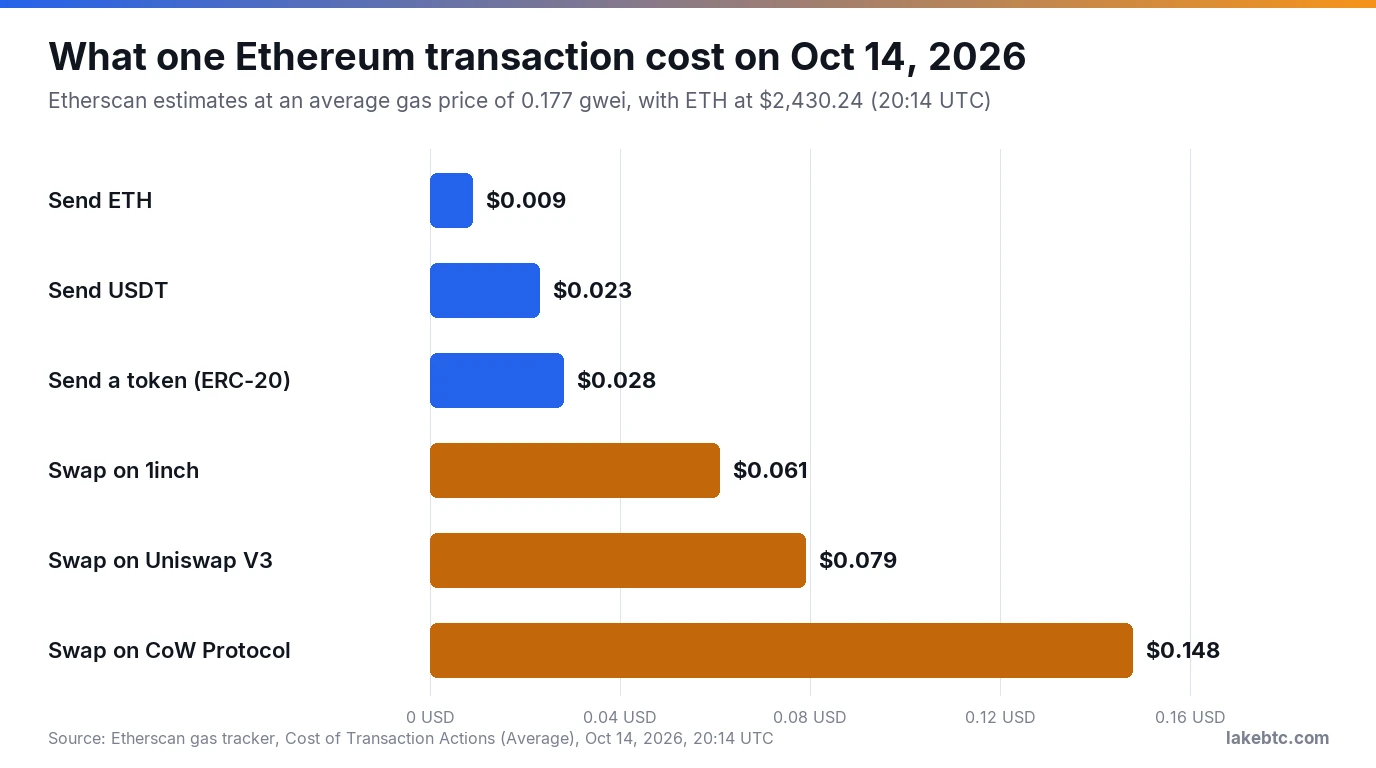
Every transaction on Ethereum needs gas, whether you’re sending 1 ETH to a friend or swapping tokens in an app. Your wallet usually shows it as the network fee on the confirm screen. In an Etherscan reading on October 14, 2026, that fee was under a cent for a plain ETH send and roughly 6 to 15 cents for a token swap.
The gas fee isn’t set by your wallet, and it doesn’t go to the app. It moves with demand on the network, block by block. The base fee part is burned and the tip goes to the validator who includes your transaction, so how the fee splits depends on how much you tip.
So before you press Confirm, make sure the wallet holds enough ETH to cover that fee. Gas spent on a failed transaction doesn’t come back.
Before you confirm a send
- 🟢 Keep some ETH in the wallet. Gas on Ethereum is paid only in ETH, even when you send a token.
- 🟡 Fees move every block. If the fee looks high, waiting a few minutes can lower it.
- 🔴 A failed transaction still costs gas. Check the address and network before you send.
- 🟢 Withdrawing from an exchange? You pay the exchange’s withdrawal fee instead of setting gas yourself.
In this article
How a gas fee is calculated
The formula is short: units of gas used times the base fee plus the priority fee. Each piece does a different job.
- Gas used: how much work your transaction needs. A plain ETH transfer uses 21,000 units. A swap or other smart contract action uses more.
- Base fee: a price per unit of gas that the network sets for each block. It’s burned, so nobody receives it.
- Priority fee: an optional tip per unit of gas. It goes to the validator and helps your transaction get picked sooner.
Prices are quoted in gwei, a tiny slice of ETH. One ETH is 1 billion gwei, so gwei works like cents do for dollars. Your wallet does this math for you and usually shows the result in ETH and dollars.
A worked example, step by step
The Ethereum developer docs walk through one example transfer with round numbers. Someone sends 1 ETH when the base fee is 10 gwei, and adds a 2 gwei tip.
- Gas used: 21,000 units for a standard transfer.
- Price per unit: 10 gwei base plus 2 gwei tip, so 12 gwei.
- Fee: 21,000 times 12 is 252,000 gwei.
- The sender’s balance drops by 1.000252 ETH. The receiver gets exactly 1 ETH.
- Of the fee, 0.00021 ETH is burned and 0.000042 ETH goes to the validator.
That’s the shape of every fee on Ethereum. Only the numbers change.
What a send costs in dollars
On October 14, 2026 at 20:14 UTC, the Etherscan gas tracker showed a base fee of 0.176 gwei, far below the example’s 10 gwei, and an average gas price of 0.177 gwei, with ETH at $2,430.24. At that average, a 21,000-unit ETH transfer costs 3,717 gwei, or 0.000003717 ETH. That’s about $0.009, less than a cent.
Token sends and swaps run contract code, so they use more gas and cost more at the same price. At the same reading, Etherscan put a USDT transfer at 54,128 gas, about $0.023, and a Uniswap V3 swap at 184,523 gas, about $0.079. Across the swap apps it lists, a swap ran from about $0.06 to $0.15.
Swapping a token for the first time in an app? You’ll usually confirm two transactions: a token approval that lets the app move that token, then the swap. The approval is recorded on chain, so it costs gas too. After that, the app can move up to the amount you approved without a new approval.
Treat these numbers as a snapshot: gas can multiply within minutes when the network gets busy, and your wallet shows the network fee for your transaction on the confirm screen before you send.
Why gas fees go up
Gas is an auction for space in the next block. When more people want in, they raise their tips to get ahead, and the base fee climbs too.
The base fee follows a fixed rule from EIP-1559. Each block has a target size. If the last block was fuller than the target, the base fee goes up; if it was emptier, it goes down. The change is capped at 12.5% per block, so a busy stretch pushes fees up quickly, one block after another.
Gas fee or withdrawal fee? It depends where you send from
The fee you see depends on where the coins sit when you press send. Here’s how the common cases differ.
| You send from | What you pay | Who sets it | Paid in |
|---|---|---|---|
| Your own wallet, on Ethereum | Gas fee: gas used times (base fee plus tip) | The network, plus the tip you choose | ETH |
| Your own wallet, sending a token like USDC on Ethereum | Gas fee, usually higher than a plain ETH send | The network, plus your tip | ETH, not the token (some wallets can take a token like USDC instead) |
| A layer 2 network such as Base, Arbitrum or OP Mainnet | A fee to run it on the layer 2 plus a fee to post it to Ethereum, generally lower in total | That network; the Ethereum part moves with mainnet demand | ETH on that layer 2, not ETH on Ethereum mainnet |
| An exchange account (for example Kraken) | The exchange’s withdrawal fee | The exchange; the final fee shows at confirmation | At Kraken, the coin you withdraw, taken out of the amount sent |
| Other blockchains, like Bitcoin or Solana | A network fee, calculated differently | That network | BTC on Bitcoin, SOL on Solana |
On an exchange, you don’t set gas at all. Kraken, for example, charges a withdrawal fee to cover the cost of moving coins out, and the final amount appears before you confirm. Our crypto exchange fees page breaks down what exchanges charge.
Watch the token row. The network only takes ETH, so unless your wallet pays it for you in another token, you can’t move USDC on Ethereum until the same wallet holds some ETH. Send a little ETH there first. Some wallets, such as MetaMask and Trust Wallet, let you pay the fee in a token like USDC instead. MetaMask’s gas included sends take USDC, USDT, DAI and other tokens on Ethereum and add a small MetaMask fee. Trust Wallet’s FlexGas takes USDT, USDC or TWT on Ethereum, Arbitrum, OP Mainnet, Base and BNB Smart Chain.
Why a failed transaction still costs gas
This feels unfair, but it follows from what gas pays for. Validators still have to run your transaction to find out it fails. As MetaMask’s help center puts it, you pay for the computation whether the transaction succeeds or fails, and the wallet can’t refund it.
Two cases behave differently. If your gas limit is too low to even start, say 20,000 for a plain transfer, the network rejects the transaction before it’s included and no gas is used. If it runs out partway, the changes are undone but all the gas you allowed is spent. That’s the “out of gas” error, and the fix is a higher gas limit next time.
That gas went to the network, not to your wallet maker, so there’s no one to ask for it back.
How to pay less gas
You can’t avoid gas, but you can choose when and where you pay it.
- Wait out a spike. Gas prices change every twelve seconds. If the fee looks high, waiting a few minutes can bring it down.
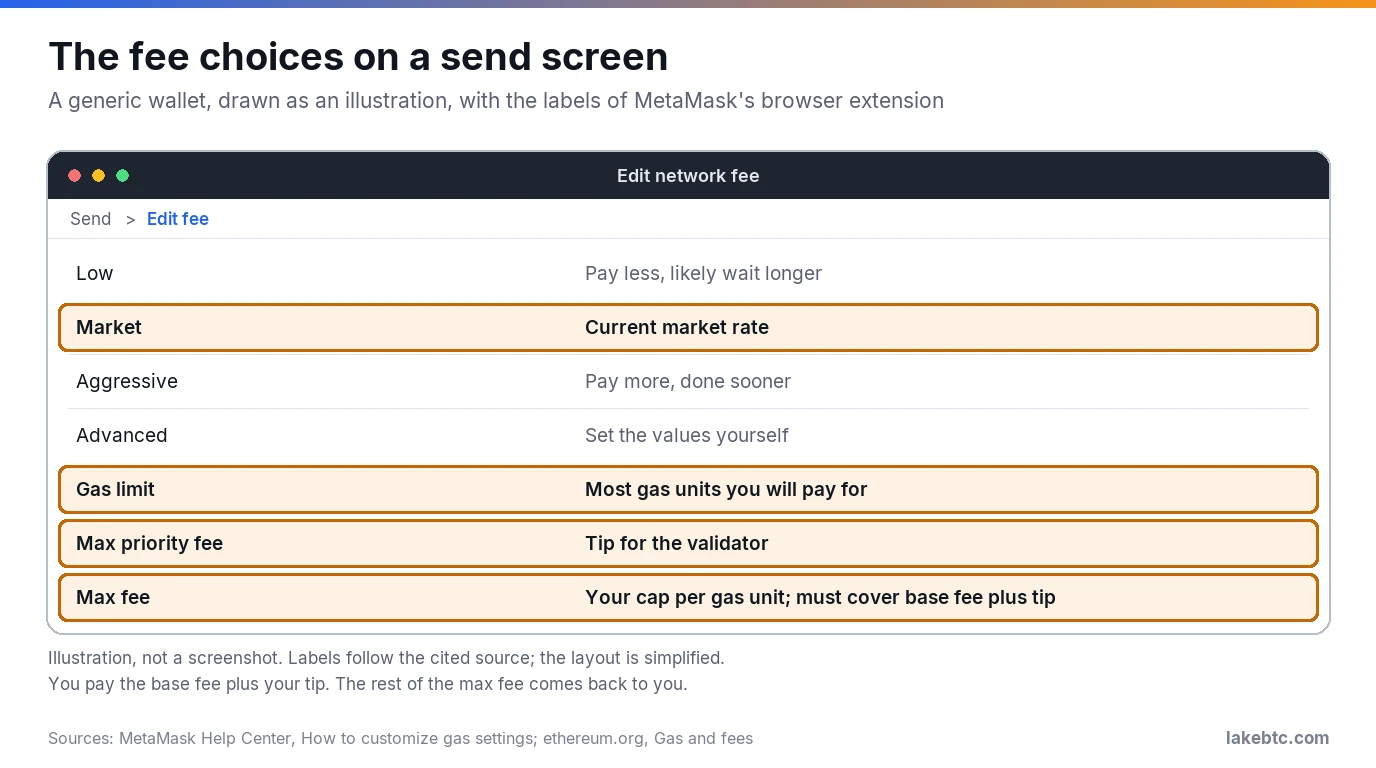
- Choose a lower fee option. In MetaMask’s browser extension, Low costs less but will likely take longer, Market follows current rates, and Aggressive pays more to go faster. The mobile app offers Low, Market and Advanced.
- Use a layer 2 network. Layer 2 networks such as Base, Arbitrum and OP Mainnet run on top of Ethereum with lower fees. You pay gas there in ETH that’s on that network, so bridge or withdraw some ETH to it first. Only send there if the receiver supports that same network.
Picked Low and the send sits on pending? You don’t have to wait it out. In MetaMask, Speed up resubmits the same transaction with a higher fee. It reuses the same nonce, so you don’t pay gas twice, only the higher price.
Cancel costs gas too. MetaMask’s manual method is a new transaction with the same nonce, such as 0 ETH sent to your own address, and it has to pay more than the stuck one to get picked first: a priority fee at least 10% higher and a max fee at least 30% higher. Cancel works only while the transaction is still pending. Once it’s confirmed, it can’t be reversed.
Leave the gas limit alone unless you know why you’re changing it. Wallets such as MetaMask set it for the transaction you’re making, and a limit that’s too low just gets you a failed transaction that still costs gas. A high max fee isn’t a trap: if it’s above the base fee plus your tip, the difference comes back to you.
Frequently Asked Questions
Does MetaMask or my wallet keep the gas fee?
No. Gas goes to the Ethereum network: the base fee is burned and the tip goes to a validator. MetaMask states that it doesn’t charge or collect gas, which is also why it can’t refund it. One twist is a gas included send, where MetaMask pays the network for you in another token. That fee estimate includes a small MetaMask fee.
Why do I need ETH to send USDC?
Because the Ethereum network takes gas only in ETH, no matter which token you move. Without ETH in the same wallet, a USDC transfer on Ethereum won’t go through unless the wallet can cover the fee from a token. MetaMask’s gas included sends and Trust Wallet’s FlexGas both accept USDC for that, and MetaMask adds a small fee of its own.
Is a gas fee the same as a network fee?
Mostly, yes. Wallets often say network fee for the same thing. Gas is the Ethereum name; Bitcoin and Solana charge network fees too, but work them out differently.
Can I get gas back after sending to the wrong address?
No. The gas paid for processing the transaction, and the transfer itself can’t be reversed. When the amount matters, a small test send first is the cheapest insurance.
Why does a swap cost more gas than a send?
A swap runs smart contract code, and every step of that code uses gas. A plain ETH send uses 21,000 units, while Etherscan’s October 14, 2026 table listed 184,523 for a Uniswap V3 swap, close to nine times as much. Your first swap of a token in an app can also need a separate approval transaction.
What to do next
If you’re moving coins off an exchange, compare its withdrawal fee with what sending from your own wallet would cost. Our Coinbase review and Kraken review cover those accounts, and the guide to moving crypto from Coinbase to a cold wallet walks through a withdrawal.
Gas paid on a sale or a swap can matter for US taxes, since the IRS instructions for Form 1099-DA count transaction fees tied to a sale as costs that reduce your proceeds; see our Form 1099-DA guide.
Using a self-custody wallet for the first time? Read whether Coinbase Wallet is safe before you fund it, and keep a little ETH in it for gas.
Drafted with AI by the LakeBTC Editorial Team, then edited and fact-checked against the sources linked in the text. How we use AI · Report an error