Coinbase Staking Explained: Rewards, Risks, and US Rules

In this article
- What Is Coinbase Staking?
- How Coinbase Staking Works
- Step-by-Step: How to Stake Crypto on Coinbase
- Coinbase Staking Rewards: What to Expect
- Is Coinbase Staking Safe?
- US Regulatory Status of Coinbase Staking
- Coinbase Staking Taxes
- Coinbase Staking vs. Alternatives
- Common Pitfalls to Avoid When Staking on Coinbase
- Bull Case, Bear Case, and a Neutral Takeaway
- FAQ
What Is Coinbase Staking?
Coinbase staking lets users lock supported crypto assets so the underlying network can use that stake to validate transactions, in exchange for a share of the protocol’s staking rewards. Coinbase runs the validator infrastructure on the user’s behalf; the user delegates funds rather than running hardware directly.
Quick definition
In proof-of-stake networks, validators are chosen to propose and confirm blocks based partly on how much crypto is staked behind them. When Coinbase stakes a customer’s ETH, SOL, ADA, or another eligible asset, that customer’s balance contributes to a validator’s total stake and earns a proportional share of the rewards the network pays out, minus Coinbase’s commission.
Coinbase Staking vs. “Coinbase Earn”
“Coinbase Earn” is the broader umbrella Coinbase uses on its earn page for several distinct reward mechanisms: staking rewards on proof-of-stake assets, USDC rewards for holding stablecoin balances, and lending programs. Staking specifically refers to the validator-delegation mechanism described above; it is not the same product as USDC balance rewards, even though both appear under the same marketing umbrella.
Where Staking Lives in the Product Stack
Retail staking is offered directly through the Coinbase app and Coinbase.com. Separately, Coinbase Prime packages staking with custody, trading, and financing for institutional clients, and Coinbase’s developer platform offers a Dedicated ETH Staking product for larger, self-directed setups. These are related but structurally distinct programs with different minimums and fee schedules.
How Coinbase Staking Works
Delegated, Pooled Staking Mechanics
Rather than requiring each user to run their own validator node, a technically demanding and, for some networks, capital-intensive process, Coinbase operates validator infrastructure and pools customer balances into it. Users retain an accounting claim to their staked balance and accrued rewards but do not hold the private keys used to run the validator itself, which is the core custodial trade-off of exchange-based staking.
Auto-Stake vs. Manual Staking
Coinbase offers an auto-stake toggle for some assets, which automatically stakes newly purchased or deposited eligible crypto, alongside a manual option where users choose which balances to stake and when.
Which Assets Are Eligible
Coinbase’s published fee schedule lists ADA, ATOM, AVAX, DOT, ETH, MATIC, SOL, and XTZ among assets subject to its standard staking commission, indicating these are core supported staking assets on the platform. Not every asset Coinbase lists pays a reward at any given time; reward availability and rates depend on each network’s own inflation schedule and validator participation, and can be zero for some assets during periods of low network issuance.
Coinbase’s Commission Structure
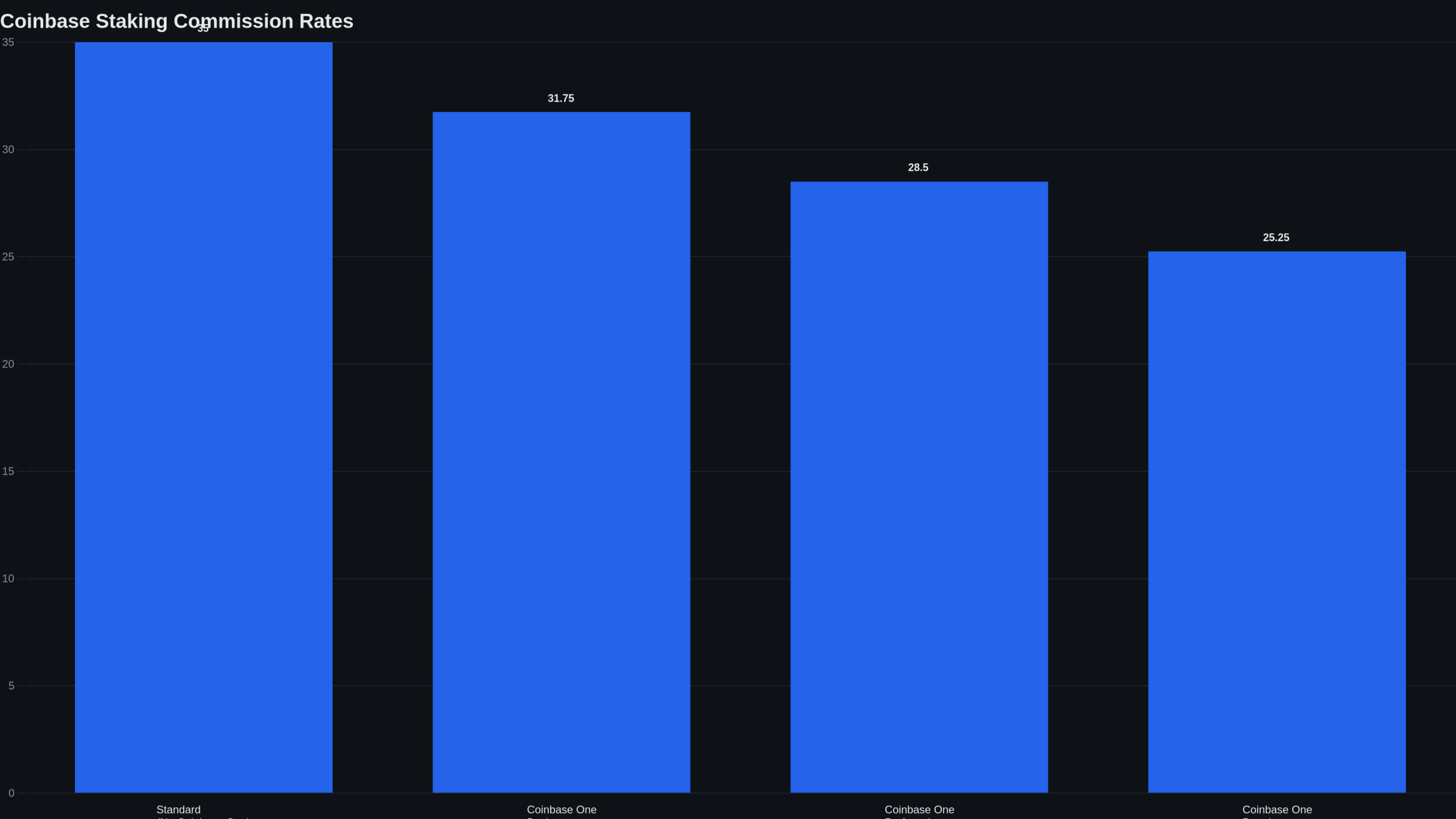
Coinbase does not pass through the full protocol reward rate. It deducts a commission before crediting rewards to the user’s account. According to Coinbase’s own fee documentation, the standard commission on ADA, ATOM, AVAX, DOT, ETH, MATIC, SOL, and XTZ is 35% of staking rewards. Coinbase One subscribers receive reduced rates on ADA, ATOM, DOT, ETH, SOL, and XTZ: 31.75% for Basic, 28.5% for Preferred, and 25.25% for Premium tiers.
| Commission Tier | Applies To | Commission on Rewards |
|---|---|---|
| Standard (no Coinbase One) | ADA, ATOM, AVAX, DOT, ETH, MATIC, SOL, XTZ | 35% |
| Coinbase One – Basic | ADA, ATOM, DOT, ETH, SOL, XTZ | 31.75% |
| Coinbase One – Preferred | ADA, ATOM, DOT, ETH, SOL, XTZ | 28.5% |
| Coinbase One – Premium | ADA, ATOM, DOT, ETH, SOL, XTZ | 25.25% |
Fee figures verified as of 2026-08-04.
Separately, Coinbase’s developer documentation for its institutional Dedicated ETH Staking product, designed for operators staking at least 32 ETH through the Coinbase Developer Platform, cites a standard commission distinct from the consumer schedule above. Retail users staking ETH through the Coinbase app fall under the consumer fee table, not the institutional developer terms, since the two programs are structured and priced separately.
Step-by-Step: How to Stake Crypto on Coinbase
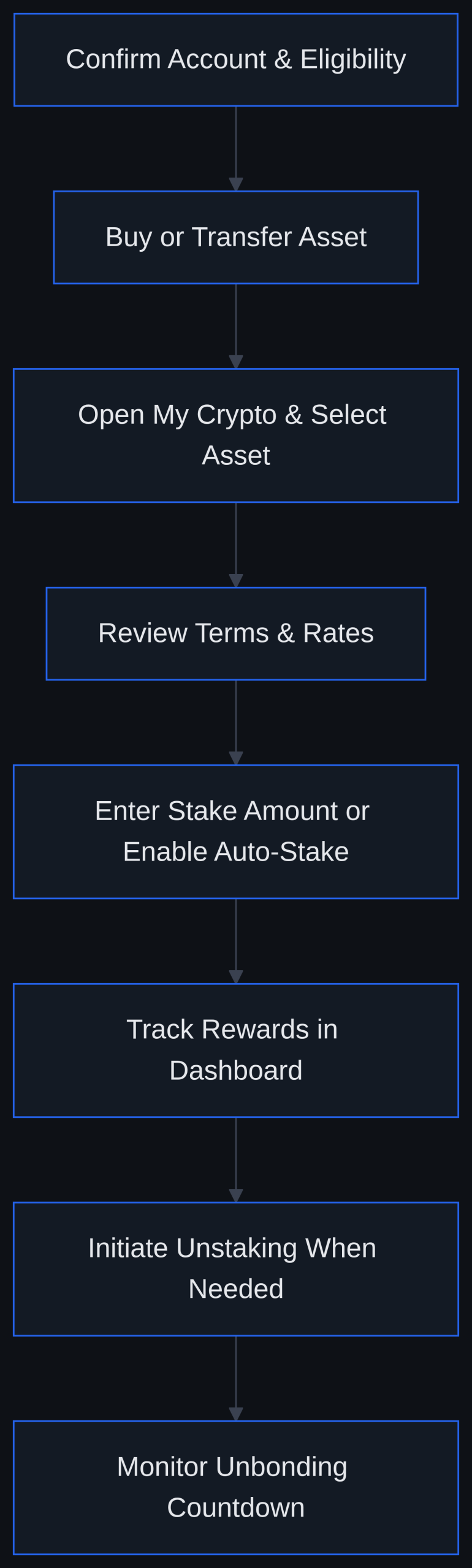
- Confirm your Coinbase account is in good standing and that the asset you want to stake is currently eligible in your state of residence.
- Buy the eligible asset directly on Coinbase or transfer it in from an external wallet or another exchange.
- Open “My Crypto,” select the asset, and navigate to its Staking tab.
- Review the terms shown on that screen, including the current reward rate, Coinbase’s commission, and any lock-up or unbonding period before you confirm.
- Enter the amount to stake, respecting any minimum for that asset, or enable Auto-stake so future purchases are staked automatically.
- Track accrued rewards in the Staking dashboard, which typically updates as rewards are distributed.
- When you need liquidity, initiate unstaking and monitor the unbonding countdown shown in the app before funds become available to trade or withdraw.
How to Unstake
Standard unstaking follows each network’s native unbonding schedule. Per Coinbase Prime’s own documentation, Solana withdrawals typically take two to four days, while other assets’ bonding and unbonding periods can range from a few days to a few weeks depending on the protocol’s own rules, a timeline retail users should expect to broadly mirror, even though Prime and consumer-app timelines are not guaranteed to be identical. Coinbase has also been reported to offer a paid immediate/instant unstaking option for certain assets, carrying an additional fee reportedly around 1%, per third-party reporting, on top of the standard unbonding path.
Coinbase Staking Rewards: What to Expect
How the Net Rate Is Calculated
The rate a user actually earns is the network’s protocol reward rate minus Coinbase’s commission. Because protocol reward rates move with network inflation schedules, validator participation, and total amount staked network-wide, the net rate a Coinbase user sees can shift week to week; Coinbase publishes current rates on its own per-asset earn pages rather than fixing them.
Typical Reward Ranges and Why They Vary
Because reward rates are asset-specific and shift with each network’s own inflation schedule, validator participation, and total amount staked network-wide, no single fixed number captures them accurately across assets or over time. As a directional data point, a report from crypto-news outlet MEXC stated that Coinbase customers earned more than $450 million in staking rewards during 2024, with some assets reportedly offering yields as high as 15% APY and a roughly 1% fee applied to immediate unstaking, figures that come from third-party reporting rather than Coinbase’s own investor disclosures and should be treated as illustrative rather than current.
Staking vs. USDC Rewards vs. Lending
Within the Coinbase Earn umbrella, staking rewards come from a proof-of-stake network’s own issuance schedule and carry protocol-level risk (discussed below). USDC rewards are a separate program tied to holding a stablecoin balance rather than delegating to a validator, and lending programs involve a different risk profile tied to counterparty and collateral terms. Comparing net rates across all three requires checking each program’s current terms individually, since they are not fungible products despite sharing a marketing page.
Is Coinbase Staking Safe?
Custodial Risk
Coinbase, not the user, holds the keys that control the staked position and the validator infrastructure. This is the central trade-off of any exchange-based staking service: convenience and lower technical barriers in exchange for depending on the platform’s operational integrity and solvency.
Slashing and Protocol Risk
Most proof-of-stake networks can penalize (“slash”) a validator’s stake for downtime or malicious behavior. Coinbase’s marketing materials describe its validator operations as designed to minimize this risk, but that claim comes from the company’s own disclosures rather than an independent third-party audit, so it should be read as a company statement rather than a guarantee.
Liquidity and Lock-Up Risk
Because unstaking is not instant on most networks, market prices can move meaningfully during the unbonding window described earlier. A user who needs to sell during a market decline may not be able to access staked funds immediately unless they use a paid instant-unstake option where available.
Platform Risk
Coinbase Global, Inc. trades on the Nasdaq Global Select Market under the ticker COIN, having gone public via direct listing on April 14, 2021, and remains a Nasdaq-listed public company as of its SEC filings, a level of public reporting and regulatory visibility that smaller or unlisted platforms do not carry.
Can You Lose Your Crypto by Staking It?
Staking itself does not typically cause outright loss of principal the way a hack or fraud would; the more realistic risks are a slashing penalty on the rewards side, price movement while funds are locked in unbonding, and the broader platform risk of relying on any custodian. None of these are equivalent to a guaranteed loss, but none of them should be dismissed either.
Pros: low technical barrier, no need to run validator hardware, integrated with an existing Coinbase account, reduced commissions available through Coinbase One.
Cons: commission reduces net yield by roughly a third at the standard rate, custodial exposure, unbonding delays limit liquidity, availability varies by state.
US Regulatory Status of Coinbase Staking
SEC’s Staking-as-a-Service Precedent: Kraken
In February 2023, the SEC settled charges against Kraken (Payward Ventures, Inc. and Payward Trading Ltd.) alleging that its crypto-asset staking-as-a-service program constituted an unregistered offer and sale of securities. Kraken agreed to immediately cease offering or selling securities through the program and to pay $30 million in disgorgement, prejudgment interest, and civil penalties, according to the SEC’s official press release. The SEC separately alleged that Kraken’s staking program held U.S. investor assets worth over $2.7 billion and had advertised annual yields of as much as 21%, per the SEC’s press release. Readers can find more on Kraken’s broader compliance record in LakeBTC’s Kraken review.
How Coinbase’s Position Differs
Coinbase has separately litigated its position with the SEC on multiple fronts. On February 27, 2025, the SEC filed a joint stipulation to dismiss its civil enforcement action against Coinbase, Inc. and Coinbase Global, Inc. In a related regulatory development, the SEC’s Division of Corporation Finance issued a statement dated May 29, 2025, expressing the staff’s view that certain protocol staking activities on proof-of-stake networks do not, by themselves, involve the offer and sale of securities, a staff view rather than binding rulemaking, but one that shifted the regulatory backdrop for exchange-based staking programs generally.
State-by-State Availability
Regulatory status also varies by state. In July 2023, Coinbase paused or limited retail staking for customers in California, New Jersey, South Carolina, and Wisconsin after those states’ regulators required changes to the program while proceedings were pending, according to Coinbase’s own blog post at the time. Coinbase later said it received New York regulatory approval to offer staking to New York residents, and stated in a company blog post that this expanded retail staking access to a reported 46 states after related state actions in Vermont, Illinois, Kentucky, Alabama, and South Carolina were dismissed. A subsequent report from Cryptonews indicated that residents of California, New Jersey, Maryland, and Wisconsin had, at that point, collectively missed out on more than $130 million in potential staking rewards due to continued state-level restrictions. Given how frequently this list has moved, readers should treat any specific state count as a snapshot rather than a permanent status.
Coinbase Staking Taxes
IRS Treatment of Staking Rewards
In the US, staking rewards are generally treated as ordinary income based on their fair market value at the time they are received or made available to the taxpayer. This income obligation typically applies regardless of whether the rewards are later sold, held, or restaked, though tax treatment of digital assets continues to evolve and can vary by individual circumstances.
Coinbase’s Tax Reporting
Coinbase provides transaction history exports and, depending on account activity and thresholds, may issue relevant tax forms through its tax center. Because staking rewards and later sales are taxed differently, ordinary income on receipt, capital gain or loss on eventual disposal, users should not assume a single form covers both events.
Cost Basis on Later Sales
When staking rewards are eventually sold, the cost basis is typically the fair market value at the time the reward was received and taxed as income, with any price movement between receipt and sale treated as a separate capital gain or loss. Because individual situations can differ, it’s worth confirming this treatment with a tax professional before filing.
Record-Keeping Tips
Export full transaction history periodically, note the fair market value at the date each reward was credited, and keep staking records separate from simple buy/sell records, since the two are taxed under different rules. This article is not tax advice; a licensed tax professional can confirm how these rules apply to a specific situation.
Coinbase Staking vs. Alternatives
Coinbase vs. Self-Custody Staking
Running a personal validator or staking through a self-custodied wallet gives full control of private keys but requires more technical setup, in some cases higher minimum stake amounts, and personal responsibility for validator uptime, a meaningfully different risk-and-effort trade-off than delegating to an exchange.
Coinbase vs. Other US Exchange Staking Programs
Other US-based exchanges also offer staking, and the Kraken settlement above illustrates that staking-as-a-service programs generally have drawn regulatory scrutiny, not just any single platform. Readers comparing options may find LakeBTC’s Coinbase vs. Kraken comparison and best crypto exchanges guide useful starting points, alongside checking each platform’s current terms directly.
Liquid Staking and DeFi Alternatives
Protocols such as Lido or Rocket Pool offer liquid staking tokens that can be used elsewhere in DeFi while the underlying asset remains staked. This can improve capital efficiency but introduces additional smart-contract risk that a centralized exchange’s staking product does not carry in the same form.
Common Pitfalls to Avoid When Staking on Coinbase
- Ignoring the unbonding window and getting caught needing liquidity before funds are available.
- Staking right before anticipated volatility or a planned sale, without accounting for the lock-up delay.
- Not confirming state eligibility before attempting to stake, given how often the restricted-state list has changed.
- Forgetting that staking rewards are taxable as ordinary income the moment they are credited, not when later sold.
- Concentrating most holdings into a single staked asset rather than spreading exposure.
- Misunderstanding Auto-stake terms or the cost of any paid instant-unstake option before relying on it.
Bull Case, Bear Case, and a Neutral Takeaway
Bull Case
Staking through Coinbase removes the technical burden of running validator infrastructure, supports small minimums, and integrates directly with an account many US users already hold, which lowers the barrier to earning passive rewards on idle crypto.
Bear Case
Coinbase’s standard commission takes 35% of gross rewards, a substantial cut that meaningfully narrows net yield; separately, custodial and regulatory risk remain real considerations given the Kraken precedent, and reward rates fluctuate with network conditions rather than staying fixed.
Neutral Takeaway
Coinbase staking may suit passive holders who are comfortable with custodial risk and who understand that displayed rates are not fixed. It is not a substitute for understanding the underlying protocol’s own risk profile or for planning around the tax treatment of staking rewards. Anyone new to acquiring the underlying assets first may want to review LakeBTC’s how to buy crypto guide before staking.
FAQ
Is Coinbase staking worth it?
It depends on the asset, the commission tier that applies, and whether the user is comfortable with custodial and lock-up risk. Coinbase’s standard commission takes 35% of gross rewards, which meaningfully narrows the net yield compared with the full protocol rate.
How much can you earn staking on Coinbase?
Earnings depend on the specific asset’s live protocol reward rate minus Coinbase’s commission, and these figures change over time. Coinbase’s earn pages show per-asset rates that shift with each network’s own inflation schedule, validator participation, and total stake, rather than following a single fixed number.
Is there a downside to staking crypto?
Yes. Downsides include reduced net yield from exchange commissions, unbonding delays that limit liquidity, potential slashing penalties at the protocol level, and dependence on the custodian’s operational and regulatory standing.
Can I lose my crypto if I stake it?
Staking itself is not designed to cause loss of principal the way theft or fraud would, but realistic risks include slashing penalties on rewards, price moves during unbonding, and broader platform risk tied to relying on any custodian.
Is Coinbase staking available in my state?
Availability has changed over time; Coinbase paused retail staking in California, New Jersey, South Carolina, and Wisconsin in July 2023, later restored it in New York, and reported broader multi-state availability afterward, though the exact current list of any remaining restricted states can still shift as state regulatory actions evolve.
How are Coinbase staking rewards taxed?
Staking rewards are generally treated as ordinary income based on their fair market value when received, and any later sale of those rewards is taxed separately as a capital gain or loss based on the price change since receipt. This is general information, not tax advice.