How to Buy Cardano (ADA) in the US: Apps, Wallets and Staking
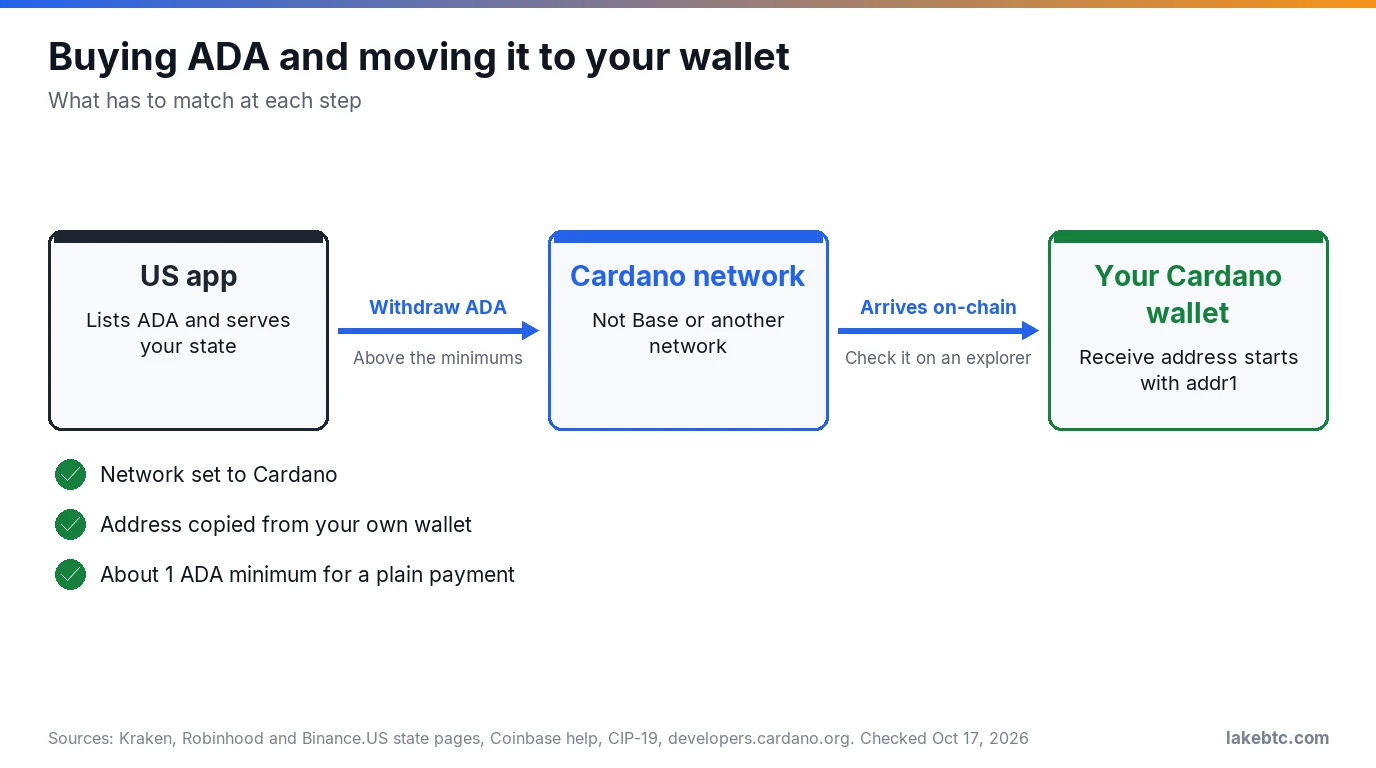
Buy ADA on a US app that lists it and serves your state. To hold it yourself, withdraw on the Cardano network to an address starting
addr1.
Coinbase, Kraken and Robinhood all sell ADA, Cardano’s coin, to US customers, and the purchase itself is the easy part. The trouble comes before and after it: an app that won’t take customers from your state, a hold on your first withdrawal, or ADA sent on the wrong network.
So work in this order. Check that the app serves your state first, which matters most in New York. Before you fund the account, check how long the app holds your coins after each payment method. Then decide whether your ADA stays on the app or moves to a Cardano wallet you control, where you can stake it without locking it up.
Before you buy ADA
- 🟡 In New York, Kraken won’t open an account for you. Binance.US’s state list says no too, and its fee page describes a BitGo app account instead. Robinhood lists ADA as tradable there.
- 🔴 Withdraw on the Cardano network only. A current Cardano address starts with addr1, never 0x.
- 🟡 Plan for holds and minimums: Kraken holds withdrawals for 7 days after a bank deposit through Plaid, and a plain ADA payment needs about 1 ADA.
- 🟢 Staking from your own wallet doesn’t lock your ADA. A new wallet pays a refundable 2 ADA deposit, and first rewards come about 15 to 20 days later if your pool makes blocks.
In this article
- Where you can buy ADA in the US
- How to buy ADA, step by step
- Should your ADA stay on the app?
- What a Cardano address looks like
- How to move ADA to your wallet without losing it
- Staking ADA after you buy
- The scam that copies this process
- Taxes when you buy and hold ADA
- Frequently Asked Questions
- What to do next
Where you can buy ADA in the US
Coinbase, Kraken, Robinhood and Binance.US all list ADA. What differs is who they’ll accept as a customer and what else you can do with it there. Here’s what each platform’s own pages showed on October 17, 2026.
| Platform | ADA listed? | Who can’t sign up | Good to know |
|---|---|---|---|
| Coinbase | Yes | No state limits on its Cardano page | No new ADA staking in California, Maryland, New Jersey or Wisconsin |
| Kraken | Yes, from $10 | New York and Maine | On-chain staking only in the states on Kraken’s list |
| Robinhood | Yes, New York included | Nobody: every state, plus DC, Puerto Rico and the US Virgin Islands | Accepts both current and older Cardano address formats |
| Binance.US | Yes | 12 states and 4 territories on its state list, including New York and Texas | Crypto only in Kansas and Wisconsin, with no dollar deposits |
| Any other app | Check its asset list | Check its state list before you fund it | Make sure it lets you withdraw ADA on the Cardano network |
New York shrinks the list. Kraken doesn’t serve New York residents. Binance.US’s state list rules New York out too, but its fee page says New Yorkers who sign up in the Binance.US app get an account held by BitGo, outside Binance.US, so check that ADA is offered there before you fund it.
Robinhood flags the coins New Yorkers can’t trade, and on its crypto availability list ADA carries no such mark. Coinbase’s Cardano page doesn’t say either way, so look for ADA on the app’s buy screen before you deposit money.
Washington state is the opposite case: Binance.US won’t register you there, but Kraken will, since it names only New York and Maine as states it doesn’t serve.
How to buy ADA, step by step
- Pick an app from the table that serves your state. Do this before you hand over your ID and bank details.
- Open an account and finish the identity check. On Kraken it usually takes a few minutes. Turn on two-factor sign-in while you’re in the settings.
- Add money. Kraken, for example, takes bank wires and ACH transfers, and from US clients only debit cards, not credit cards. Kraken’s fees depend on the trade amount and the payment type, so read the total on the preview screen.
- Enter a dollar amount and preview the ADA you’ll get. A market buy fills at the current price. A limit order waits until ADA reaches the price you set.
- Check the price, amount and fees, then confirm. On Kraken the ADA shows up in your account right away.
- Decide where your ADA lives. A small first buy can sit on the app. To stake it yourself or hold the keys, move it to a Cardano wallet, as the next sections show.
If you plan to move the ADA soon, check how you paid. On Kraken, you can trade a bank deposit made through Plaid at once, but cash or crypto equal to the deposit can’t be withdrawn for 7 days. Card purchases trigger a 72-hour hold, while a FedWire deposit carries none. On Robinhood, crypto transfers turn on only after Robinhood verifies it’s you, which is usually quick but can take up to 5 business days.
Starting small is fine. Kraken lets you begin with $10, and you’ll learn the screens before real money is involved.
Should your ADA stay on the app?
While ADA sits on an exchange, the exchange holds it for you until you send it to a wallet you control. That’s convenient for a first buy. It also means the app’s rules decide when you can withdraw and whether you can stake.
A Cardano wallet hands you the keys instead. Cardano’s wallet finder lists browser-and-phone wallets such as Lace and Eternl, the phone-only VESPR, and Daedalus, a desktop wallet that checks the whole chain itself.
For larger amounts, a hardware wallet keeps the keys on the device. On a Trezor, Cardano works on the Safe 3, Safe 5, Safe 7 and Model T, but not on the Model One. Ledger devices run a Cardano app, and Ledger’s own guide shows ADA staked from Ledger Live on a desktop, with the transaction confirmed on the device.
A wallet built for other chains won’t do. Coinbase Wallet (formerly the Base app) lists Ethereum-style networks, Solana and Bitcoin, but not Cardano. And the 0x address MetaMask shows for an Ethereum account, like any Ethereum-style address, is never a Cardano address.
Whichever wallet you choose, its recovery words go in one place only. On a hardware wallet that takes the words on its own screen, such as a Ledger or a Trezor Safe, that’s the device itself. On a phone or browser wallet, it’s the restore screen of that wallet’s official app, installed from the maker’s own site or app-store link.
If you pair a Ledger or Trezor with a wallet app such as Lace, connect the device and never type its words into the app. Our guide to what a seed phrase is and how to store it covers the backup.
What a Cardano address looks like
Cardano addresses don’t look like Bitcoin or Ethereum ones. Cardano’s address spec encodes them in Bech32 or Base58 rather than the hex format with 0x that Ethereum uses. The first few characters tell you what you’re looking at.
| Starts with | What it is | Send ADA there? |
|---|---|---|
addr1 |
A current mainnet address, the most common kind | Yes |
Ae2 or DdzFF |
An older Byron-era address from an early wallet | It can receive ADA, but it can’t earn staking rewards |
stake1 |
Your stake address, which handles delegation and rewards | No: use your addr1 address for payments |
addr_test |
A testnet address | No: it isn’t for real ADA |
0x |
An Ethereum-style address, such as one holding cbADA on Base | No: it isn’t on Cardano |
| Anything else | An old Byron address, or an address on another blockchain | Not until your own Cardano wallet shows that exact address |
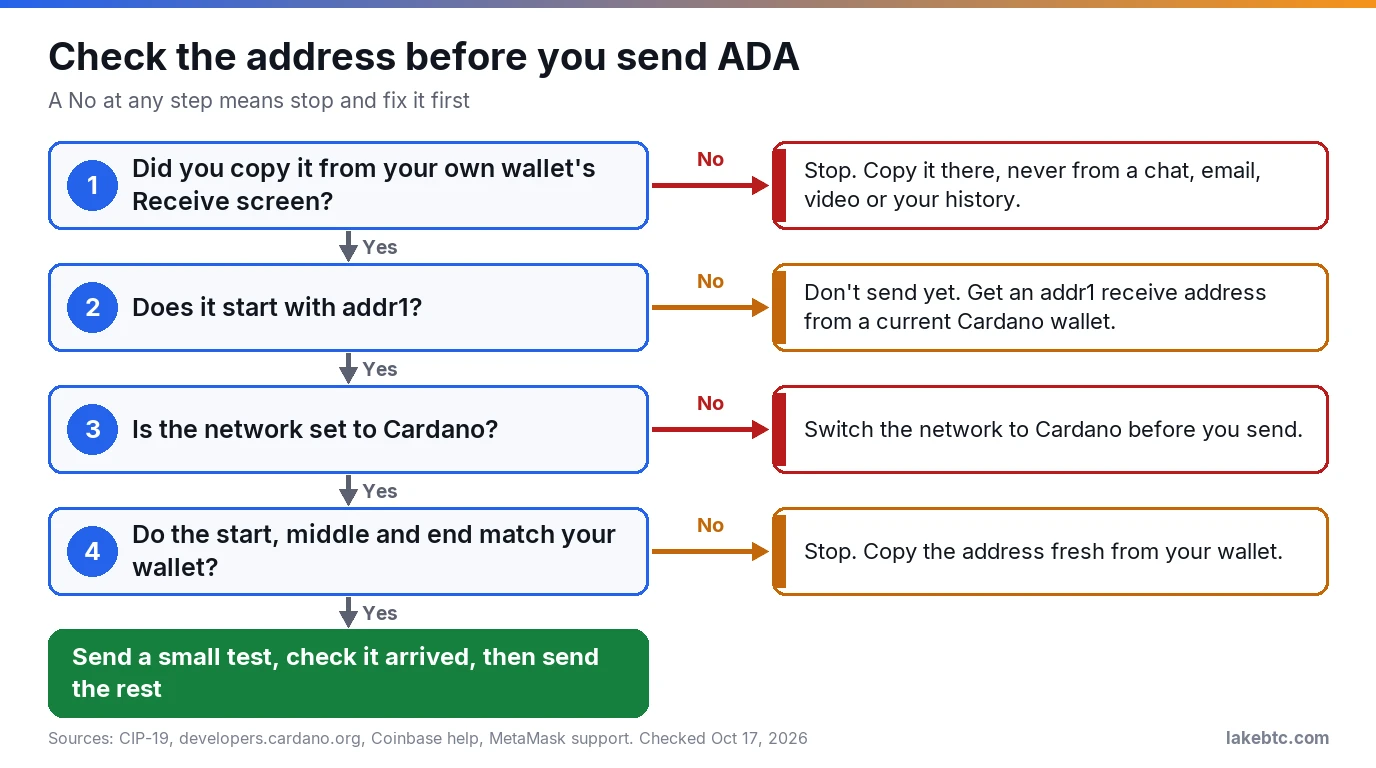
Bech32’s built-in error detection helps here. A mistyped addr1 address usually fails the check instead of sending. It can’t catch a valid address that belongs to someone else, though.
Scammers can plant a look-alike address in your history with a tiny transfer, a trick MetaMask’s guide calls address poisoning. The fake is built to match the start and end, which is why the steps below have you copy the address fresh and check its middle too.
How to move ADA to your wallet without losing it
- Copy your address from your own wallet. Open the wallet’s Receive screen and copy the
addr1address. Never take an address from a chat, an email, a video or your transaction history. - Start the send on the app. In the Coinbase app, that’s the Pay tab: pick ADA, enter an amount, then paste the address.
- Pick the Cardano network. If the app offers more than one network, choose Cardano. Coinbase can’t retrieve funds sent on the wrong network, so treat this choice as final.
- Send more than the minimums. Every Cardano output has to carry a minimum amount of ADA, about 1 ADA for a plain ADA payment. Your app may set a higher withdrawal minimum on top.
- Check the address, then send a test. Compare characters at the start, in the middle and at the end with your wallet. When the amount matters, send a small test first and wait for it to arrive.
- Confirm it arrived. If your wallet still shows nothing, paste your address into a block explorer such as Cardanoscan. Wallets can lag behind the chain.
In a 2021 Cardano Forum thread, for example, a user’s ADA from Coinbase already showed up on Cardanoscan while the wallet app was stuck with a synchronization error.
The network fee itself is small. Cardano doesn’t auction block space: the fee follows a published formula based on the transaction’s size, and a typical simple transfer costs about 0.17 to 0.20 ADA. At $0.2232 per ADA (CoinGecko, October 17, 2026), that’s about 4 cents. What your app deducts can differ: Kraken charges its own withdrawal fee, while Robinhood charges no transfer fee of its own and shows the network fee estimate before you confirm.
The wrong-network trap
Some ADA look-alikes live on other blockchains. Coinbase issues cbADA, a wrapped ADA token on Base, backed 1:1 by ADA that Coinbase holds. On BaseScan it’s an ERC-20 token with a 0x contract address, not ADA on Cardano, and your addr1 address can’t receive it.
Forum threads show the same mistake on other networks. In one from 2021, a user withdrew ADA over BEP20 to an Ethereum-format Ledger address and found a Binance Peg Cardano Token there instead. A later poster who did the same thing still couldn’t work out how to recover the ADA.
Staking ADA after you buy
On Cardano, staking means delegating your ADA to a stake pool. The ADA stays in your wallet and stays spendable. There’s no lock-up, no slashing and no minimum amount.
The first delegation from a new wallet registers your stake address. That takes a refundable deposit of 2 ADA, about 45 cents at $0.2232, which comes back in full if you deregister later. The delegation itself is one transaction with a small fee.
The pool takes its share too: its operator deducts a fixed cost and a margin from the pool’s rewards before sharing the rest, so compare both on a pool explorer such as Cardanoscan before you pick one.
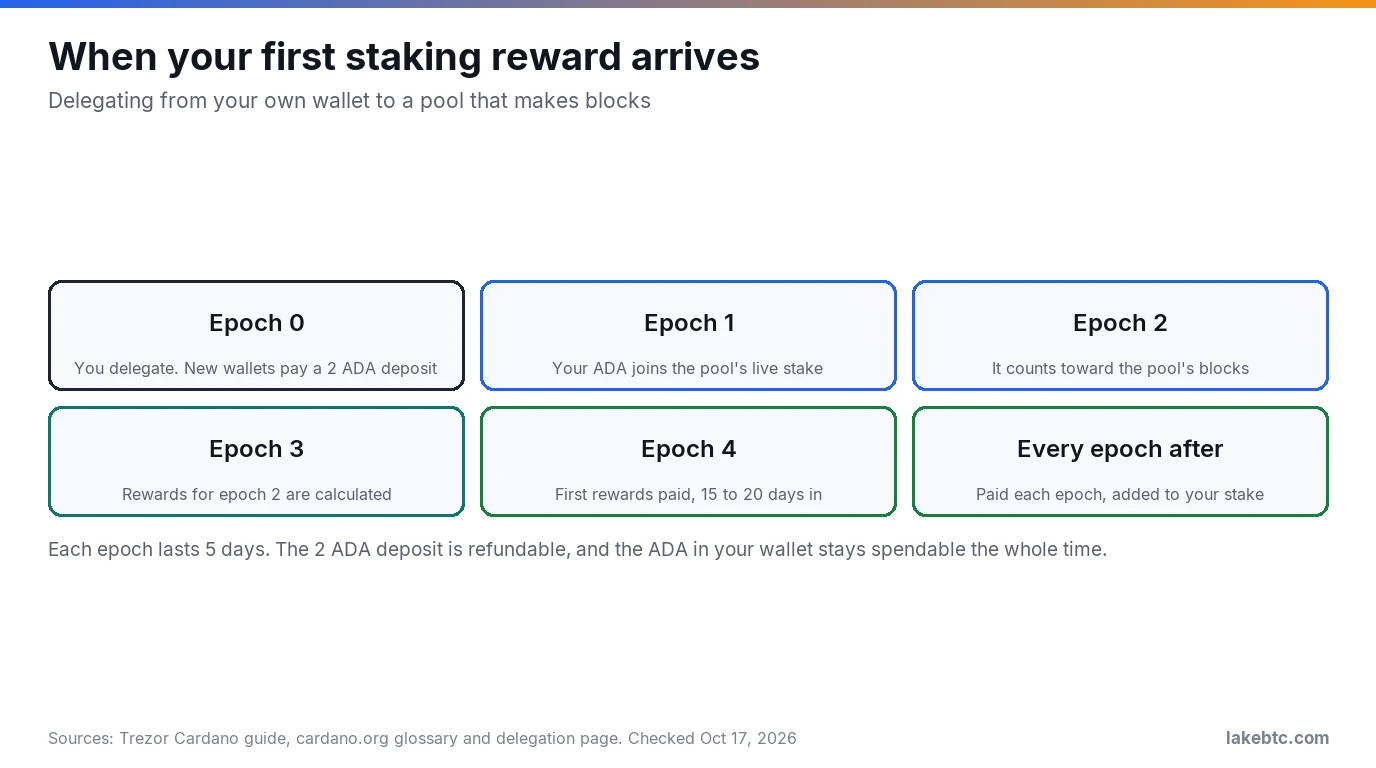
Rewards take a while to start. Your delegation becomes active in the epoch after next, each epoch lasts five days, and first rewards arrive about 15 to 20 days after you delegate, as long as your pool makes blocks. From then on they’re paid every epoch and add to your stake automatically.
One newer rule catches long-time holders. Since the Plomin hard fork on January 29, 2025, a stake address can’t withdraw rewards until it has a voting preference: a DRep, Abstain or No confidence. The rewards keep building either way, and setting a preference in your wallet unblocks them.
An old Byron address can’t earn staking rewards, so move that ADA to a current addr1 address first.
Staking on an app works differently, because the app’s terms apply. Coinbase won’t let you trade or send staked ADA until unstaking finishes, which it estimates at about 2 days, and its standard commission is 35% of the rewards. Robinhood won’t let you sell staked crypto, says bonding or unbonding can take weeks, and deducts 25% of your rewards.
State rules apply on top. Neither Coinbase nor Robinhood takes new stakes in California, Maryland, New Jersey or Wisconsin. Kraken offers on-chain staking only in the states on its list, which leaves out 11 of the states it serves: Alabama, California, Illinois, Kentucky, Maryland, New Jersey, South Carolina, Texas, Vermont, Washington and Wisconsin.
The scam that copies this process
The FBI’s 2025 Internet Crime Report puts crypto investment fraud at $7.2 billion in reported losses, the highest source of financial losses to Americans that year. It often starts with a text, a social media message or a dating app. Then you’re guided into buying crypto and sending it to a platform that shows fake profits and charges taxes and fees when you try to withdraw.
Another version is a giveaway. Someone posing as a well-known name promises to multiply any ADA you send. The FTC’s answer is short: free money promises are always fake, and only scammers guarantee profits or big returns.
So send ADA only to an address you copied from your own wallet’s Receive screen, and never share your recovery words: anyone who has them can restore your wallet and empty it.
Taxes when you buy and hold ADA
For federal taxes, crypto is property, not currency. Under the IRS’s digital asset guidance (updated September 2, 2026), if you only bought ADA with dollars and held it, you can answer No to the digital asset question on your return.
Moving ADA between your own wallets is also a No, unless you paid the transfer fee with crypto. A send from your own Cardano wallet pays its fee in ADA, so it counts. By our reading, so does an app withdrawal whose fee comes out of your ADA.
Selling or swapping ADA goes on Form 8949. Staking rewards are income in the year you gain control over them, under Rev. Rul. 2023-14. They go on Schedule 1 and make your answer to the digital asset question a Yes. For 2026 sales, brokers report gross proceeds on Form 1099-DA, plus your cost basis on certain sales. A tax professional can confirm this for your situation.
Frequently Asked Questions
Can I buy Cardano in New York?
Yes, but you have fewer choices than in most states. Robinhood is the app in our table whose own list shows ADA as tradable for New Yorkers. Kraken doesn’t accept New York residents. Binance.US’s state list says no too, so the only route there is the BitGo app account its fee page describes: check that it offers ADA before you fund it.
Where do I buy ADA if I already own other crypto?
You can convert it inside an app: Kraken lets you swap Cardano for other assets, and Binance.US lets you convert into ADA. Cardano’s own decentralized exchanges, such as Minswap, need ADA to start with, so they aren’t a way in for a first purchase.
Can I buy ADA with a credit card?
Not on Coinbase or Kraken. Coinbase says credit cards can’t be used to buy Cardano, and Kraken takes only debit cards from US clients. Binance.US lists debit or credit card funding at 3.99%. Card issuers can add their own charges on top, such as a cash advance fee.
How long does it take for ADA to arrive?
Robinhood credits an ADA deposit after 30 confirmations, about 10 minutes, but says the whole process can take up to a few hours under ordinary conditions. Robinhood also reviews each transfer for security, which can add time.
Do I need a Cardano wallet to buy ADA?
No. The app keeps it for you after the purchase. You only need your own wallet to hold the keys yourself, stake outside the app, or use Cardano apps directly.
What to do next
If an app in the table serves your state, start with a small buy and get used to its screens. Our beginner’s guide to buying crypto covers account security, and the crypto exchange fees breakdown shows where the simple buy button costs more than the advanced screen.
Planning to hold the keys? Set up the wallet first, back up its words, and do one small withdrawal before the real one. Coming from Coinbase, the walkthrough on moving crypto from Coinbase to a cold wallet shows the same send flow with a hardware device. Buying SOL as well? Our guide on how to buy Solana covers where to buy SOL in the US and which wallets hold it.
Drafted with AI by the LakeBTC Editorial Team, then edited and fact-checked against the sources linked in the text. How we use AI · Report an error
Update history 1
- Rewritten and re-checked against primary sources.