USDC vs USDT: What Backs Each Coin and Which Network to Use
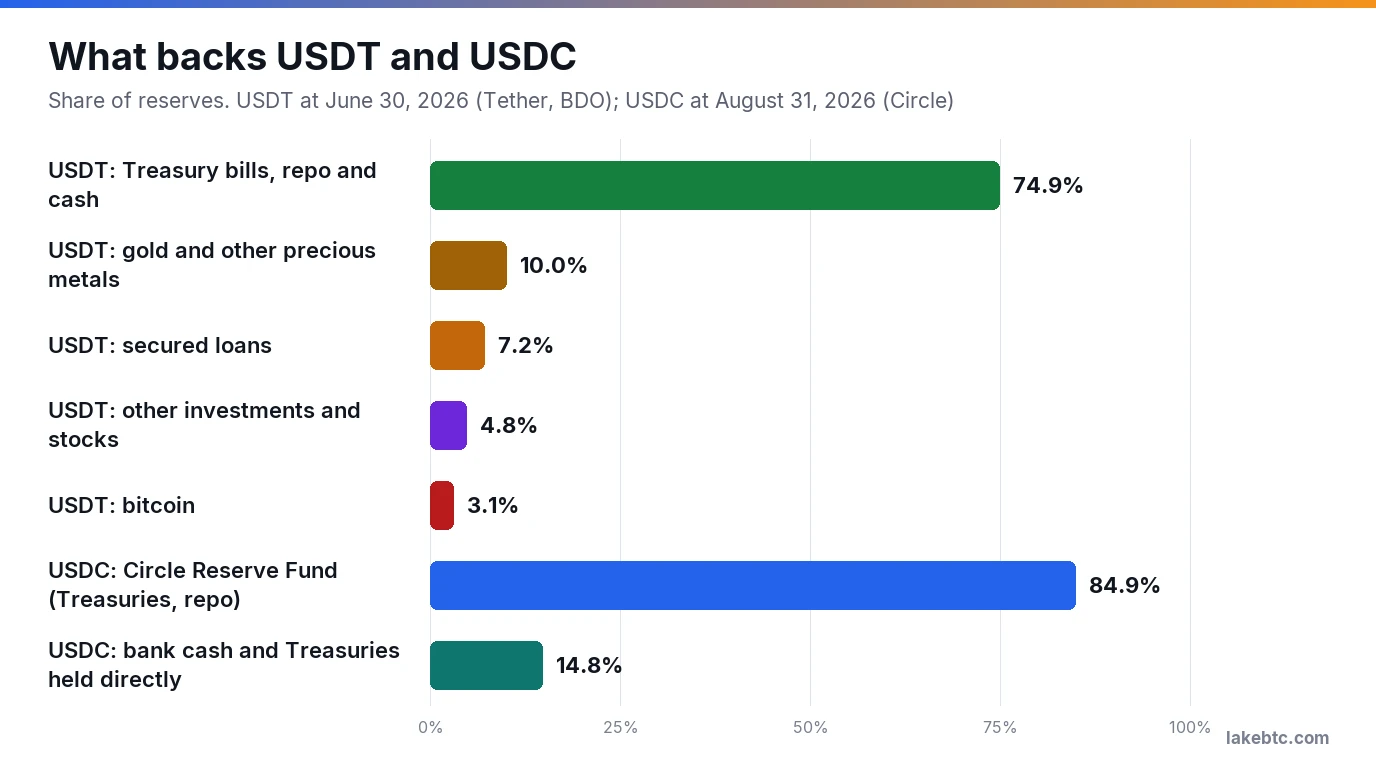
Both are dollar stablecoins meant to stay at $1. USDC is backed by cash and short-term Treasuries; USDT adds gold, loans and bitcoin. The network you send on matters most.
USDT and USDC look the same on a buy screen: a dollar is a dollar. Underneath, two different companies issue them, hold different reserves and run them on partly different networks.
For a US holder, three differences change what you do: what backs each coin, which networks each one lives on, and how US rules treat each issuer from January 2027.
Before you pick one or send either
- 🟢 Both aim to stay at $1. USDC reserves are cash and short-term Treasuries; USDT reserves are mostly Treasury bills and repo, plus gold, loans and bitcoin.
- 🟡 USDT and USDC are different tokens. Sending one to an address that only accepts the other can mean the deposit never shows up.
- 🟡 The network has to match on both screens. About half of all USDT is on Tron, where Circle no longer issues USDC.
- 🔴 Swapping USDT for USDC counts as disposing of one coin for US tax, even at $1 for $1.
In this article
USDT vs USDC at a glance
| USDT (Tether) | USDC (Circle) | |
|---|---|---|
| Issuer | Tether International, S.A. de C.V. | Circle Internet Financial, LLC, part of Circle Internet Group (NYSE: CRCL) |
| In circulation | About $183 billion (October 20, 2026) | About $72.4 billion (October 21, 2026) |
| What backs it | 74.9% Treasury bills, repo and cash; the rest gold, loans, bitcoin and other investments (June 30, 2026) | The Circle Reserve Fund plus cash at regulated banks (August 31, 2026) |
| Outside checks | Quarterly BDO assurance report; KPMG audit of the 2025 financial statements | Monthly examination report from a Big Four firm; holdings disclosed weekly |
| Biggest networks | Tron and Ethereum | Ethereum, then Solana |
| Redeeming for dollars | Directly with Tether: verified accounts, $100,000 minimum, fee of $1,000 or 0.1%, whichever is greater | On Coinbase, $1 for 1 USDC; a 0.10% fee only on net conversions to dollars above $5 million in 30 days |
| Freezes | Tether reported about $4.2 billion frozen as linked to illicit activity (March 2026) | Circle can block addresses; 129.9 million USDC were restricted on August 31, 2026 |
| US status | Working toward GENIUS Act compliance, per Tether (January 2026); its separate US token is USAT | Regulated as stored value under state money transmission laws |
Circulation changes every day, so treat those two figures as a snapshot. The reserve figures are as of the date shown next to each one.
What backs each coin
Both issuers say their coin is fully backed. What they hold to back it differs.
At June 30, 2026, Tether’s reserves report listed $187.75 billion in assets against $183.64 billion in liabilities. About $115 billion of that was US Treasury bills. Another $18.84 billion was precious metals, $13.45 billion secured loans and $5.80 billion bitcoin. Gold and bitcoin can move in price, and a loan is only worth something if it’s repaid. On that date, Tether’s assets exceeded its liabilities by $4.11 billion.
USDC is simpler. Circle’s August 2026 reserve report showed $73.40 billion in reserves for $73.32 billion of USDC on August 31. Most sat in the Circle Reserve Fund, a government money market fund holding Treasuries and Treasury repurchase agreements. The rest was cash at regulated financial institutions and a small slice of Treasuries held directly.
The checks differ too. Tether’s quarterly report is an assurance report on one point in time. In August 2026, Tether also announced that KPMG issued an unqualified audit opinion on its 2025 financial statements, its first full audit. Circle gets a monthly examination of its reserves.
Neither coin has a perfect record. In March 2023, $3.3 billion of USDC reserves, about 8% of the total, sat at Silicon Valley Bank when it failed. USDC lost its dollar peg that weekend. The peg came back once regulators said all depositors would be made whole.
Neither coin is a bank deposit, whichever you pick. The FDIC says its insurance doesn’t apply to crypto assets and doesn’t protect you if an exchange, custodian or wallet provider fails. A stablecoin balance is only as safe as the issuer’s reserves and the platform holding it.
The network matters more than the coin
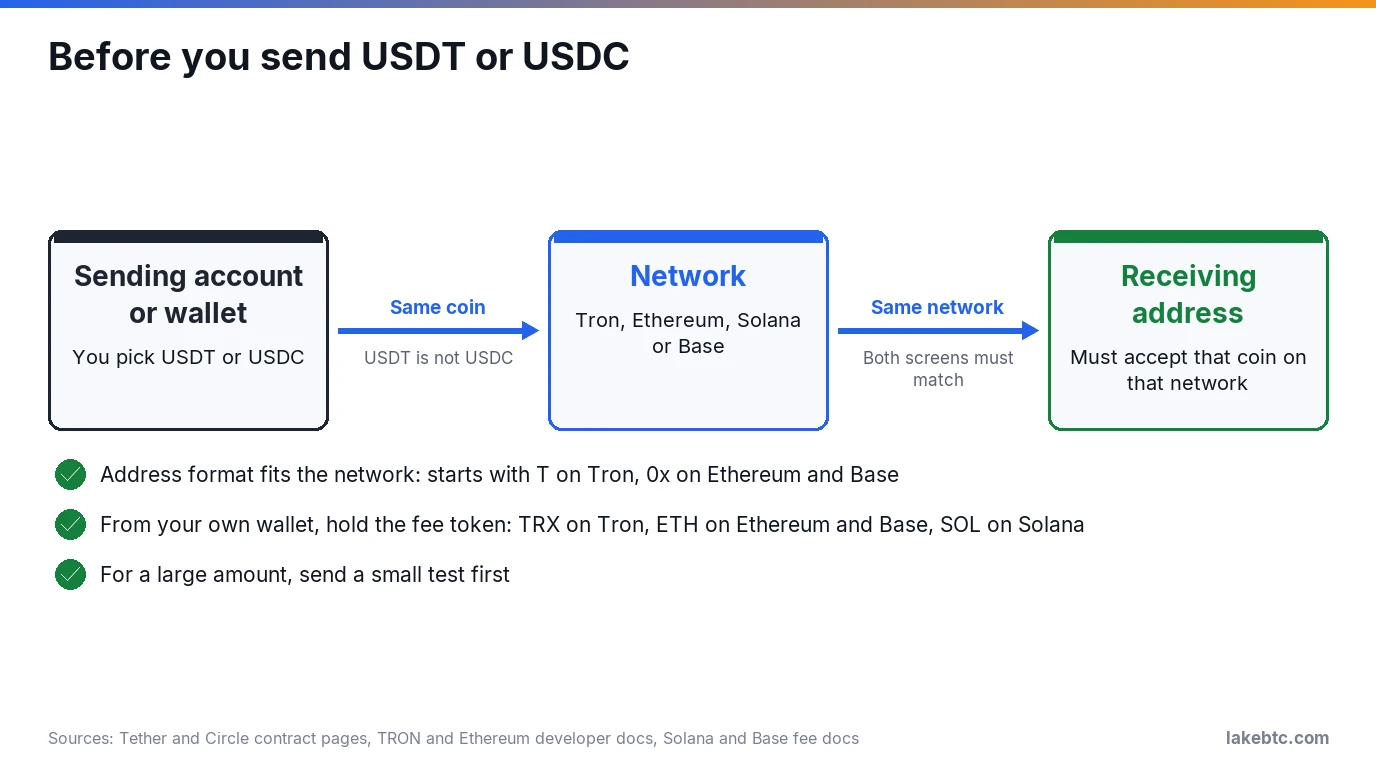
Each coin exists as a separate token on each network. USDT on Tron and USDT on Ethereum are both real USDT, but a Tron address can’t receive the Ethereum version. So when someone asks for “USDT,” the network is half the instruction.
| Network | USDT | USDC | Address looks like | Fee from your own wallet |
|---|---|---|---|---|
| Tron | Yes, about half of all USDT | Redemptions only, no new USDC | 34 characters starting with T |
TRX, or energy from staked TRX |
| Ethereum | Yes, most of the rest | Yes, about two-thirds of all USDC | 0x plus 40 characters |
ETH |
| Solana | Yes | Yes | Solana’s own address format | SOL |
| Base | Not on Tether’s list | Yes | 0x, same format as Ethereum |
ETH |
| Every other network | Check Tether’s supported list; it no longer issues on Omni, EOS, Algorand, Kusama or Bitcoin Cash SLP | Check Circle’s list, and watch for bridged versions such as USDC.e that Circle doesn’t issue or back | Varies | That network’s own coin |
The 0x networks are where mistakes hide. Ethereum, Base and other EVM networks use the same address format, so a wrong pick still looks right. If it went to a regular account in your own wallet, the tokens usually aren’t lost: in MetaMask, the same recovery phrase gives the same address on every EVM network. Smart contract addresses are the catch: MetaMask says there’s no guarantee of recovery there.
An exchange deposit address is different too. On Coinbase, unsupported crypto sent to your account isn’t received and the funds are lost, though some assets can be recovered.
Receiving into your own wallet? Anyone can create a token called USDT or USDC. Scam tokens can copy the name and symbol, but not the contract address. Before you treat a payment as received, match the token’s contract with the issuer’s own list: Tether’s for USDT and Circle’s for USDC.
Fees catch people too. A USDT transfer on Tron uses energy, and energy has no free quota, so your wallet needs TRX or staked TRX. On Ethereum you need ETH, unless your wallet can pay gas from a token. Our guide to gas fees covers how that works.
Before you press Send, go in this order:
- Find out which coin and which network the receiver accepts. On an exchange, it’s shown next to the deposit address.
- Pick the same coin and the same network on your send screen.
- Check the address fits the network:
Ton Tron,0xon Ethereum and Base. Copy it fresh from the receiver’s deposit screen, never from your transaction history, and check the middle characters as well as the start and end. Address poisoning scams plant look-alike addresses in your history that match only the ends. - Sending from your own wallet? Make sure it holds the fee token for that network.
- For a large amount, send a small test and wait until it shows up.
- Then send the rest. Crypto transfers can’t be reversed once they’re sent.
Switching between USDT and USDC
You can’t send USDT and have it arrive as USDC. You trade one for the other: on an exchange, or by selling one for dollars and buying the other.
The cost depends on where you do it. On Coinbase, you can convert $1 for 1 USDC with no fee, under its terms, in either direction. A 0.10% processing fee applies only when the USDC you turn into dollars tops the dollars you turn into USDC by more than $5 million in a rolling 30 days. Trading USDT for USDC is different: it’s a crypto-to-crypto convert, where Coinbase charges a fee and builds a spread into the rate, so check the preview before you confirm.
USDT withdrawals from Coinbase carry a 0.01% processing fee, capped at 20 USDT, plus the network fee. Other exchanges set their own trading fees and spreads; our Coinbase vs Gemini comparison lists the networks Gemini accepts USDC on.
Redeeming USDT straight with Tether is built for large holders. Its fee page sets a $100,000 minimum, a $150 verification fee and a redemption fee of $1,000 or 0.1%, whichever is greater. Below that, the practical route is selling on an exchange.
Don’t forget tax. For stablecoins held as capital assets, trading one for another means a capital gain or loss under the IRS digital asset FAQs. At an even swap there may be little or no gain, but the trade still goes on your return. Small stablecoin sales may not appear on your form, as our Form 1099-DA guide explains.
What US rules change, and when
The GENIUS Act became law on July 18, 2025. It requires permitted issuers to hold reserves at least 1 to 1 in cash, bank deposits, Treasury bills with 93 days or less to maturity and similar assets. They also have to publish their reserve composition every month.
The law takes effect on January 18, 2027, the date the OCC gave on October 21, 2026, when it issued its final rule. Three years after enactment, on July 18, 2028, US platforms may no longer offer or sell a payment stablecoin to people in the US unless a permitted issuer issued it. The Act has exceptions, including for foreign issuers that meet its conditions.
The two issuers are taking different routes. Circle’s USDC is already regulated as stored value under state money transmission laws, and in July 2026 Circle got final OCC approval for a national trust bank. Tether launched a separate US token, USAT, in January 2026, issued by Anchorage Digital Bank. When it launched USAT, Tether said USDT would keep operating globally while it worked toward GENIUS Act compliance.
USAT isn’t USDT. If a platform offers both, they’re separate tokens with separate issuers, and you’d swap between them like any other pair.
Can your coins be frozen?
Yes, either issuer can. Under its USDC terms, Circle can block addresses it links to illegal activity and freeze the USDC in those it custodies. Its August 2026 report counted 129.9 million USDC restricted to comply with a law, regulation or legal order.
Tether freezes too: by its own count in March 2026, around $4.2 billion in assets linked to illicit activity. In February 2026 it helped US authorities recover $61 million in USDT tied to a pig butchering fraud, after a victim reported it.
For an ordinary holder, freezes cut both ways. Under Circle’s terms, USDC you receive from a blocked address can be frozen. But freezes are also how stolen stablecoins can sometimes be stopped. If you’re scammed, report it fast and include the receiving address.
Frequently Asked Questions
Is 1 USDC equal to 1 USDT?
Both are designed to hold the same dollar value, each backed by its own issuer’s reserves. They aren’t the same token, though. Swapping one for the other goes through a trade, and each issuer redeems only its own coin.
Can I transfer USDT to USDC?
Not by sending it. You convert: sell USDT for USDC on an exchange that lists the pair, or sell it for dollars and buy USDC. Either way it’s a trade, with any fee or spread that platform charges.
Is USDT a stablecoin?
Yes. Tether says each USDT is pegged 1-to-1 to the US dollar and backed by its reserves, and it publishes a quarterly reserves report and circulation data that’s typically updated daily.
Which is the safest stablecoin?
No single answer fits everyone, so check four things: what the reserves hold, how often an outside firm checks them, whether you can redeem at $1, and whether the coin works on your network. On reserves alone, USDC holds cash and short-term Treasuries, while USDT also holds gold, loans and bitcoin.
Can I redeem USDT directly with Tether?
Only with a verified Tether account and at least $100,000. Below that, people sell USDT on an exchange instead.
Will I owe tax if I swap USDT for USDC?
You report it, since it’s a disposal of one digital asset for another. With both close to a dollar, the gain or loss is often small. Your exchange’s records give you the dates and amounts.
What to do next
If you’re about to receive stablecoins, ask the sender for the coin and the network in writing, then read your own deposit screen to confirm it accepts both. If you’re about to send, run the six checks above.
If you hold a large balance on one exchange, it’s worth knowing what that platform publishes about its own reserves. Our Kraken vs Binance.US comparison covers Kraken’s proof of reserves, which includes USDC and USDT.
Drafted with AI by the LakeBTC Editorial Team, then edited and fact-checked against the sources linked in the text. How we use AI · Report an error