
AI XRP Price Prediction: What the Models Actually Say
XRP price predictions for 2026 and beyond vary widely depending on the methodology used, but most independent model outputs and analyst forecasts reviewed in mid-2025 cluster in the $2–$4 range by end-2026, according to aggregated data from sources such as Changelly and reporting by Yahoo Finance. These figures are probabilistic estimates, not guarantees, and carry substantial uncertainty given crypto market volatility, evolving regulation, and shifting macro conditions.
Understanding XRP and the Ripple Ecosystem
XRP is the native digital asset of the XRP Ledger (XRPL), an open-source blockchain maintained by a distributed network of validators. Ripple Labs, the company closely associated with XRP’s development, uses the asset as a bridge currency in its On-Demand Liquidity (ODL) cross-border payment product. This institutional payment utility is one of the primary factors that distinguishes XRP’s demand drivers from those of general-purpose smart-contract platforms.
Key on-chain and market characteristics of XRP, as documented by the XRP Ledger Foundation, include:
- Maximum supply: 100 billion XRP minted at genesis; Ripple Labs holds a portion in escrow, releasing a capped amount monthly.
- Transaction settlement: The XRPL targets 3–5 second finality under normal network conditions, according to its public documentation.
- Consensus mechanism: The Federated Byzantine Agreement (FBA) model, no proof-of-work mining, keeps energy usage comparatively low.
- Regulatory history: The SEC filed suit against Ripple Labs in December 2020; a partial ruling in July 2023 found programmatic XRP sales did not constitute securities offerings, though institutional sales faced different treatment. The case concluded in 2025: after a court-ordered $125 million civil penalty, both Ripple and the SEC dropped their appeals in August 2025, making the ruling final and ending the litigation.
What Drives XRP’s Price: Key Variables
Any price projection framework for XRP should account for the following demand and supply variables, which analysts broadly cite in their modeling:
| Driver | Potential Bullish Effect | Potential Bearish Effect |
|---|---|---|
| Regulatory clarity (US & global) | Expanded institutional adoption, ETF approval pathways | Adverse rulings could restrict trading or custody |
| ODL / RippleNet volume growth | Higher utility demand for XRP as bridge asset | Stablecoin competition may reduce bridge-asset need |
| Bitcoin market cycle | Historically altcoins have rallied in BTC bull phases | BTC drawdowns tend to compress the broader market |
| Escrow releases by Ripple Labs | Predictable, capped schedule limits supply shocks | Ongoing circulating supply growth applies sell pressure |
| XRPL DeFi / NFT adoption | Expands on-chain use cases, fee burn potential | Nascent ecosystem; developer traction unproven at scale |
| Macro interest-rate environment | Rate cuts historically correlate with risk-asset inflows | Tightening cycles historically reduce speculative capital |
XRP Price Prediction 2026: What Models Currently Show
A June 2025 Yahoo Finance report queried four large-language-model AI systems, including ChatGPT and Claude, for XRP price projections through end-2026. The outputs clustered between approximately $2 and $4, with the report characterizing the consensus as suggesting “moderate upside rather than an explosive rally.”
Similarly, Changelly’s aggregated forecast model projected an estimated average XRP price in the vicinity of $3.93 for the relevant period, with a modeled low near $3.85 and a modeled high near $4.05. These figures represent the output of quantitative trend models, not guarantees, and Changelly explicitly notes forecasting limitations in its methodology disclosure.
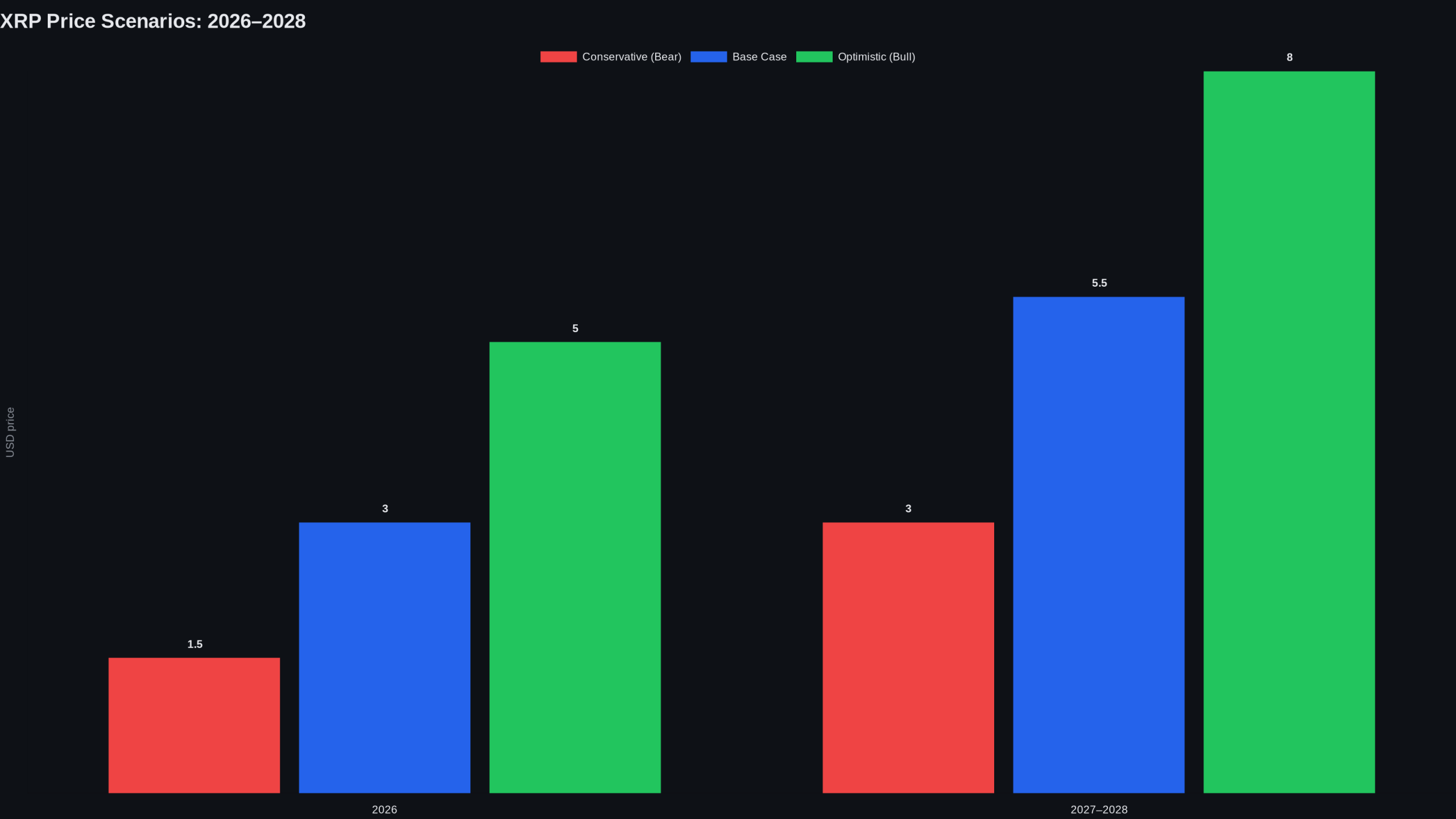
Taken together, the current forecast space for 2026 can be summarized as:
- Conservative scenario: XRP consolidates in the $1.50–$2.50 range if regulatory headwinds persist or broader crypto sentiment weakens.
- Base-case scenario: Multiple models suggest a $2–$4 trading range assuming moderate institutional adoption and a neutral macro backdrop.
- Optimistic scenario: Some outlier models cited by analysts project figures above $5; since this article was originally drafted, a spot XRP ETF (Canary Capital XRPC) was approved in the US and began trading in November 2025. ODL volume growth remains the key scaling variable, and these projections carry higher uncertainty.
No model output should be treated as investment advice. Cryptocurrency forecasting has a historically poor track record across timeframes beyond 90 days.

XRP Price Prediction 2027–2028
Extending the forecast window to 2027–2028 introduces substantially wider confidence intervals. Several factors that may influence prices in this window include:
- Bitcoin halving cycle effects: The April 2024 Bitcoin halving historically precedes a 12–18 month altcoin expansion phase, though past cycles are not reliably predictive of future ones.
- Global CBDC development: Central bank digital currency pilots may either compete with or integrate with XRP-based settlement rails, depending on design choices.
- Ripple’s market development fund activity: Ripple Labs periodically deploys XRP for ecosystem grants and partnerships; the scale of this activity affects circulating supply dynamics.
- Competitive pressure: Stellar (XLM), Solana (SOL), and stablecoin-based settlement networks remain active competitors in the cross-border payments space.
Quantitative model ranges for 2027–2028 from aggregators such as Changelly and CoinCodex suggest potential trading ranges spanning from under approximately $3 to above approximately $8 depending on scenario inputs, though these long-range figures carry low statistical confidence and should be contextualized as scenario planning tools, not price targets.
XRP Price Prediction 2030 and Beyond
Decade-scale forecasts for any cryptocurrency asset are highly speculative. Structural factors that analysts cite as potential long-term tailwinds for XRP include:
- Global cross-border payment volumes, which the Bank for International Settlements estimates at trillions of dollars annually, a market where XRP-based ODL is positioned as an alternative to correspondent banking.
- Institutional tokenization of assets on the XRPL, a sector receiving attention from major financial institutions as of 2024–2025.
- Potential integration by central banks or regulated financial institutions if XRP achieves ISO 20022 alignment, a messaging standard the XRPL has pursued.
Counterbalancing these factors, some analysts argue that XRP’s centralized supply distribution (with Ripple Labs holding significant reserves) and ongoing legal uncertainty in jurisdictions outside the US represent structural overhangs on price appreciation relative to more decentralized assets.
For investors evaluating XRP as part of a broader digital-asset allocation, comparing fees and custody options across platforms is a practical starting point. Our guide to the best crypto exchanges covers platform security, liquidity, and supported pairs for US-based buyers, and our XRP investment analysis weighs the fundamental bull and bear cases in more depth.
Methodology: How Price Predictions Are Generated
Understanding forecast methodology helps contextualize the wide variance between different published projections:
- Technical analysis models: Use historical price action, moving averages, Fibonacci retracement levels, and momentum indicators. These are backward-looking by nature and perform poorly as standalone long-range tools.
- On-chain analysis: Platforms such as Glassnode and Messari track network metrics (active addresses, exchange inflows, token velocity) that may signal near-term supply/demand shifts.
- AI language model outputs: As noted in the Yahoo Finance reporting, querying LLMs produces outputs synthesized from training data, these are probabilistic pattern-matching results, not independent economic models with proprietary datasets.
- Fundamental valuation: Some analysts attempt to value XRP based on projected ODL transaction volumes and the float required to settle a given payment corridor, a utility-value approach that is inherently assumption-sensitive.
No single methodology dominates. Professional risk managers typically use scenario ranges rather than point forecasts when evaluating digital assets.
XRP Fees and Buying Considerations
For US-based participants, trading costs can meaningfully affect net returns over time. XRP is listed on the majority of major regulated exchanges operating in the US, including Coinbase, Kraken, and Gemini, among others. Typical spot trading fees on these platforms range from approximately 0.0% to 0.60% per trade depending on volume tier and fee structure, though exact rates vary and should be verified on each platform’s current fee schedule. Our crypto exchange fees guide provides a structured comparison of maker/taker rates across major platforms.
The XRPL itself requires a small XRP reserve (currently documented at 1 XRP for an activated wallet address, reduced from 10 XRP by a validator vote effective December 2024, per XRPL.org documentation) and charges a nominal transaction fee in drops of XRP, fractions of a single coin, making on-chain transfer costs effectively minimal for most use cases.
If you are new to acquiring digital assets, our how to buy crypto guide covers account setup, KYC requirements, and funding methods for US exchanges. For XRP-specific steps, see our how to buy XRP in the US guide.
Frequently Asked Questions
What is the most likely XRP price by end of 2026?
Based on aggregated model outputs reviewed in mid-2025, the most commonly cited range for end-2026 is approximately $2–$4, according to sources including Changelly and AI model outputs reported by Yahoo Finance. These are probabilistic estimates and not price guarantees. Actual prices may fall materially above or below this range depending on regulatory developments, macro conditions, and adoption rates.
Could XRP reach approximately $10 or higher?
Some outlier forecasts and scenario models do project XRP above approximately $10 under conditions such as widespread institutional adoption, a favorable US ETF approval, and sustained bull market conditions. However, most aggregated model outputs for the 2026 timeframe do not support approximately $10 as a base-case scenario. Long-range projections beyond three years carry very low statistical confidence.
How does the SEC lawsuit affect XRP’s price outlook?
The July 2023 partial ruling from US District Judge Analisa Torres found that programmatic XRP sales on secondary markets did not constitute unregistered securities offerings, a finding that contributed to XRP’s re-listing on several US exchanges. The case then concluded in 2025: a court-ordered civil penalty of $125 million was left in place, and in August 2025 both Ripple and the SEC dropped their appeals, closing the litigation. This resolution removed a significant legal overhang from XRP.
Is XRP a good investment?
LakeBTC does not provide investment advice. XRP carries significant risks including price volatility, regulatory uncertainty, and competitive pressure from other payment networks and stablecoins. Any allocation decision should be made in accordance with an individual’s own risk tolerance, investment horizon, and after consultation with a qualified financial adviser. For a broader fundamental analysis, see our dedicated XRP investment guide.
Where can I check real-time XRP price data?
Real-time price and market data for XRP is available on aggregators such as CoinMarketCap and CoinGecko, as well as directly on exchange platforms where XRP is listed. On-chain data is accessible via the XRPScan explorer.
What is the difference between XRP and Ripple?
XRP is the digital asset native to the XRP Ledger, which is an open-source, decentralized network. Ripple Labs is a private company that holds a significant portion of the XRP supply and builds payment products using the XRPL. The two are legally and technically distinct entities, a distinction that was central to the SEC litigation.


