Dogecoin Staking: Can You Stake DOGE, and Where Do Rewards Come From?
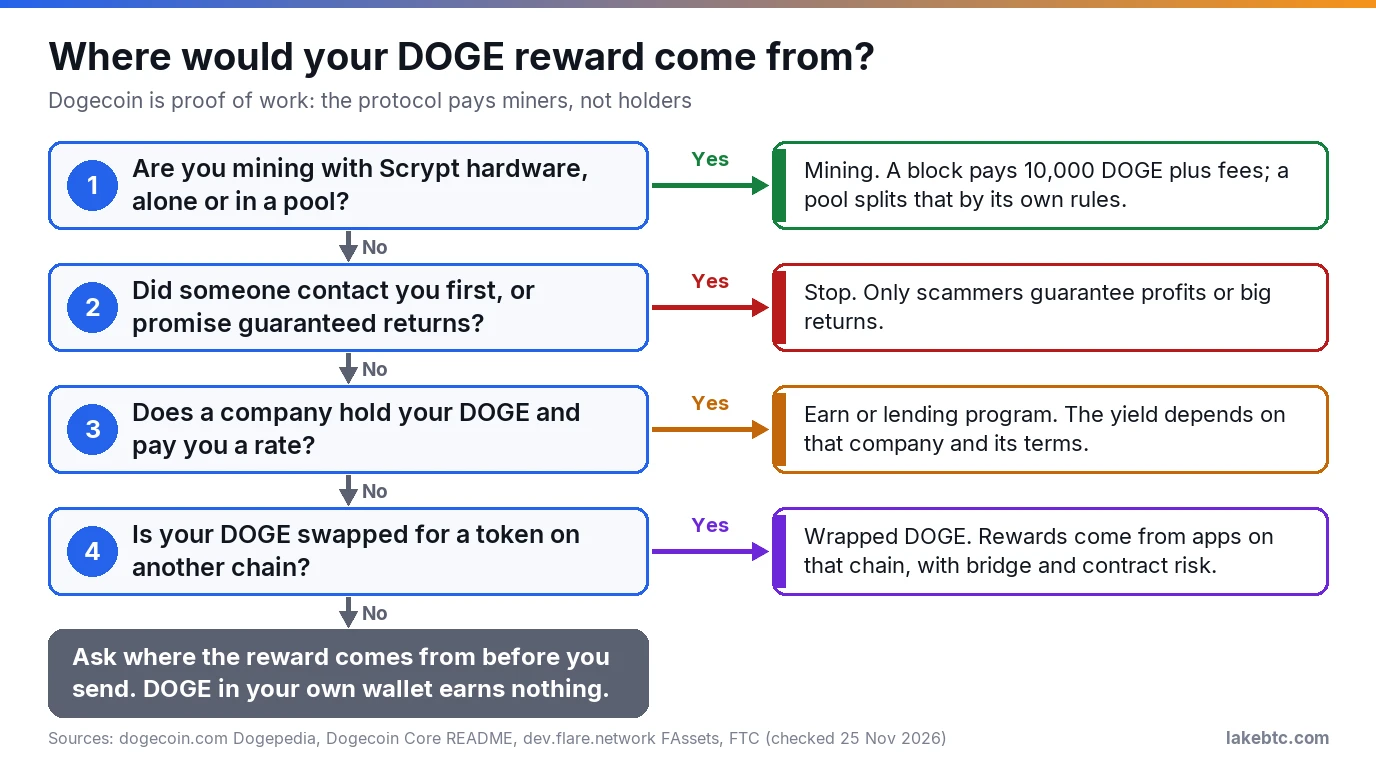
You can’t stake Dogecoin. It runs on proof of work, so new DOGE goes to miners. A DOGE staking rate usually means lending, a wrapped token or a scam.
You’ve found a page offering a rate for staking your DOGE, maybe with a calculator that shows your coins growing every day. Before you move anything, know this: Dogecoin has nothing in its protocol to stake.
Dogecoin pays its rewards to miners who run special hardware. Holding DOGE in a wallet earns you nothing from the network. So if someone pays you a rate on DOGE, the money comes from a company, from another blockchain, or from other victims of a scam. Each of those is a different deal with a different risk.
The flow chart above sorts any offer into one of those buckets. The sections below go through them in the same order.
Dogecoin staking in four points
- 🔴 Dogecoin is proof of work. There is no staking, and holding DOGE earns nothing from the network.
- 🟢 The protocol pays miners: 10,000 DOGE per block plus fees.
- 🟡 Earn programs and wrapped DOGE pay a rate, but someone else holds your coins.
- 🔴 A guaranteed daily DOGE staking rate is the scam pattern.
In this article
Why Dogecoin can’t be staked
Staking is how proof-of-stake chains choose validators: the protocol can weigh how many coins you lock up, and it pays rewards in extra coins. Dogecoin doesn’t work that way. The Dogecoin Core software uses the Scrypt hashing method for proof of work. It’s proof of work like Bitcoin, and it shares the Scrypt algorithm with Litecoin.
In proof of work, miners race to solve a cryptographic puzzle, and the winner creates the next block. Miners compete with hashing hardware, so your DOGE balance plays no part in that. Locking coins up wouldn’t help the network, and the network doesn’t pay for it.
Where Dogecoin staking rewards actually come from
Here’s what sits behind each kind of DOGE reward you’ll run into, and who holds your coins in each case.
| Route | Who holds your DOGE | Where the reward comes from | What can go wrong |
|---|---|---|---|
| Mining in a pool | You, once the pool pays out | Block rewards and transaction fees | Hardware and power cost more than you earn |
| Exchange or app earn program | The company | Whatever the company does with the coins, under its terms | The company fails, freezes withdrawals or changes its terms |
| Wrapped DOGE on another chain | A bridge, custodian or vault | The apps you use on that chain | Bridge, collateral and smart contract problems |
| Staking site with a guaranteed daily rate | The scammer | Nowhere | You lose what you send |
| Anything else | Ask before you send | Ask before you send | If nobody can name the source, treat it as a red flag |
Mining: the protocol’s own reward
The only reward Dogecoin itself pays goes to miners. A miner who finds a block gets 10,000 DOGE as a block reward, plus the fees from the transactions in it. A new block comes about every minute. By our arithmetic, that’s about 14.4 million new DOGE a day going to miners.
You can’t get a slice of that by holding DOGE. You’d need to mine. Dogecoin’s own guide says miners who do this profitably use Scrypt ASIC machines, join a mining pool, and need cheap electricity. Since 2014, Dogecoin has allowed merged mining with other Scrypt coins such as Litecoin, so the same work earns rewards on more than one network.
Mining is a business with real costs, not a passive return. If a cloud mining site promises a fixed daily DOGE payout, read the next section first.
The fake Dogecoin staking scam
You see a slick dashboard with a staking calculator and a fixed daily rate. Often someone finds you first: a stranger in a chat group, a reply under a post about DOGE, a new online friend with a tip. The FTC’s line is blunt: “Only scammers will guarantee profits or big returns.“
The balance on screen keeps climbing. When you try to withdraw, the site asks for a fee first. The FTC describes exactly that: you can’t withdraw at all, or only after paying high fees. Don’t pay it. Crypto investment fraud drew 61,559 complaints and $7.228 billion in reported losses in the FBI’s 2025 IC3 report.
Don’t type your wallet’s recovery words into any staking site. A rewards program has no reason to ask for them. If you already did, move your DOGE to a new wallet with a fresh seed phrase right away.
Exchange and app earn programs
The legitimate version of DOGE staking is usually an earn or lending program. You leave DOGE in a platform account, opt in, and the platform pays you a rate. Since Dogecoin has no staking, the platform has to earn that money some other way.
The Nexo case shows what that can look like. In January 2023, state regulators and the SEC announced a settlement with Nexo over its Earned Interest Product. Their release says investors earned interest by loaning digital assets to Nexo, and Nexo kept total discretion over how the returns were earned. That’s the deal in any program like it: you’re trusting the company’s choices with your coins.
Before you opt in, find these answers in the platform’s terms:
- Is the program open in your state?
- Does the platform lend your DOGE out, and what happens to it if the company goes bankrupt?
- How quickly can you withdraw, and are rewards paid in DOGE or in another token?
If the terms don’t say, assume the worst case and size your deposit to match.
Wrapped DOGE on other chains
Some yields come from turning DOGE into a token on another blockchain and using it in apps there. The model works like Flare’s FAssets system: you deposit the original coin, get a wrapped token you can use in DeFi apps, and can redeem it later for the underlying coin. The yield comes from those apps, not from Dogecoin.
Flare says its model is designed for DOGE as well, but as of November 2026, FXRP is the live FAsset, not a DOGE version. A wrapped token is only as good as the coins held behind it, so find out who holds them before you deposit.
Taxes on DOGE rewards and mining income
Earn-program rewards and mining payouts both show up on your federal return. On the IRS digital assets page, receiving digital assets as a reward, or from mining, staking and similar activities, is a reason to answer Yes on the digital assets question. If your mining or rewards aren’t a business, that income goes on Schedule 1. If your mining is a business you run as a sole proprietor, report it on Schedule C instead, and IRS Notice 2014-21 says the net earnings are self-employment income, subject to self-employment tax.
Write down the dollar value of each reward or pool payout on the day you receive it. The IRS asks you to keep records of the fair market value in U.S. dollars of digital assets you receive as income, and you’ll need that value again to work out your gain or loss when you sell.
Don’t wait for a form to tell you the total. Brokers don’t have to report wrapping transactions on Form 1099-DA for now, and our Form 1099-DA guide covers what the form does show. Keep your platform’s rewards history or your pool’s payout records.
Frequently Asked Questions
How long does it take to mine 1 Dogecoin?
The network creates 10,000 DOGE about every minute, but your share depends on how much hashing power you add compared with everyone else. In a pool, payouts are split among members by the pool’s own rules.
Can I lose my DOGE in an earn program?
Yes. The company holds your coins, so its finances and its terms decide what happens to them. On a fake staking site, the FTC says you may not be able to withdraw at all.
Are DOGE staking calculators accurate?
There’s no protocol staking rate to calculate. A calculator can only show a rate some platform chose to offer, and that rate can change or disappear.
Does merged mining pay Dogecoin?
Yes. Miners on Litecoin and other Scrypt coins can contribute to Dogecoin at the same time and receive rewards from both chains. A pool sends your DOGE share to a Dogecoin wallet you give it.
Do I need to keep DOGE on an exchange to earn rewards?
For an earn program, yes, and that’s the trade-off. DOGE in a wallet you control earns nothing, but no company can freeze it.
What to do with your DOGE now
If you hold DOGE for the long run, keep it in a wallet you control, such as a hardware wallet, and accept that it won’t earn a yield. If you still want a rate, pick the route first: earn program or wrapped token. Then read that row in the table and decide if the risk is worth it.
Moving DOGE somewhere new? Crypto payments typically can’t be reversed, the FTC warns, so send a small test amount first. If the sending app asks you to pick a network, choose Dogecoin. Then compare the whole address, beginning, middle and end, not just the first and last characters, before you press Send.
Drafted with AI by the LakeBTC Editorial Team, then edited and fact-checked against the sources linked in the text. How we use AI · Report an error