Do You Pay Taxes on Crypto Before Withdrawal? What Is Taxed and the Scam to Avoid
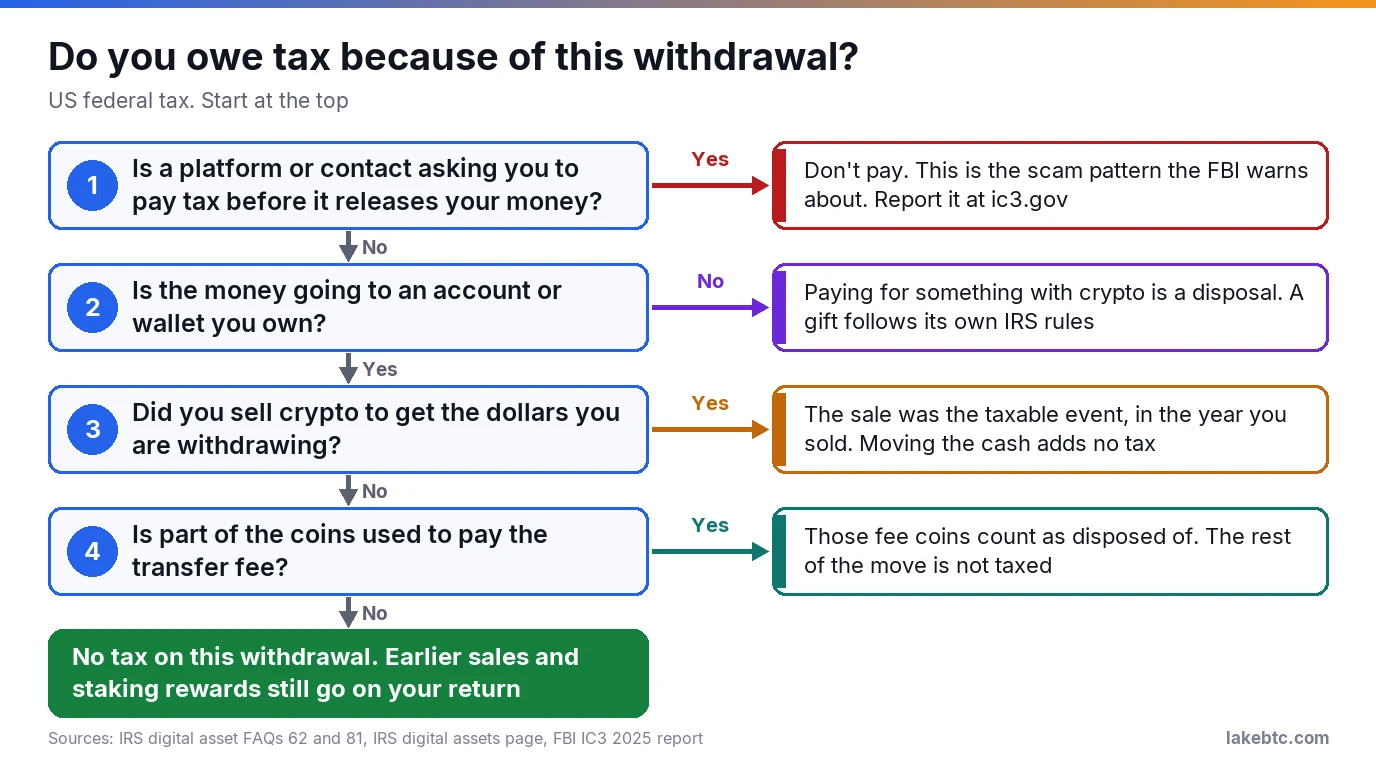
No. US tax follows selling, swapping, spending or earning crypto, not the withdrawal. You pay the IRS, not the platform. A platform demanding tax first is a scam sign.
Under US federal rules, taking coins or dollars off a platform doesn’t create tax by itself.
Tax comes from what you did with the crypto. Selling it, swapping it for another coin, spending it and earning it as a reward are the events that count. Each one goes on your return for the year it happened, whether the money stayed on the exchange or not.
So check two things first. Is anyone asking you to pay before they release your funds? And did you sell, swap or spend anything this year? The first is a warning sign. The second is what you’ll actually report.
Before you withdraw or pay anything
- 🟢 Moving the same coins or cash between accounts you own is not taxed. The tax comes from selling, swapping, spending or earning.
- 🟡 If part of your coins pays the transfer fee, those fee coins count as disposed of.
- 🟡 Sold in 2026? That gain goes on your 2026 return, filed in 2027, whether you withdrew the money or not.
- 🔴 A platform that wants tax paid before it releases your balance matches the FBI warning on investment scams. Don’t pay.
In this article
When crypto is actually taxed
For federal taxes, your crypto is property, not currency. That splits what you do with it into two groups: actions that create a gain or loss, and actions that don’t.
| What you did | Taxable? | What it means for you |
|---|---|---|
| Bought crypto with dollars and kept it | No | Nothing to report until you sell, swap or spend it. |
| Moved the same coins between wallets or accounts you own | No | Not a taxable event. Coins used for the fee are the exception. |
| Sold crypto, then withdrew the dollars to your bank | The sale is, the withdrawal isn’t | Report the gain or loss for the year you sold. |
| Swapped one coin for another | Yes | A capital gain or loss, even though no dollars changed hands. |
| Paid for goods or services with crypto | Yes | A disposal, so a gain or loss. |
| Earned staking rewards | Yes, as income | Income in the year you gain control of the rewards. |
| Anything else: gifts, hard forks, wages paid in crypto | Depends | Each has its own rules in the IRS FAQs linked below. |
Selling for dollars, swapping coins and paying for services are all disposals with a capital gain or loss, as the IRS digital asset FAQs confirm. There’s no minimum, either. You report every taxable transaction for its tax year, regardless of the amount or whether you get a form.
How long you held the coins matters too. Sell within a year of buying and it’s a short-term gain or loss. Hold them more than a year and it’s long-term.
Rewards work differently. Staking rewards are income in the year you gain dominion and control over them, under Rev. Rul. 2023-14. So they can be taxable while they’re still sitting on the exchange.
Moving coins to your own wallet: watch the fee
Sending coins from an exchange to a hardware wallet you control isn’t a sale. The IRS calls a transfer between your own wallets, addresses or accounts a non-taxable event.
There’s one catch. If the network fee for that transfer is paid in crypto, whether you pay it or it’s withheld from the amount you send, those fee coins count as disposed of. However small the fee, it counts.
It also changes your answer on Form 1040. Every return asks a Yes or No question about digital assets. If moving coins between your own accounts was all you did, you can answer No, unless you paid a transaction fee with digital assets. Our guide to gas fees explains how those network fees are set on Ethereum.
Your purchase records don’t travel with the coins. If you later move them to another exchange and sell there, that exchange counts them as transferred in and doesn’t have to report what you paid. Your 1099-DA can then show the full sale amount with no cost basis. Save the purchase history from the old account before you move anything, or you’ll struggle to prove your basis later.
Sending to someone else’s wallet is a different case. Paying for something with crypto is a disposal. A gift has its own rules, and the IRS points gift givers to Form 709, the gift tax return.
How much tax, and when you pay it
What you owe depends on how long you held the coins and on your total taxable income. Short-term gains are taxed as ordinary income. Long-term gains get lower rates of 0%, 15% or 20%. The table shows the taxable income up to which the 0% rate applies, and where the 15% band ends.
| Tax year | Single | Married filing jointly | Head of household | 15% band ends, single |
|---|---|---|---|---|
| 2026 sales (return filed in 2027) | Up to $49,450 | Up to $98,900 | Up to $66,200 | $545,500 |
| 2025 sales (return filed in 2026) | Up to $48,350 | Up to $96,700 | Up to $64,750 | $533,400 |
These limits apply to your total taxable income, not to the crypto sale alone, so a large gain can push part of itself into the 15% band. The 2026 figures are in Rev. Proc. 2025-32, the 2025 ones in IRS Topic 409.
A big sale can also bring the 3.8% net investment income tax. It applies once your modified adjusted gross income passes $200,000 single or head of household, or $250,000 married filing jointly, and it covers net gains from selling property, which is how the IRS treats crypto. Budget for it on top of the rates above.
Sold at a loss? Losses offset your gains first. Beyond that, you can deduct up to $3,000 a year ($1,500 if married filing separately) against other income, and carry the rest forward.
You don’t pay at the moment you sell or withdraw. You settle up with your federal return for that year, or during the year through estimated tax. For 2026, the Form 1040-ES instructions say you generally must pay estimated tax if you expect to owe at least $1,000 after withholding and refundable credits, and your withholding won’t cover 90% of your 2026 tax or 100% of your 2025 tax, whichever is smaller. If your 2025 adjusted gross income was over $150,000 ($75,000 married filing separately), that second figure is 110%.
If a big sale this year puts you in that spot, here’s the order:
- Work out the gain on each sale: what you received minus what you paid, with the fees you paid to buy added to your cost.
- Estimate your total 2026 tax and compare it with what’s withheld from your paychecks.
- If you’re short under the test above, pay the remaining installment. The last 2026 payment is due January 15, 2027.
- Pay the IRS directly. The IRS tells taxpayers to make payments to the United States Treasury.
The earlier 2026 due dates were April 15, June 15 and September 15. Late or short payments can bring a penalty. You can skip the January payment if you file your 2026 return by February 1, 2027 and pay the full balance with it.
Sold late in the year? The 1040-ES instructions point people with a large capital gain late in the year to the annualized income installment method, which can lower or remove the earlier payments. If you use it, file Form 2210 with Schedule AI with your return.
Will your exchange hold back tax when you withdraw?
For 2025 and 2026 sales, no. Brokers don’t have to backup withhold on digital asset sales in those two calendar years. A US exchange reports instead: sales it handled show up on Form 1099-DA, which our Form 1099-DA guide walks through box by box.
Relief for 2027 sales is narrower in the same notice, so some customers could see backup withholding then. For existing customers, it’s tied to the broker checking your name and tax ID against IRS records, so make sure your exchange has both exactly as they appear on your return.
Withholding does apply elsewhere, for example to crypto paid as wages: digital assets paid by an employer are subject to federal income tax withholding, like a paycheck. Where withholding applies, the tax comes out of the payment itself. It isn’t a separate bill you settle to unlock a withdrawal.
The “pay tax to withdraw” scam
This is where people lose real money. Crypto investment fraud was the biggest source of losses in the FBI’s 2025 Internet Crime Report: $7.2 billion. The report describes how those scams end. When victims try to withdraw, they’re charged taxes and fees as a last grab before the scammers disappear with the funds.
The setup usually starts with a text, a social media contact, an ad or a dating app. The conversation moves to a messaging app, and you’re steered to a trading platform. The balance grows on screen. Then a withdrawal request triggers a demand: a tax, a penalty, a release fee or an unlock fee.
A June 2026 FBI warning adds a newer twist. The fake exchange says your account has been “flagged” and sends a courier to collect cash. When you try to withdraw again, the loop restarts with more fraudulent taxes and penalties.
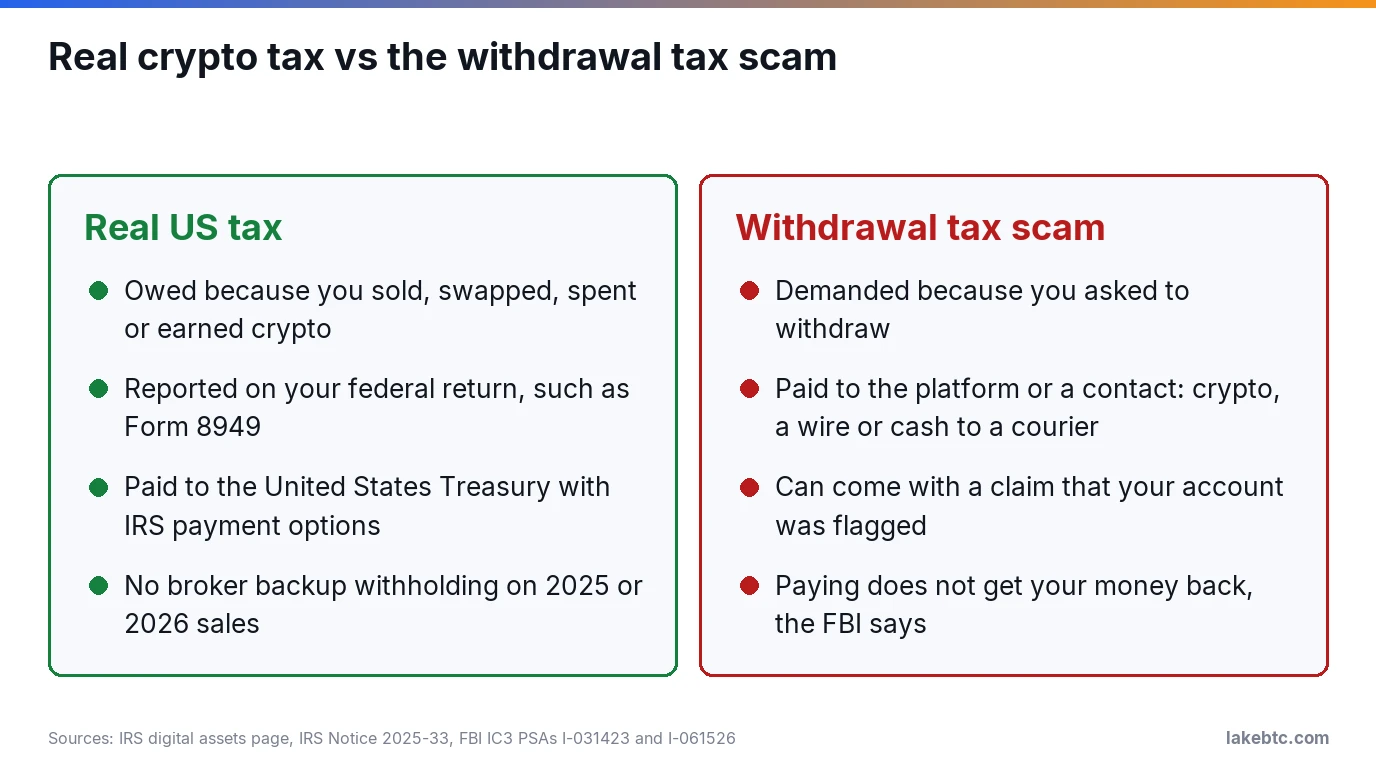
Why can’t the demand be real? A tax on your crypto is owed to the IRS, and it’s based on what you did with the coins, not on a request to withdraw. Real network fees are paid as part of the transaction itself. MetaMask warns that requests to prepay taxes or gas fees to release funds are almost always a scam, since gas is paid from your wallet when the transaction happens.
The FTC is blunter: only scammers demand payment in cryptocurrency.
If they’re pressing you, or you already paid
- Stop paying. The IC3 describes the tax demand as a final attempt to take more money, so another payment won’t unlock the balance.
- Don’t hand cash to a courier or send a wire, and never share your recovery phrase or login.
- Save everything: the platform’s web address and app name, screenshots of the chats, and every bank account and wallet address you were told to pay.
- File a complaint at
ic3.govand a report atReportFraud.ftc.gov. If you’re 60 or older, the DOJ Elder Justice Hotline at 1-833-FRAUD-11 can help you file with the IC3. - Call the company you paid through right away. For a bank transfer, the FTC says to report it to your bank or credit union and ask them to reverse it. For crypto sent through an exchange or a crypto ATM, tell that company it was fraud and ask for the same. Crypto payments usually can’t be reversed, so don’t wait.
- Ignore anyone who offers to recover the money for a fee. The IC3 says victims get targeted again by recovery scams, and our breakdown of fake support and recovery scams shows how they work.
Worried a real tax bill is behind the message? The IRS generally mails a bill first. It doesn’t call to demand immediate payment by a set method like a gift card or wire transfer.
Frequently Asked Questions
Do you have to pay taxes on crypto when you cash out?
Cashing out usually means selling, and the sale is taxable, so you report the gain or loss for that year. Sending the dollars to your bank afterward adds nothing. A sale at a loss creates no tax and can offset other gains.
How much crypto can you withdraw without paying tax?
Any amount, when you’re moving coins or cash you already own between your own accounts. The size of the withdrawal isn’t what’s taxed. What counts is whether you sold, swapped, spent or earned crypto, plus any coins used for the transfer fee.
How much crypto can I sell without paying taxes?
There’s no tax-free sales allowance, and every sale gets reported. A long-term gain can still be taxed at 0% if your total 2026 taxable income stays within $49,450 as a single filer or $98,900 filing jointly. Short-term gains get ordinary income rates.
Do I owe tax on crypto I haven’t sold?
Not on a rise in price you haven’t cashed in. Rewards are the exception: staking rewards count as income once you control them, even if you never move them off the exchange.
Will the exchange take the tax out of my withdrawal?
Not for 2025 or 2026 sales, because brokers aren’t required to backup withhold on them. You pay what you owe yourself, through estimated tax or with your return.
Could a message saying I owe tax to unlock my account be real?
That isn’t how the IRS collects. It generally sends a bill by mail and tells you to pay the United States Treasury. A demand that shows up inside a trading app, tied to releasing your balance, fits the scam the FBI describes.
What to do next
If you sold this year, download the transaction history from each exchange and wallet now, while it’s easy to get. Note the date, amount and price of each sale and any coins spent on fees. When your 1099-DA arrives, compare it with those records before you file.
If a platform won’t release your money until you pay, don’t send another payment. File with the IC3 today and keep the records listed above.
Moving coins to a wallet you control instead? Back it up first: our guide to what a seed phrase is covers the words that restore it.
Drafted with AI by the LakeBTC Editorial Team, then edited and fact-checked against the sources linked in the text. How we use AI · Report an error