Form 1099-DA: What It Shows and Where It Goes on Your Return
Form 1099-DA is the form US crypto brokers send listing what you received from crypto sales and trades. From 2026, it also shows basis for coins bought and held there.
Your broker files the same form with the IRS, so your return has to account for every sale on it. What the form can’t give you on its own is your gain. That takes your basis, and the form often leaves it out.
For 2026 sales, the 2026 instructions require a broker to report your basis, what you paid, only for coins you bought in that account after 2025 and kept there. Coins you bought earlier or moved in from elsewhere can come with box 1g blank. On 2025 forms, basis was optional for every sale. So a 1099-DA can show a big number in box 1f and nothing in box 1g. That isn’t your gain. It’s half the math.
Start with two things on the form: the code in the box marked Applicable checkbox on Form 8949, and whether box 1g is filled in. Those two tell you where each sale goes on your return and whether you need your own records.
Before you enter anything
- 🟢 Copy box 1f into column (d) of Form 8949. If you received more than it shows, enter the correct proceeds instead.
- 🟡 Box 1g blank? Your basis comes from your own purchase records, not from the form.
- 🟡 Any number in box 1g, even zero, was reported to the IRS as your basis.
- 🔴 No 1099-DA for a sale doesn’t make it tax-free. You still report every taxable sale or trade.
In this article
What Form 1099-DA reports
The IRS calls it Digital Asset Proceeds From Broker Transactions. A broker files one with the IRS and sends you a copy for sales, trades and other disposals it handled for you. That covers selling crypto for dollars, swapping one coin for another, and spending crypto through a broker.
Who counts as a broker? Mainly US exchanges and apps that hold your crypto for you. Bitcoin ATM operators that let you sell are treated as brokers too. A company that only makes wallet software or a hardware wallet, where you control the keys, isn’t one. So the maker of your self-custody wallet won’t send you a 1099-DA for the wallet itself, even though your trades there still count.
Some things stay off the form. Staking rewards are one: the 1099-DA instructions tell brokers not to report rewards and staking payments on it. Under Notice 2024-57, brokers also don’t have to report certain transactions until the Treasury and the IRS issue further guidance. Those include the staking transactions themselves, wrapping and unwrapping, and liquidity provider transactions.
Neither rule makes rewards tax-free. They count as income in the year you gain control of them, under Rev. Rul. 2023-14. The 2025 Form 1040 instructions name staking income as digital asset income for Schedule 1, line 8v, when it isn’t reported elsewhere, and the draft 2026 Schedule 1 keeps that line.
Small amounts can drop off too: a broker using the optional method can leave out qualifying stablecoin sales of $10,000 or less for the year, and specified NFT sales of $600 or less.
Don’t expect a 1099-DA for swaps you make on a DeFi platform from your own wallet. Treasury and the IRS had issued a rule requiring certain decentralized finance industry participants to report as brokers. Congress disapproved it in Public Law 119-5, signed April 10, 2025, and the rule has no force or effect.
None of that changes what you owe. If a trade was taxable, including a DeFi swap, it goes on your return whether or not a form shows it.
2026 vs 2025: what the form shows by tax year
The rules phase in. The big change is basis: what you paid for the coins you sold. Here’s what to expect for each kind of sale.
| Sale | Proceeds (box 1f) | Basis (box 1g) | Where your basis comes from |
|---|---|---|---|
| 2026 sale of coins bought on that platform after 2025 and kept there | Required | Required (covered security) | The form; fix it on Form 8949 if it’s wrong |
| 2026 sale of coins bought before 2026 | Required | Optional (noncovered, box 9) | Your own records |
| 2026 sale of coins you transferred in from elsewhere | Required | Optional (noncovered, box 9) | Your own records |
| Any sale in 2025 (your 2025 return or an amended one) | Required | Optional for the broker | Your own records, unless the broker reported it |
| Trades with no 1099-DA (self-custody wallets, DeFi platforms, non-US platforms) | Not on a form | Not on a form | Your own records, for every taxable sale |
Watch the transfer-in row. Say you bought bitcoin on one exchange in 2023, moved it to another, and sold it there in 2026. The selling exchange never saw your purchase, so the 2026 instructions treat those coins as noncovered. Box 9 may be checked and box 1g left blank, with the transfer shown in boxes 12a and 12b.
The boxes to read first
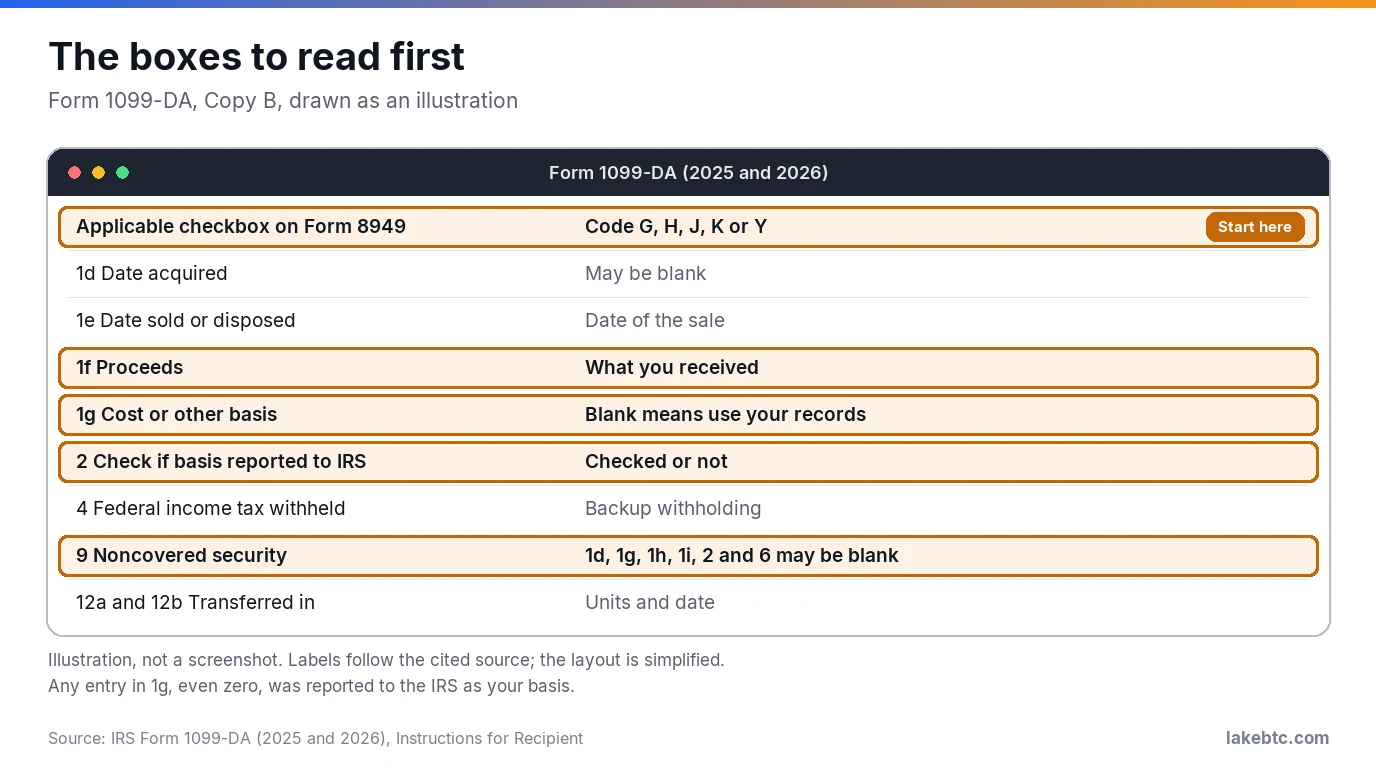
Most of the form is identification. Five spots do the real work, and the recipient instructions on the 2026 Copy B explain each one. The 2025 form uses the same boxes.
- Applicable checkbox on Form 8949: a letter. G and H are short-term, J and K are long-term. G and J mean basis went to the IRS; H and K mean it didn’t. Y means the broker doesn’t know your holding period.
- Box 1f, Proceeds: what you received. That can be dollars, another coin, or goods and services.
- Box 1g, Cost or other basis: blank means you work out basis from your own records. Any entry, even
0, was reported to the IRS as your basis. - Box 2, Check if basis reported to IRS: decides which Form 8949 box you use.
- Box 9, noncovered security: if checked, boxes 1d, 1g, 1h, 1i, 2 and 6 may be blank.
Don’t take the broker’s sale fee off box 1f a second time. Brokers must reduce the proceeds by transaction costs related to the sale, such as transaction fees and commissions. The Gross proceeds or Net proceeds check in box 3a doesn’t change that: on Copy B it only says whether box 1f was adjusted for an option premium. If you paid a sale cost the form doesn’t reflect, the Form 8949 instructions use code E and a negative amount in column (g).
Under Notice 2025-33, brokers don’t have to backup withhold on digital asset sales in 2025 or 2026. If box 4 shows an amount anyway, include it on your return as tax withheld.
Where it goes on your return
Crypto sales are capital gains and losses, reported on Form 8949 and totaled on Schedule D. Since tax year 2025, Form 8949 has its own boxes for digital assets: G, H and I for short-term sales, J, K and L for long-term. The old boxes C and F aren’t used for crypto anymore, and the draft 2026 Form 8949 keeps the same six digital asset boxes for 2026 returns. The IRS hasn’t posted 2026 instructions for Form 8949 yet, so the steps below follow the 2025 instructions.
- On page 1 of Form 1040, answer Yes to the digital asset question. Getting a 1099-DA generally means you had a sale.
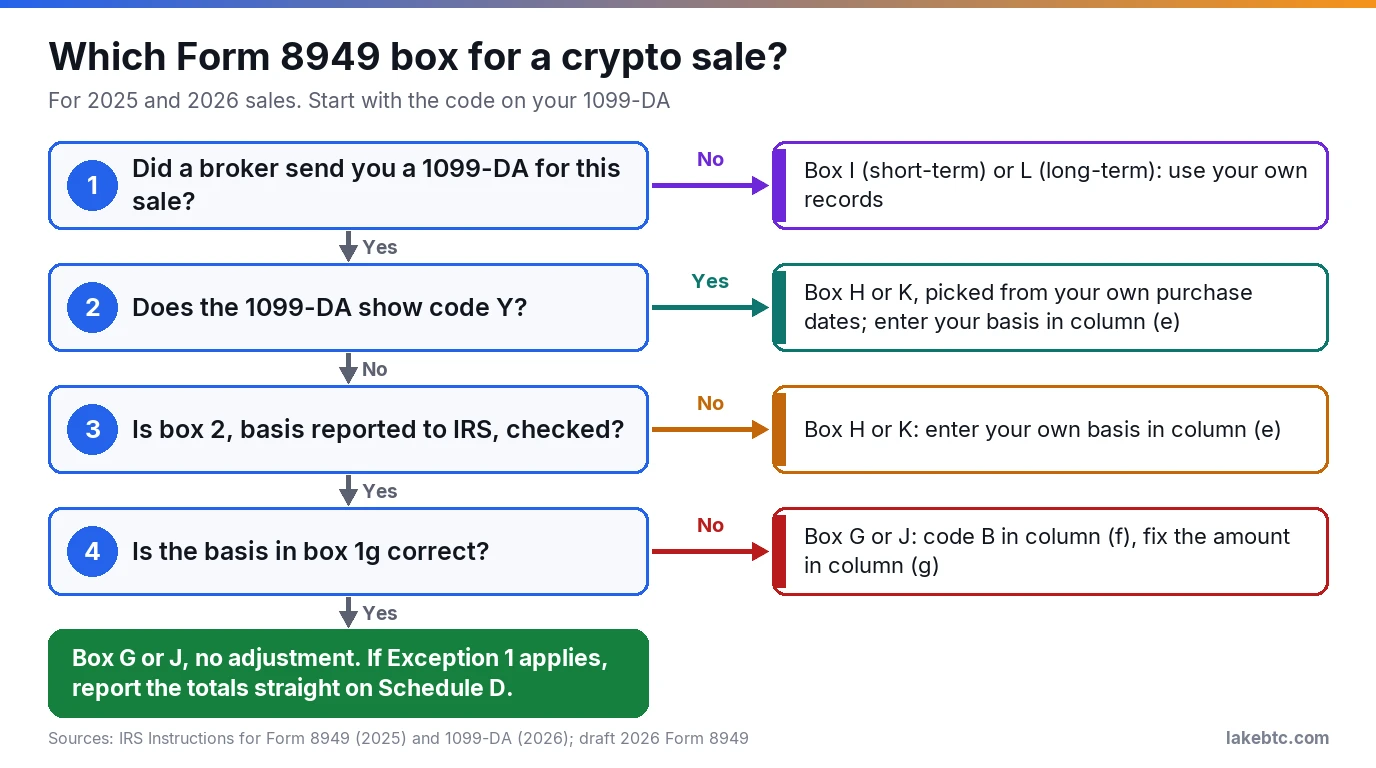
- Group your 1099-DA sales by the letter in the Form 8949 checkbox: G, H, J or K. A Y means the broker doesn’t know your holding period, so you pick H or K from your own purchase dates.
- For each sale, copy box 1f into column (d) of Form 8949, unless you received more than it shows. Then enter the correct proceeds.
- If box 2 is checked, copy box 1g into column (e). If it isn’t, enter the basis from your own records.
- Add sales that had no 1099-DA under box I (short-term) or box L (long-term).
- Carry the totals to Schedule D.
Here’s how the math works, using the IRS’s own example. You bought one unit of a coin for $1,000 and traded it three years later for a coin worth $3,000. Proceeds of $3,000 minus basis of $1,000 is a long-term gain of $2,000. Your basis includes the fees you paid to buy.
One shortcut, which the Form 8949 instructions call Exception 1: you can put the totals of qualifying 1099-DA sales straight on Schedule D, line 1a for short-term or 8a for long-term, and leave them off Form 8949. A sale qualifies only if all of these hold:
- The 1099-DA shows basis was reported to the IRS, with no adjustments in box 1h or 1i.
- The Ordinary box in box 6 isn’t checked.
- You don’t need to adjust the basis, the type of gain or loss, or the gain or loss itself.
- It isn’t a sale of collectibles, and you aren’t deferring gain, or ending a deferral, through a Qualified Opportunity Fund.
Sales without a 1099-DA still go on Form 8949. If your tax software imports the form, compare the imported basis with box 1g before you file.
When the form and your records disagree
The form is the broker’s view. Your records cover the whole picture, including coins that came from somewhere else.
Basis is blank. This is normal for coins bought before 2026 or transferred in, and for 2025 sales. Don’t leave column (e) at zero. Enter what you actually paid, from purchase confirmations, old exchange exports or bank statements. If you report proceeds with no basis, the full amount shows up as gain.
Basis is filled in but wrong. Keep the reported number in column (e) if the sale is under box G or J. Then enter code B in column (f) and the correction in column (g): a positive number if the reported basis is too high, a negative one in parentheses if it’s too low. Under box H or K, enter the correct basis in column (e), code B in column (f), and 0 in column (g).
Your tax software and the broker show different basis. Since January 1, 2025, the rules for working out which units you sold apply to each wallet or account on its own, not to all your coins as one pool. If you used to treat them as one pool, Rev. Proc. 2024-28 let you assign your leftover basis to each wallet or account as of that date. Commenters warned the IRS that this switch could leave gaps between your records and the basis brokers report on Form 1099-DA.
So check two things. Your software should track each exchange account and wallet separately, not as one pile. Then compare its basis for each broker sale with box 1g, and where they differ, work out which one follows the coins in the account they were actually sold from.
A sale is missing. You still report it. The IRS says gains count regardless of the amount or whether you get a form, and that applies to unreported stablecoin swaps too.
Your records are gone. This happens after a platform shuts down or an old account is closed, and the 1099-DA then shows proceeds with no basis. Rebuild what you can from bank transfers, emails and screenshots, and keep that file with your return. A tax professional can confirm how to handle a gap like that for your situation.
From 2026, the broker’s lot rules matter too. If your broker offers a choice and you don’t pick the units by the time of the sale, the oldest units are treated as sold first. If it offers only one method, that method applies. Look for a cost basis or lot setting in your exchange account before you sell.
The form itself is wrong
If your 1099-DA has incorrect information, the IRS tells you to request a corrected form from the issuer: the filer named in the top left corner of the form. Don’t contact the IRS, which says it can’t correct your Form 1099-DA. Keep the original, the corrected copy and your messages with the broker. Got a 1099-DA you shouldn’t have? Contact the filer right away, the same way.
Don’t wait to file your taxes while you sort it out. A wrong basis is something you can already fix on Form 8949 with code B, as above.
A transfer between your own accounts shows up as a sale
Moving coins from one wallet or account you own to another you own isn’t a taxable event. Coins you spend, or that are withheld, to pay for the transfer are different: those count as disposed of, so a small sale for the fee can be right.
If the broker reported the transfer itself as a sale, that’s incorrect information on the form. Ask the filer for a corrected 1099-DA, as above, and keep records of the transfer that show both ends are yours.
Frequently Asked Questions
Will my hardware wallet send me a 1099-DA?
Not for the wallet itself. A company that only provides hardware or software letting you control your own keys, with no other services, isn’t a digital asset middleman under the 1099-DA rules. Trades you make from that wallet are yours to report.
Does Form 1099-DA include staking rewards?
No. Brokers are told to leave rewards and staking payments off Form 1099-DA. That doesn’t make them tax-free: rewards are income in the year you get control of them, form or no form, so keep your exchange’s rewards history. If you later sell those coins through a broker, the sale shows up on a 1099-DA like any other.
My 1099-DA shows $0 in box 1g. Is that right?
Only if your basis really is zero. A zero was reported to the IRS as your basis, so if it’s wrong, report the correct amount on Form 8949 with code B.
When should my 1099-DA arrive?
For 2026 sales, brokers must furnish it by February 16, 2027. Pub. 1099 sets the date at February 15 of the following year, moved to the next business day when it falls on a weekend or legal holiday, and February 15, 2027 is Washington’s Birthday, a federal holiday. For 2025 sales, the deadline was February 17, 2026. Brokers can send it electronically, so look in your account’s tax documents, not only your mailbox.
Will I get a form for NFT sales under $600?
Maybe not. A broker using the optional method doesn’t have to report specified NFT sales that total $600 or less for the year. Any gain on them is still taxable.
Does the 1099-DA cover all my exchanges together?
No. Each broker reports only the sales it handled, so you can get one form per exchange. Coins you moved from one to another arrive as transferred in, so the new broker usually has no basis for them.
What to do next
Download every 1099-DA your exchanges posted, then pull a full transaction history from each account. Earned staking rewards? Export that history too, since rewards go on your return as income, not on the 1099-DA. On Coinbase or Kraken? Our Coinbase review and Kraken review cover those accounts.
Moving coins off an exchange this year? Our steps to move crypto from Coinbase to a cold wallet show the transfer. Save your purchase records before you move anything, because a future broker won’t have them. Exchange fees you paid to buy also add to your basis; see our breakdown of crypto exchange fees.
Drafted with AI by the LakeBTC Editorial Team, then edited and fact-checked against the sources linked in the text. How we use AI · Report an error