Dogecoin vs Shiba Inu: Which Meme Coin Wins?

Dogecoin and Shiba Inu are both meme-origin cryptocurrencies, but they are built differently and serve different purposes. Dogecoin runs on its own Layer-1 blockchain and functions primarily as a payments and tipping token, while Shiba Inu is an Ethereum-based ERC-20 token with a broader (and more experimental) DeFi ecosystem. Neither “wins” outright, the better fit depends on whether an investor values simplicity and merchant adoption or ecosystem expansion and burn-driven scarcity.
In this article
- At a Glance: Dogecoin vs Shiba Inu Comparison Box
- What Are Dogecoin and Shiba Inu? (Origins & History)
- Technology & Blockchain Architecture
- Supply Mechanics & Tokenomics
- Ecosystem & Utility Comparison
- Price History & Performance Data
- Market Cap & Liquidity Comparison
- Fee & Cost Table (Buying/Trading Each Coin)
- Pros and Cons
- Security Considerations
- Doge vs Shib Investment Case: Bull Case, Bear Case, Neutral Takeaway
- Doge vs Shib Price Prediction: What Analysts and Community Say
- Meme Coin Correlation & Macro Sensitivity
- Regulatory & Tax Treatment Considerations
- Choosing Based on Investor Profile, Not Just “Which Wins”
- Verdict: Which Meme Coin Wins?
- FAQ
At a Glance: Dogecoin vs Shiba Inu Comparison Box
| Attribute | Dogecoin (DOGE) | Shiba Inu (SHIB) |
|---|---|---|
| Launch date | December 6, 2013 | August 2020 |
| Founder(s) | Billy Markus and Jackson Palmer | Pseudonymous “Ryoshi” |
| Blockchain | Native Layer-1 (forked from Litecoin) | Ethereum (ERC-20); Shibarium Layer-2 since August 2023 |
| Consensus mechanism | Scrypt Proof-of-Work, merge-mined with Litecoin | Inherits Ethereum’s consensus; Shibarium uses its own validator set |
| Max supply | None (uncapped) | Fixed initial mint of 1 quadrillion tokens |
| All-time high price | approximately $0.7376 (May 8, 2021), according to Coinbase | approximately $0.0000884 (October 28, 2021), per aggregated market-data sources (Coinbase) |
| Spot price snapshot | approximately $0.07667 (Coinbase, checked 2026-07-04) | approximately $0.000004285 (Coinbase, checked 2026-07-04) |
| Primary use case | Peer-to-peer payments, tipping, merchant transactions | DeFi/DEX ecosystem, NFTs, Layer-2 scaling experiments |
Fees and availability verified as of July 4, 2026.
Quick verdict snapshot: Dogecoin tends to appeal to investors who want a simpler, payments-oriented meme coin with a longer track record, while Shiba Inu appeals to those interested in a wider DeFi/ecosystem bet built around token burns. Both remain highly speculative, sentiment-driven assets rather than fundamentals-driven ones.
What Are Dogecoin and Shiba Inu? (Origins & History)
Dogecoin launched on December 6, 2013, created by software engineers Billy Markus and Jackson Palmer as a lighthearted parody of Bitcoin, built around the “Doge” internet meme, according to Dogecoin’s official history page. It grew a loyal online tipping community on Reddit and Twitter long before most people took it seriously as an asset.
Shiba Inu emerged in August 2020, created by a pseudonymous figure known as “Ryoshi” and described in the project’s “WoofPaper” as an ERC-20 token minted on Ethereum, according to Cube Exchange’s project overview. Its branding explicitly positioned it as a “Dogecoin killer,” and it spread through coordinated online communities rather than an organic meme migration.
Both assets gained mainstream visibility through social-media catalysts, Dogecoin through repeated mentions by high-profile figures, and Shiba Inu through retail-driven Reddit and Twitter campaigns in 2021.
Technology & Blockchain Architecture
Dogecoin operates its own Layer-1 blockchain, forked from Litecoin’s codebase, and uses Scrypt-based Proof-of-Work with merge-mining alongside Litecoin, which lets miners secure both networks simultaneously. Block times run roughly once per minute.
Shiba Inu was originally issued purely as an ERC-20 token, meaning every transaction settled on the Ethereum base layer and was subject to Ethereum gas costs. That changed with the August 2023 launch of Shibarium, a dedicated Layer-2 network built to lower fees and increase throughput for SHIB-related activity, according to ChangeHero’s Shibarium overview.
In practice, Dogecoin transaction costs have historically stayed low and predictable because the network is simple and purpose-built for transfers. SHIB transaction costs vary: moving SHIB directly on Ethereum can be expensive during network congestion, whereas Shibarium is designed to bring those costs down substantially. Investors comparing the two should check live gas trackers before transacting, since fees fluctuate with network demand.
Supply Mechanics & Tokenomics
Dogecoin has no maximum supply cap. The protocol issues a fixed 5 billion new DOGE per year through mining, according to Dogecoin’s official FAQ. Because that issuance is a flat annual number rather than a percentage, the effective inflation rate declines mathematically as circulating supply grows.
Shiba Inu was minted with a fixed initial total supply of 1 quadrillion tokens, per Cube Exchange. Rather than ongoing issuance, the project relies on a burn mechanism where tokens are periodically removed from circulation, intended to make the asset progressively scarcer. The current percentage of total supply burned changes continuously; readers should check a live tracker such as Shibburn.com for up-to-date figures rather than relying on a static number.
The practical difference is psychological as much as mathematical: Dogecoin’s more moderate total supply produces a higher per-token price, while Shiba Inu’s enormous supply keeps its per-token price fractions of a cent even at meaningful market capitalization.
Ecosystem & Utility Comparison
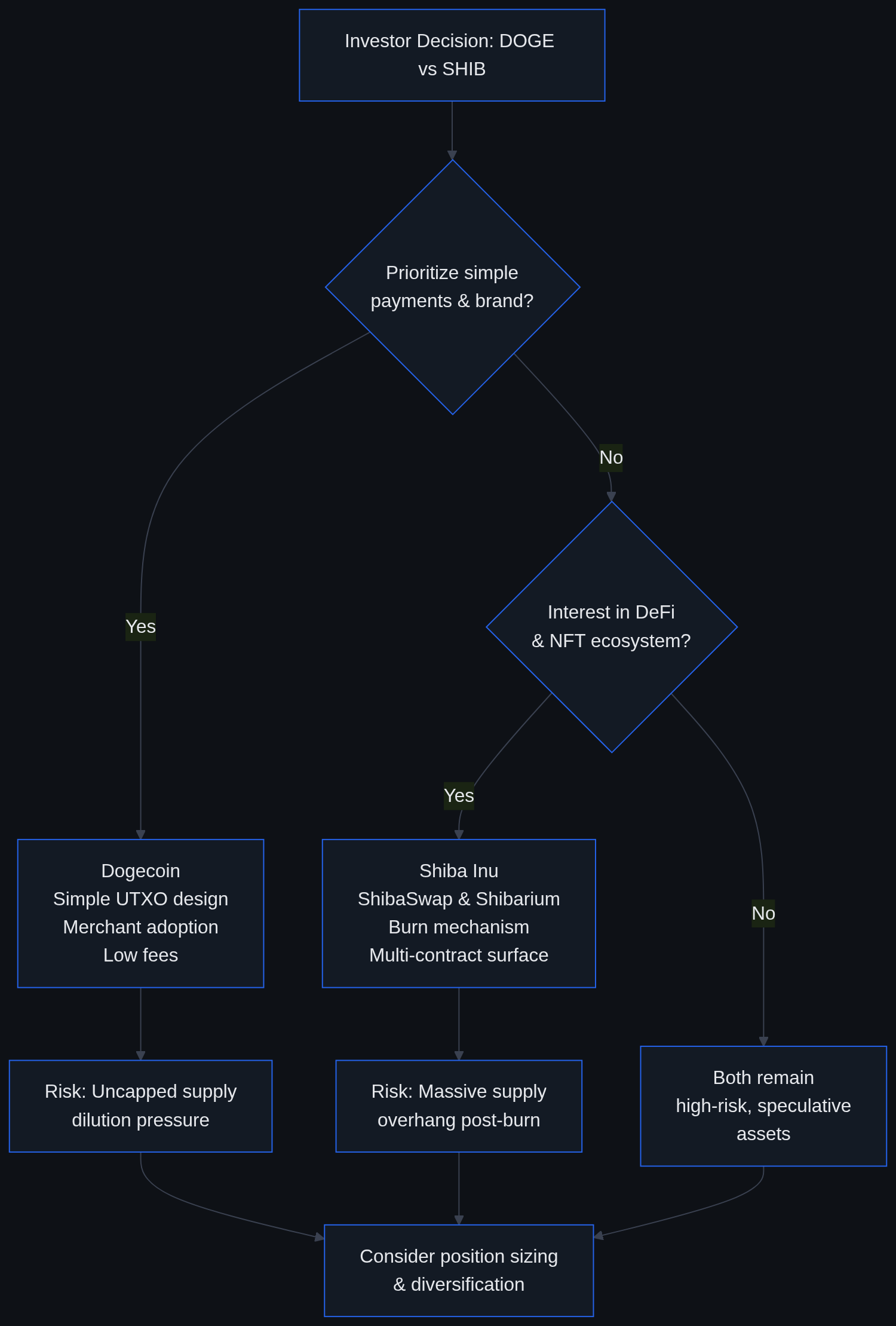
Dogecoin’s utility centers on payments and tipping. Some merchants have accepted DOGE for goods and services over the years, and BitPay’s own comparison of the two coins notes that Dogecoin sees more real-world payment usage among its merchant network than Shiba Inu, according to the BitPay blog. Its simple UTXO-based design keeps transactions straightforward.
Shiba Inu has built out a more elaborate ecosystem: ShibaSwap (a decentralized exchange), companion tokens LEASH and BONE, an NFT collection called Shiboshis, and the Shibarium Layer-2 network. This gives SHIB a broader set of use cases beyond simple transfers, though much of that ecosystem remains speculative and dependent on continued community engagement.
On the recurring question of whether either coin has “legitimate” utility beyond speculation, a topic frequently debated in communities such as r/CryptoCurrency, the honest answer is that both retain real but limited utility: Dogecoin as a low-friction payments token, and Shiba Inu as an entry point into a DeFi/NFT ecosystem. Neither functions as a fundamentals-driven asset in the way a cash-flow-generating equity does.
Price History & Performance Data
Dogecoin’s all-time high was approximately $0.7376, reached on May 8, 2021, according to Coinbase. Shiba Inu’s all-time high was approximately $0.0000884, reached on October 28, 2021, per aggregated market-data sources (Coinbase). Both tokens peaked within months of each other during the 2021 retail crypto surge and have traded well below those highs since, with periodic rallies tied to broader market cycles in 2024 and 2025, as Yahoo Finance has noted in its own comparison of the two assets.
As of the most recent check, Dogecoin traded at approximately $0.07667 and Shiba Inu at approximately $0.000004285 (Coinbase, checked 2026-07-04), both figures sit well below their respective 2021 peaks. Investors should treat any percentage-off-ATH figure as a moving target and verify current pricing directly before making decisions.
Volatility for both assets has historically tracked broader risk-on/risk-off sentiment in crypto markets, often amplified relative to Bitcoin during periods of retail enthusiasm and social-media attention.
Market Cap & Liquidity Comparison
Dogecoin has generally maintained a larger market capitalization than Shiba Inu, reflecting its longer track record, wider exchange support, and higher per-token price base. Both coins are listed on most major US exchanges and carry meaningful trading volume, though liquidity depth can vary by trading pair and platform. For a broader look at where DOGE and SHIB (and other assets) can be traded, see LakeBTC’s roundup of the best crypto exchanges.
Holder concentration is worth examining independently for each coin through on-chain explorers, since large-wallet concentration can influence short-term price behavior for both assets. Current concentration data changes over time and should be checked via a live blockchain explorer rather than a static figure.
Fee & Cost Table (Buying/Trading Each Coin)
| Cost factor | Dogecoin (DOGE) | Shiba Inu (SHIB) |
|---|---|---|
| Exchange trading fee | Varies by exchange; e.g., Coinbase Exchange uses a maker-taker model tiered by 30-day trailing volume | Same maker-taker model applies on shared order books |
| Network/withdrawal fee | Low, native-chain transaction fee | Ethereum gas fee (variable) if withdrawing as ERC-20; lower fees available via Shibarium |
| Staking availability | Not stakeable in the traditional Proof-of-Stake sense | Not stakeable in the traditional Proof-of-Stake sense; some third-party platforms offer SHIB yield products outside the core protocol |
Fees and availability verified as of July 4, 2026.
Because SHIB primarily moves as an ERC-20 token, trading or withdrawing it can involve Ethereum gas costs that fluctuate with network congestion, whereas Dogecoin’s fees stay tied to its own simpler, purpose-built chain. Always confirm current fee schedules directly on an exchange’s fee page, as noted for Coinbase Exchange, since schedules and tiers can change.
Pros and Cons
Dogecoin
- Pros: Simple design, strong brand recognition, documented merchant/payment adoption, generally low transaction fees, an active development community following its 2021 foundation revival.
- Cons: Uncapped supply creates ongoing dilution pressure, limited technical innovation relative to newer chains, price behavior heavily tied to social-media sentiment.
Shiba Inu
- Pros: Broader ecosystem including Shibarium, ShibaSwap, and companion tokens; a deflationary burn mechanism intended to reduce supply over time; an expanding roadmap beyond a single asset.
- Cons: Enormous nominal supply that can weigh on price psychology even after burns, historical reliance on Ethereum gas costs pre-Shibarium, steeper historical drawdown from its all-time high, and concentration risk tied to large wallet holdings.
Security Considerations
Dogecoin’s network security stems from its Scrypt Proof-of-Work design and merge-mining relationship with Litecoin, which pools hashing power across both chains and has historically made majority hash-rate attacks (commonly referred to as “51% attacks”) difficult to execute at scale, according to general blockchain security analyses of merge-mined networks.
Shiba Inu’s security profile is more layered: the core SHIB token relies on Ethereum’s underlying security as an ERC-20 asset, while Shibarium introduces its own validator set and bridge infrastructure, components that carry smart-contract and bridge-specific risk distinct from Ethereum’s base-layer guarantees. Any specific incident involving Shibarium’s bridge should be verified against official Shiba Inu team statements or independent audit reports (e.g., CertiK) rather than assumed, since details and remediation status can change. In general, SHIB’s multi-contract ecosystem (ShibaSwap, LEASH, BONE, Shibarium) carries more smart-contract surface area than Dogecoin’s comparatively simple script-based protocol.
Doge vs Shib Investment Case: Bull Case, Bear Case, Neutral Takeaway
Bull case for Dogecoin: unmatched brand recognition among meme coins, periodic speculation about payment integrations tied to high-profile platforms, and continued merchant acceptance growth.
Bull case for Shiba Inu: growing Shibarium adoption, an accelerating burn rate some community members argue increases scarcity, and an expanding DeFi/NFT ecosystem that broadens use cases beyond a single token.
Bear case for Dogecoin: uncapped issuance caps long-term upside pressure on price absent proportional demand growth, and the project lacks a deep technical development roadmap compared with smart-contract platforms.
Bear case for Shiba Inu: even with burns, the remaining supply is measured in the hundreds of trillions, creating a persistent overhang; the token has historically posted a steeper drawdown from its all-time high than Dogecoin, and its price action remains closely tied to speculative retail interest rather than fundamental cash flows.
Neutral takeaway: both DOGE and SHIB remain high-risk, sentiment-driven assets. Neither is backed by cash flows, and price moves for both have historically been driven more by social virality and market-wide risk appetite than by fundamentals. Position sizing and risk management matter more here than with many other digital assets.
Doge vs Shib Price Prediction: What Analysts and Community Say
Community discussion on forums such as Reddit’s r/SHIBArmy and r/CryptoCurrency frequently centers on supply dynamics, for instance, some community members argue that Dogecoin’s comparatively smaller circulating supply and declining percentage inflation give it more room to appreciate per-token than Shiba Inu’s vastly larger supply base, even after burns. These are opinions from community participants, not fundamental valuation models, and should be treated as such.
No credible source can responsibly forecast a specific price target for either coin. Any “prediction” circulating online reflects speculation, not a financial-modeling exercise, and should not be treated as investment guidance.
Meme Coin Correlation & Macro Sensitivity
Both Dogecoin and Shiba Inu have historically shown higher volatility than Bitcoin or Ethereum, and both tend to move with broader risk-on cycles in crypto markets, rallying alongside general retail enthusiasm and pulling back during risk-off periods or shifts in Bitcoin dominance. Because SHIB settles on Ethereum (and now partly on Shibarium), its liquidity and gas-cost environment can also be indirectly affected by Ethereum network conditions, an exposure Dogecoin’s independent chain does not share.
Regulatory & Tax Treatment Considerations
Neither Dogecoin nor Shiba Inu appears on the NYDFS “Greenlist” of coins pre-approved for New York-licensed virtual currency entities; the September 2023 update narrowed that list to Bitcoin, Ether, and six New York-issued stablecoins, according to Greenberg Traurig’s analysis of the NYDFS update. As a result, listing either token for New York residents generally requires a licensed entity to separately self-certify or obtain case-by-case NYDFS approval, a regulatory mechanism, not a guarantee of current listing status, so investors should check an exchange’s own state-availability page directly.
Regarding federal classification, no formal SEC.gov order or rule has classified Dogecoin as either a security or a commodity; this reflects secondary reporting rather than a primary regulatory finding, and readers should consult SEC.gov litigation releases directly for the current state of any enforcement matters. For general tax treatment, the IRS treats cryptocurrency dispositions as property transactions subject to capital gains rules; see IRS.gov digital asset guidance for specifics.
Choosing Based on Investor Profile, Not Just “Which Wins”
A more useful framework than picking an outright “winner” is matching the coin to an investor’s goals:
- Investors drawn to simplicity, brand recognition, and payments-style use cases may find Dogecoin’s design more aligned with their interest.
- Investors interested in a broader (if more speculative) DeFi/NFT ecosystem and a burn-driven scarcity narrative may find Shiba Inu’s roadmap more relevant.
Given the volatility profile of both assets, many risk-conscious approaches limit meme coin exposure to a small portion of a diversified portfolio. Before buying either, consider checking current circulating supply and burn data, confirming the coin’s availability on a reputable, US-compliant exchange, and reviewing an exchange’s security track record. For a broader survey of platforms that support both assets, see LakeBTC’s best crypto exchanges guide, and for step-by-step purchasing details, see our guides on how to buy Shiba Inu and background analysis in is Dogecoin a good investment in 2026.
Verdict: Which Meme Coin Wins?
The two coins differ meaningfully on technology, tokenomics, and ecosystem breadth. Dogecoin offers a longer operating history, simpler architecture, and more documented merchant payment use. Shiba Inu offers a wider DeFi/NFT ecosystem and a burn-based scarcity mechanic layered on top of an Ethereum-derived security model. Neither has demonstrated fundamentals that would make it a clear “winner” in a traditional valuation sense, both remain sentiment-driven, high-volatility assets where outcomes depend heavily on continued community engagement and broader market cycles rather than cash flows or contractual claims.
Regulatory status (updated September 2026): on March 17, 2026, the SEC and CFTC issued a joint interpretive release (Release Nos. 33-11412 and 34-105020) that names both Dogecoin and Shiba Inu as digital commodities, placing them under CFTC rather than SEC oversight. The release is agency guidance rather than statute, so pending market-structure legislation could still change the framework.
FAQ
Is Dogecoin or Shiba Inu a better investment in 2026?
Neither is inherently “better”, both are speculative, sentiment-driven assets. Dogecoin offers a longer track record and payments-oriented utility, while Shiba Inu offers a broader ecosystem with a deflationary burn mechanism. The comparative appeal depends on an investor’s risk tolerance and thesis, not a guaranteed outcome.
Which meme coin has more real-world utility, Doge or Shib?
Dogecoin has documented merchant payment usage, including higher adoption among BitPay merchants than Shiba Inu, per BitPay’s own comparison. Shiba Inu’s utility is spread across a DeFi and NFT ecosystem (ShibaSwap, Shibarium, Shiboshis) that is broader in scope but more experimental.
Why does Shiba Inu have a much lower price per coin than Dogecoin?
Shiba Inu was minted with an initial supply of 1 quadrillion tokens, versus Dogecoin’s far smaller circulating supply, so SHIB’s per-token price sits at a fraction of a cent even when its overall market capitalization is significant.
Can Dogecoin or Shiba Inu reach $1?
No source can responsibly guarantee a specific future price for either asset. Reaching $1 would require enormous increases in market capitalization given each coin’s current supply, and any such forecast is speculative community opinion rather than a fundamentals-based prediction.
Is there any legitimate use case for Dogecoin or Shiba Inu beyond speculation?
Yes, within limits: Dogecoin functions as a low-fee payments and tipping token with real merchant acceptance, while Shiba Inu underpins a DeFi/NFT ecosystem including its own Layer-2 network, Shibarium. Both retain meaningful speculative components alongside these more concrete uses.