Ethereum vs XRP: Key Differences and Which to Buy

In this article
- At a Glance: Ethereum vs XRP
- What Is Ethereum?
- What Is XRP and the XRP Ledger?
- Ethereum vs XRP: Key Differences
- Fee Comparison
- Ethereum vs XRP Use Cases
- Historical Performance Context
- A Hypothetical ~$5,000 Allocation Example: ETH vs XRP
- Bull Case for Ethereum
- Bear Case for Ethereum
- Bull Case for XRP
- Bear Case for XRP
- Neutral Takeaway: Which Should You Buy?
- Security Considerations
- Where to Buy Ethereum and XRP
- Frequently Asked Questions
At a Glance: Ethereum vs XRP
| Metric | Ethereum (ETH) | XRP |
|---|---|---|
| Launch year | 2015 | 2012 |
| Consensus mechanism | Proof-of-Stake (since Sept 15, 2022) | XRP Ledger Consensus Protocol (validator-based, no mining/staking) |
| Key people/entities | Vitalik Buterin (co-founder); Ethereum Foundation | Ripple Labs (issuer/steward; privately held, and management said in January 2026 it plans to remain private) |
| Market cap rank | #2 (~$217.6B) | #6 (~$69.4B) |
| Smart contracts | Yes, Turing-complete EVM | Limited native functionality (Hooks amendment, EVM sidechain) |
| Supply model | No fixed cap; EIP-1559 burn mechanism | Fixed 100 billion XRP, fully pre-mined in 2012 |
| Typical fee | Gas fee, variable with congestion (~0.345–0.844 Gwei avg. per Etherscan) | 10 drops (0.00001 XRP) base fee |
Market cap figures per CoinGecko, as of July 10, 2026, and subject to change; check the live data before making decisions.
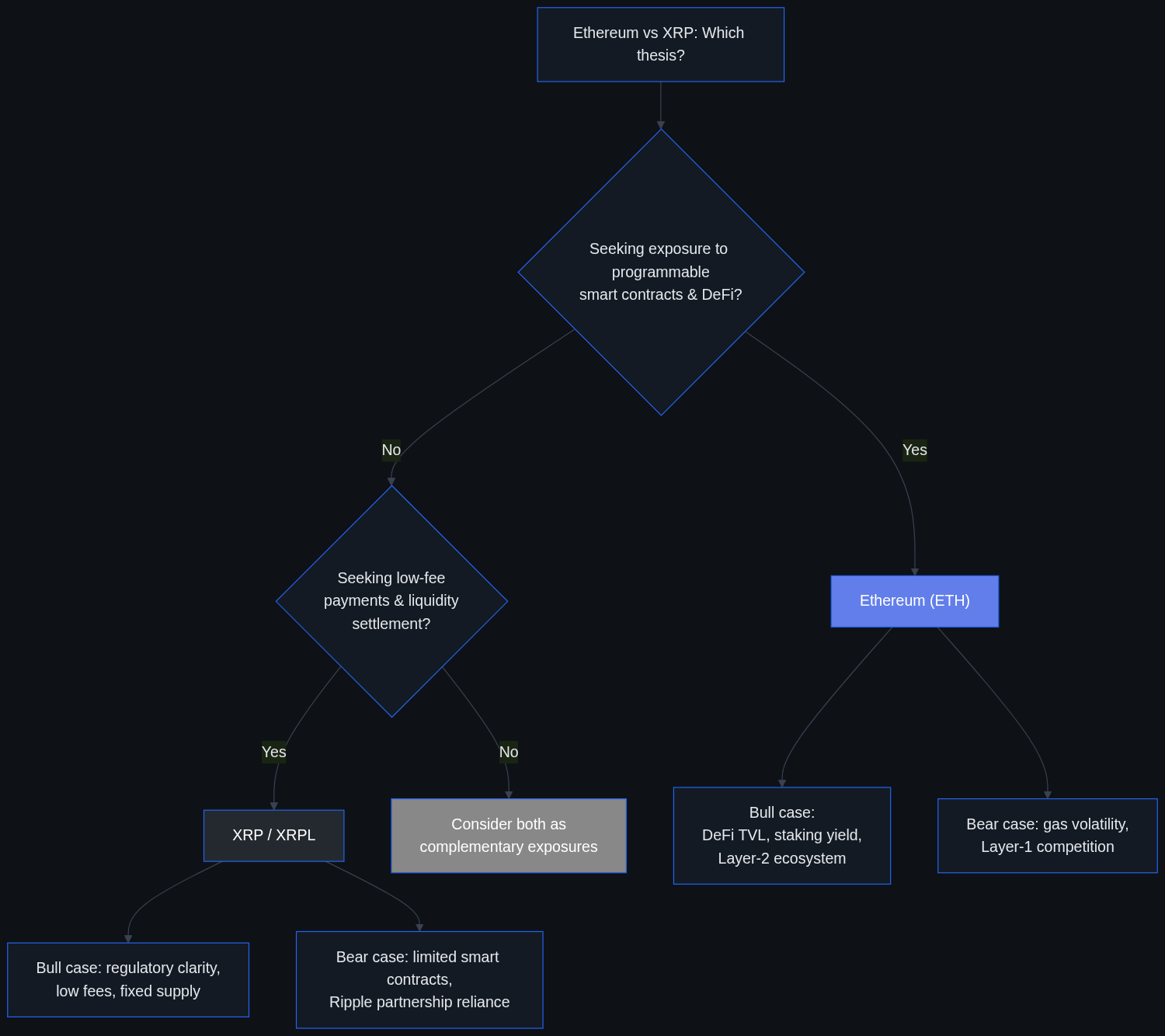
Ethereum and XRP occupy different corners of the crypto market: Ethereum is a general-purpose smart contract platform underpinning DeFi, NFTs, and tokenization, while XRP is a payments-focused asset built around fast, low-cost settlement on the XRP Ledger. Neither is objectively “better”, the answer to ethereum vs xrp which is better depends on whether an investor is looking for exposure to programmable-blockchain growth or to cross-border liquidity and payments infrastructure.
What Is Ethereum?
Ethereum is a decentralized, programmable blockchain that supports smart contracts, self-executing code that runs on the Ethereum Virtual Machine (EVM). This programmability underpins decentralized finance (DeFi), non-fungible tokens (NFTs), decentralized autonomous organizations (DAOs), and a growing wave of real-world-asset tokenization projects. According to DeFiLlama, Ethereum’s mainnet currently holds roughly $38.3 billion in total value locked (TVL), making it the dominant settlement layer for DeFi activity.
On September 15, 2022, Ethereum completed “The Merge,” transitioning from energy-intensive proof-of-work mining to proof-of-stake (PoS) validation, according to the Ethereum Foundation’s roadmap documentation. Under PoS, validators stake ETH to help secure the network in exchange for rewards; Coinbase currently estimates an approximate 1.77% staking reward rate, with roughly 33.31% of circulating ETH supply (around 40.2 million ETH) staked as of its most recent snapshot. Ethereum’s supply is not fixed, new ETH issuance funds staking rewards, while EIP-1559 burns a portion of transaction fees, a dynamic that can make net supply growth slow or even negative depending on network usage.
To address throughput and cost limitations on the base layer, Ethereum’s roadmap has shifted toward a “rollup-centric” scaling model, with Layer-2 networks such as Arbitrum, Optimism, and Base processing transactions off the main chain before settling back to Ethereum for security.
What Is XRP and the XRP Ledger?
XRP is the native digital asset of the XRP Ledger (XRPL), a blockchain launched in 2012 and designed primarily for fast, low-cost value transfer, historically marketed around cross-border payments and liquidity provisioning through products associated with Ripple Labs, the company most closely tied to XRP’s development and promotion. Unlike Ethereum or Bitcoin, the XRPL does not use mining or staking; instead, it relies on the XRP Ledger Consensus Protocol, in which a set of independent validators, more than 150 validators network-wide, with 35-plus on the default Unique Node List (UNL), agree on transaction ordering roughly every few seconds. Ripple itself operates only one of these validating nodes, according to XRPL.org’s FAQ documentation.
All 100 billion XRP were created at the ledger’s 2012 launch; there is no ongoing issuance, and a portion of the supply is held in escrow with a scheduled release cadence, per XRPL.org’s explanation of the escrow mechanism.
XRP’s regulatory backdrop has been shaped heavily by SEC v. Ripple Labs. A federal court ruled that XRP sales executed programmatically on public exchanges did not constitute securities transactions, while certain institutional sales did. Ripple was in the end ordered to pay a civil penalty of $125,035,150, with final judgment entered August 7, 2024. Both the SEC and Ripple subsequently dismissed their respective appeals in August 2025, closing the litigation, according to the SEC’s litigation release. Ripple Labs remains privately held: in January 2026, Ripple’s president publicly reiterated that the company plans to stay private, following a $500 million funding round in November 2025 at a reported $40 billion valuation.
Ethereum vs XRP: Key Differences
| Feature | Ethereum | XRP / XRPL |
|---|---|---|
| Consensus | Proof-of-Stake, validator staking | Federated consensus among independent validators (no staking/mining) |
| Settlement speed | ~12-second average block time | Settlement typically in a few seconds |
| Programmability | Full smart contract support via EVM | Limited native logic; Hooks amendment and EVM-compatible sidechain expand functionality |
| Supply | No hard cap; burn mechanism can offset issuance | Fixed at 100 billion XRP, pre-mined |
| Decentralization profile | Broad validator set (millions of ETH staked across many node operators) | 150+ network validators; Ripple runs one node but has historically influenced the default UNL list |
| Primary use case framing | Programmable finance, tokenization, DeFi settlement layer | Payments, liquidity bridging, remittance corridors |
Fee Comparison
| Network | Typical Fee | Notes |
|---|---|---|
| Ethereum mainnet | ~0.345–0.844 Gwei average gas price (July 2026 snapshot) | Fluctuates significantly with network congestion, per Etherscan’s gas tracker |
| Ethereum Layer-2s (Arbitrum, Optimism, Base) | Generally a fraction of mainnet cost | Fees vary by rollup and current base-layer congestion |
| XRP Ledger | 10 drops (0.00001 XRP) standard base fee | Scales dynamically upward under heavy load, per XRPL.org documentation |
Fees and availability verified as of July 3, 2026.
Fee structures differ across exchanges as well as networks; anyone comparing costs across platforms should consult exchange-specific fee schedules, see our overview of the best crypto exchanges for how fee models vary by provider.
Ethereum vs XRP Use Cases
Ethereum’s use cases center on programmability: lending and borrowing protocols, decentralized exchanges, NFT marketplaces, DAOs, and a growing set of tokenized real-world assets and stablecoins that settle on its base layer or Layer-2 networks. Its roughly $38.3 billion in DeFi TVL, per DeFiLlama, reflects the depth of this ecosystem relative to most competing chains.
XRP’s use cases are narrower but more specialized: cross-border remittance corridors, bank and payment-provider liquidity bridging, and partnerships historically associated with RippleNet. XRPL’s low, predictable fees and fast settlement times make it a candidate for payment-rail use cases where speed and cost matter more than programmability. That said, XRPL’s smart contract ecosystem remains comparatively immature next to Ethereum’s, even as XRPL has added features like Hooks and EVM-compatible sidechains to narrow the gap.
Historical Performance Context
Both assets have moved through the same broad market cycles, the 2017 rally and subsequent 2018 bear market, the 2021 bull run, and the 2022–2023 drawdown, though their relative performance within each cycle has varied. ETH has generally tracked its role as a growth-oriented, DeFi-linked asset, while XRP’s price action has been more directly tied to legal and regulatory headlines from the SEC v. Ripple case. Investors should pull current historical charts directly from CoinGecko or CoinMarketCap rather than relying on any fixed return figures, since crypto markets change quickly and past cycles do not predict future ones.
A Hypothetical ~$5,000 Allocation Example: ETH vs XRP
Financial media occasionally publishes scenario modeling, for example, projecting what an illustrative amount such as roughly $5,000 allocated to ETH or XRP might be worth under specific speculative price targets by a future date. These figures, wherever they appear, are hypothetical illustrations based on assumed price targets, not forecasts or guarantees. Actual outcomes depend on market conditions, adoption trends, regulatory developments, and broader macro factors that cannot be predicted with precision.
Bull Case for Ethereum
- Continued institutional interest, including exchange-traded products tied to ETH
- Staking yield (currently an estimated ~1.77% reward rate per Coinbase) that gives holders a native return mechanism
- EIP-1559’s fee-burn model, which can offset new issuance during high-usage periods
- An expanding Layer-2 ecosystem (Arbitrum, Optimism, Base) built around Ethereum’s rollup-centric roadmap
- Dominant position in DeFi and stablecoin settlement, with ~$38.3 billion in TVL
Bear Case for Ethereum
- Competition from faster, lower-fee Layer-1 networks such as Solana and Sui
- Gas fee volatility during periods of network congestion, which can price out smaller transactions
- Ongoing regulatory questions around how staking rewards may be treated
Bull Case for XRP
- Greater regulatory clarity following the closure of SEC v. Ripple in August 2025, after both parties dismissed their appeals
- Continued institutional and payment-industry partnerships built around fast, low-cost settlement
- Consistently low network fees (10 drops base fee) and rapid transaction finality
- A fixed, fully pre-mined 100 billion XRP supply, which some investors view as a predictable scarcity model
Bear Case for XRP
- Centralization concerns tied to large XRP holdings associated with Ripple and the escrow release schedule
- A comparatively limited smart contract and DeFi ecosystem relative to Ethereum
- Reliance on Ripple’s corporate partnerships, product adoption, and the residual legal history from the SEC case
Neutral Takeaway: Which Should You Buy?
Rather than framing this as strictly either/or, the decision often comes down to investment thesis and risk tolerance. Ethereum offers exposure to programmable-blockchain infrastructure, DeFi, and tokenization trends, along with a native staking yield. XRP offers exposure to a payments-and-liquidity thesis with historically low fees and fast settlement, now operating under clearer legal footing following the resolution of its SEC litigation. Some investors choose to hold both as complementary, differentiated exposures within a diversified crypto allocation rather than picking a single winner. This is not financial advice, and any allocation decision should account for individual risk tolerance and financial circumstances.
Security Considerations
Ethereum’s smart contract flexibility introduces exploit risk at the application layer, bugs in DeFi protocols or NFT contracts have historically led to losses independent of the base protocol’s own security. Validators also face slashing risk if they misbehave or go offline improperly. XRP holders face different risks: while the XRPL’s validator-based consensus has a long operational track record, exchange custody risk (holding XRP on a centralized platform rather than in self-custody) and phishing scams targeting XRP holders remain common threats. Across both assets, standard best practices apply: using hardware wallets for meaningful holdings, enabling two-factor authentication on exchange accounts, and avoiding unsolicited airdrops or unverified smart contract approvals.
Where to Buy Ethereum and XRP
Both ETH and XRP are widely available on major US-accessible exchanges, though listing status, trading pairs, and fee schedules vary by platform and by state due to differing money-transmitter licensing. Typical steps for buying either asset include:
- Create an account with a licensed exchange and complete identity verification (KYC).
- Fund the account via bank transfer, debit card, or another supported payment method.
- Place a buy order for ETH or XRP at the exchange’s listed market price.
- Withdraw larger holdings to a self-custody wallet for long-term storage.
For a broader comparison of platform fees, security practices, and asset availability, see our guide to the best crypto exchanges. Readers specifically interested in acquiring XRP can also review our step-by-step guide to buying XRP in the US, and those evaluating XRP as a long-term holding may find our honest analysis of XRP as an investment useful. Always verify an exchange’s current state-by-state availability directly on its own compliance or support pages before funding an account, since licensing status can change.
Regulatory status (updated September 2026): on March 17, 2026, the SEC and CFTC issued a joint interpretive release (Release Nos. 33-11412 and 34-105020) that names both Ether and XRP as digital commodities, placing them under CFTC rather than SEC oversight. The release is agency guidance rather than statute, so pending market-structure legislation could still change the framework.
Frequently Asked Questions
Will XRP overtake Ethereum?
As of July 10, 2026, Ethereum ranks #2 by market capitalization (~$217.6 billion) versus XRP’s #6 ranking (~$69.4 billion), a substantial gap. Whether that gap narrows depends on factors like DeFi adoption trends, regulatory developments, and payment-industry uptake of XRP-based settlement, outcomes that cannot be predicted with certainty.
Which crypto can beat Ethereum?
No single asset is guaranteed to outperform Ethereum, and any claim to the contrary should be treated skeptically. Competing Layer-1 networks such as Solana and Sui are often cited by analysts as challengers on throughput and fees, while XRP is more often framed as a differentiated payments thesis rather than a direct Ethereum substitute.
Why is XRP cheaper than Ethereum?
XRP’s lower per-unit price partly reflects its much larger fixed supply of 100 billion tokens, compared with Ethereum’s smaller, non-fixed circulating supply. Price per token is a function of total supply and market capitalization together, not a standalone measure of an asset’s value or quality.
Why is Ethereum outperforming XRP?
Performance between the two varies by time period and is influenced by different catalysts, Ethereum’s price action has often tracked DeFi activity, staking dynamics, and institutional product flows, while XRP’s has been closely tied to regulatory and legal developments from the SEC v. Ripple case. Neither asset’s past performance predicts future results.
Is it better to hold both ETH and XRP in a portfolio?
Some investors choose to hold both as a way to diversify across different crypto theses, programmable smart-contract infrastructure versus payments and liquidity settlement. Whether that approach fits a given investor depends on individual goals and risk tolerance, and it should not be treated as a recommendation.