Best Crypto Exchange for Beginners in 2026

Choosing a crypto exchange is one of the most consequential decisions a market participant can make. The right platform determines the assets you can access, the fees you pay on every trade, the security infrastructure protecting your holdings, and the regulatory oversight your account falls under. In this guide we name our current picks for beginners, examine the key factors that differentiate major US-accessible crypto exchanges in 2026, compare fee structures side by side, and outline what to look for before creating an account.
- Best overall for most beginners: Coinbase. Available in all 50 states plus DC, the most guided onboarding flow of the major platforms, and public-company transparency (NASDAQ: COIN). The trade-off is cost: its Simple interface is among the most expensive ways to buy. Beginners can offset this by switching to the free Advanced Trade view (about 0.40% maker / 0.60% taker at the base tier) once comfortable.
- Runner-up: Kraken. Lower published fees (Kraken Pro from 0.25% maker / 0.40% taker; the simple Instant Buy is a clearly labeled ~1% fee), a long security track record, and strong 2FA options. Not available to residents of New York or Maine.
- Lowest fees: Binance.US. Since April 2026, spot fees are 0% maker / 0.02% taker for every user with no volume tiers — by far the cheapest published rate among major US platforms. The trade-offs: it is unavailable in a number of states (including New York, Texas, Washington, and others), and its order books are thinner than Coinbase’s or Kraken’s.
- Simplest app experience: Robinhood Crypto. Commission-free with costs built into the spread, available in every US state plus DC, Puerto Rico, and the US Virgin Islands, and convenient if you already invest in stocks there. Best for occasional small purchases rather than active trading.
Picks reflect publicly documented fees, availability, and features verified as of July 1, 2026. They are editorial assessments for education, not financial advice; the detailed comparison below explains the reasoning.
In this article
- What Is a Crypto Exchange and How Does It Work?
- Key Criteria for Evaluating a Crypto Exchange
- Comparing Major US-Accessible Exchanges: At a Glance
- Security: What to Verify Before Depositing
- Understanding the Fee Layer: Beyond the Headline Rate
- Exchange Types for Different Use Cases
- Decentralized Exchanges: Key Differences
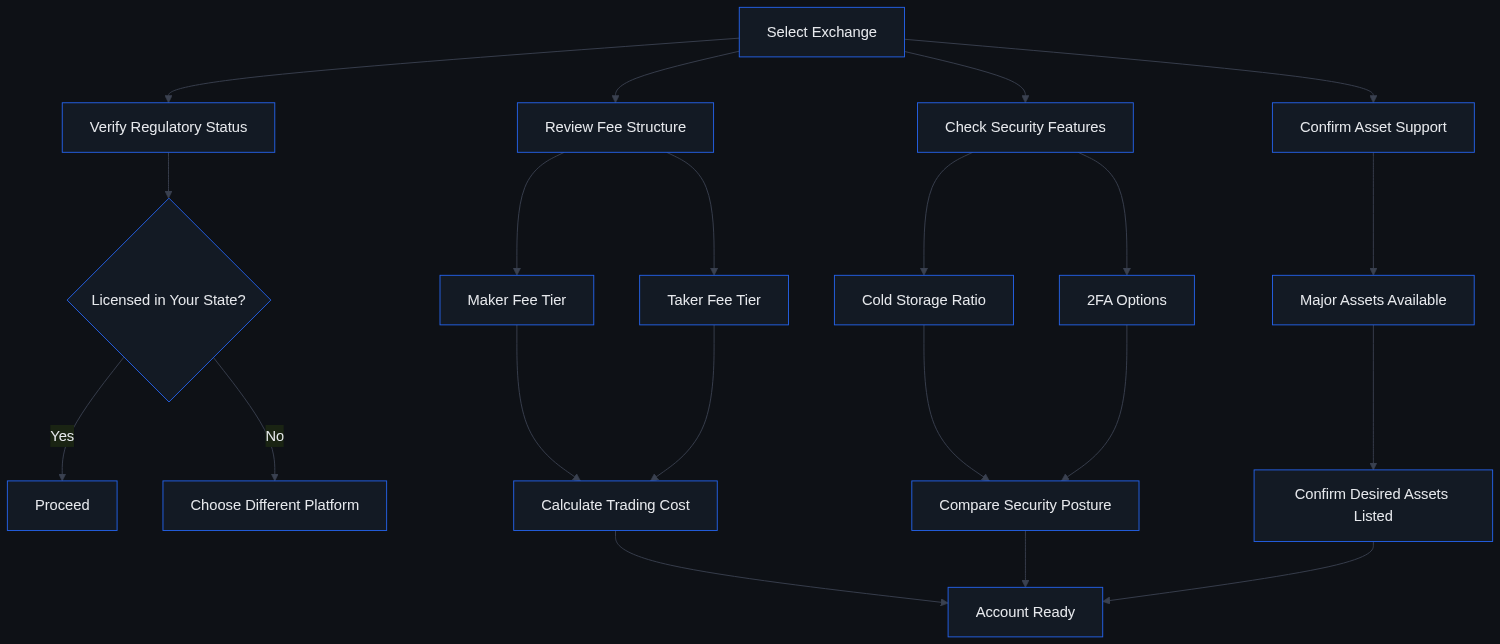
- How to Compare Exchanges: A Practical Checklist
- Frequently Asked Questions
What Is a Crypto Exchange and How Does It Work?
A cryptocurrency exchange is a platform that facilitates the buying, selling, and trading of digital assets. Exchanges operate under one of two structural models:
- Centralized exchanges (CEX): A company acts as an intermediary, holds customer funds in custodial wallets, and matches buy and sell orders through an internal order book. Examples include Coinbase, Kraken, and Gemini.
- Decentralized exchanges (DEX): Smart contracts on a blockchain replace the intermediary. Users retain custody of their private keys and transact peer-to-peer. Examples include Uniswap and dYdX.
For most US-based retail users, centralized exchanges remain the dominant entry point because they support fiat on-ramps (ACH, wire transfer, debit card), comply with FinCEN money-services-business registration requirements, and provide customer support. According to FinCEN guidance, any exchange operating in the US must register as a money-services business and implement AML/KYC programs.
Key Criteria for Evaluating a Crypto Exchange
Before comparing specific platforms, it helps to establish a consistent evaluation framework. The following criteria matter most for US-based users:
1. Regulatory Standing and Licensing
Exchanges operating in the United States must, at minimum, hold a FinCEN MSB registration. Many states impose additional requirements, New York’s BitLicense, issued by the NY Department of Financial Services, is among the most stringent. Platforms registered with the CFTC for derivatives trading face a separate compliance layer. Verifying a platform’s licensing status is a baseline due-diligence step; the CFTC’s public advisory pages list registered and non-registered entities.
2. Fee Structure
Exchange fees vary widely depending on trading volume, account tier, and payment method. Understanding the full cost, including spread, maker/taker fees, withdrawal fees, and conversion fees, is essential. For a deeper breakdown of what these charges mean in practice, see our guide to crypto exchange fees.
3. Supported Assets
Larger exchanges may list hundreds of tokens; smaller platforms may restrict trading to a handful of major assets. The breadth of the asset list matters less than whether it includes the specific assets a user wants to trade.
4. Security Infrastructure
Cold storage ratios, two-factor authentication (2FA) options (hardware key vs. TOTP app vs. SMS), proof-of-reserves audits, and insurance coverage (where applicable) are all meaningful security signals. Exchanges have historically been targets for large-scale hacks; the SEC’s enforcement record shows that regulatory actions for customer-fund mismanagement are not hypothetical.
5. Liquidity and Spread
High liquidity generally results in tighter bid-ask spreads, meaning less slippage on large orders. On-chain analytics providers such as Glassnode and market-data aggregators like CoinGecko publish exchange-level liquidity scores that can supplement published order-book data.
6. User Experience and Account Features
Beginners typically benefit from simplified interfaces, guided onboarding, and educational resources. Advanced traders generally prioritize API access, advanced order types (stop-limit, trailing stop), and charting integrations. Staking, lending, and earn products represent additional feature layers that some users value, though these products may carry separate regulatory and counterparty risks.
Comparing Major US-Accessible Exchanges: At a Glance
The table below summarizes publicly documented characteristics of several widely used platforms. Fee tiers and asset counts change frequently; always verify current terms on each exchange’s official documentation before trading.
| Exchange | Approx. Spot Maker Fee (base tier) | Approx. Spot Taker Fee (base tier) | Fiat On-Ramp | US States Covered | Notable Features |
|---|---|---|---|---|---|
| Coinbase (Advanced) | 0.40%* | 0.60%* | ACH, wire, debit, PayPal | All 50 + DC | Coinbase One subscription; staking; self-custody wallet |
| Kraken | ~0.25%* | ~0.40%* | ACH, wire, Fedwire | Available in most states (NY and ME excluded) | Futures (Kraken Pro); staking; OTC desk |
| Binance.US | 0%* | 0.02%* | ACH (zero fee), wire, debit | Unavailable in a number of states incl. NY, TX, WA, OR, OH, NC, ND, CT, GA, ME, AK, VT (Hawaii supported) | Lowest published US spot fees (since April 2026); BNB fee discount |
| Gemini | 0.20%* | ~0.40%* | ACH, wire, debit | All 50 + DC (NYDFS-chartered trust company) | ActiveTrader interface; SOC 2 Type 2 audited; NYDFS trust charter |
| Robinhood Crypto | No fixed maker/taker split (spread- and routing-based)* | No fixed maker/taker split (spread- and routing-based)* | ACH, debit | All 50 + DC, plus Puerto Rico and US Virgin Islands | Integrated brokerage; no Robinhood-side withdrawal fee to any wallet (network fee applies) |
| Bitstamp (by Robinhood) | 0.30%* | ~0.40%* | ACH, wire, SEPA | Available to US users (federal MSB registration; NY BitLicense) | Longest-operating exchange (2011); acquired by Robinhood in June 2025; increasingly institution-focused, with a reduced US retail emphasis |
* Fee rates are approximate and were checked against each exchange’s publicly available fee schedule and disclosures as of July 1, 2026. Rates may be tiered by 30-day trading volume and are subject to change. Always confirm current fees directly on the exchange’s official fee page.
Security: What to Verify Before Depositing
Security due diligence should precede any deposit. The following checklist covers the most commonly disclosed security measures across major centralized exchanges:
- Cold storage ratio: Some exchanges publicly state that a large percentage of customer funds are held in offline cold storage. Where proof-of-reserves audits exist (e.g., conducted by third-party accounting firms), they add an additional layer of verification.
- 2FA options: Hardware security keys (FIDO2/WebAuthn) offer stronger phishing resistance than SMS-based OTP. Exchanges that support hardware keys include Kraken and Coinbase.
- Insurance coverage: FDIC pass-through coverage may apply to USD cash balances held at partner banks, but this does not cover crypto assets. Private commercial insurance policies vary by exchange and may have coverage caps. Always read the fine print in an exchange’s terms of service.
- Withdrawal address allowlisting: Some exchanges allow users to whitelist withdrawal addresses, requiring email confirmation for any new address, a meaningful defense against account takeover.
- Incident history: Reviewing an exchange’s public security history (disclosed breaches, fund recoveries, and response timelines) is a reasonable baseline check.
Understanding the Fee Layer: Beyond the Headline Rate
A platform’s advertised maker/taker rate is rarely the only cost involved. Users should account for:
- Spread on simple buy/sell interfaces: Platforms that offer a “simple” or “instant buy” interface typically embed a spread (often 0.5%–2.5% depending on the platform and asset) in addition to or instead of a stated commission.
- Network withdrawal fees: Withdrawing crypto to a self-custody wallet incurs a network fee. Some exchanges charge a flat fee on top of the on-chain miner fee; others pass through the estimated network fee directly.
- Conversion fees: Converting one crypto to another (e.g., ETH to USDC) on an exchange’s simple interface may invoke a higher spread than placing a limit order on the pro/advanced trading interface.
- Inactivity and account fees: Less common but worth confirming in the platform’s terms.
For a more complete breakdown of how these charges accumulate across different trading scenarios, our dedicated resource on crypto exchange fees walks through calculation examples.

Exchange Types for Different Use Cases
For Beginners (Including the Best Crypto Apps for Beginners)
Users new to digital assets typically benefit most from exchanges that offer:
- Simple, guided onboarding with identity verification (KYC) completed in-app
- A clean, reduced-clutter buy/sell interface
- Educational content embedded in the platform
- Strong customer support channels (live chat or phone)
- Regulatory clarity (US-licensed, transparent terms)
In practice, most beginners start on a mobile app: the Coinbase and Kraken apps offer the same guided buy flows as their websites, while Robinhood’s app is the most stripped-down option for occasional purchases. Whichever app you choose, the fee mechanics described above apply equally on mobile. If you are purchasing crypto for the first time, our step-by-step walkthrough at how to buy crypto covers the account setup and verification process in detail.
For Active Traders
Higher-frequency traders generally prioritize:
- Low maker fees, ideally below 0.15% at volume tiers
- Robust API access (REST + WebSocket) with high rate limits
- Advanced order types: stop-limit, trailing stop, iceberg orders
- Deep order books and tight spreads on major pairs
- Minimal downtime and transparent SLA commitments
For Long-Term Holders
Users who plan to hold assets for extended periods should weigh:
- The security posture and cold-storage practices of the exchange
- Whether they intend to move assets to self-custody (hardware wallet) after purchase
- Availability of staking or yield products, bearing in mind that these may carry additional risk and are subject to evolving regulatory treatment
Decentralized Exchanges: Key Differences
DEXs operate without a central custodian. Users connect a non-custodial wallet (such as MetaMask or a hardware wallet) and trade directly through smart contracts on protocols like Uniswap or Curve. Significant distinctions from CEXs include:
- Custody: Users retain private-key control at all times; there is no exchange-side custody risk.
- Access: No KYC is required by the protocol itself, though interface-level restrictions may apply depending on jurisdiction.
- Slippage and liquidity: Automated market maker (AMM) models use liquidity pools rather than order books; large trades relative to pool depth may incur significant slippage.
- Smart contract risk: Code vulnerabilities in the underlying contracts represent a category of risk distinct from CEX operational risk.
- Gas fees: On Ethereum and EVM-compatible chains, every swap incurs a network (gas) fee that can be substantial during periods of high on-chain demand.
For most entry-level users, CEXs remain the more accessible starting point due to fiat on-ramp availability and customer support structures. DEXs become relevant primarily when users require access to assets not listed on centralized platforms, or when maintaining self-custody is a priority.
How to Compare Exchanges: A Practical Checklist
- Confirm the exchange operates legally in your state. Check for FinCEN MSB registration and any state-specific money-transmitter licenses relevant to your location.
- Review the full fee schedule on the exchange’s official documentation page, not a third-party summary, and calculate your estimated cost per trade at your anticipated volume tier.
- Audit the security feature set: Cold storage disclosures, 2FA options, proof-of-reserves, and withdrawal allowlisting.
- Test the onboarding process: KYC verification times, supported ID documents, and minimum deposit thresholds.
- Evaluate fiat withdrawal speed and costs: ACH withdrawals may take 1–5 business days; wire transfers may settle faster but carry fees.
- Read the terms of service for asset-specific restrictions, particularly if you intend to trade tokens that may be subject to securities classification scrutiny under SEC guidance.
For a curated, regularly updated analysis of the top platforms across all user profiles (not just beginners), see our full roundup at best crypto exchanges.
Frequently Asked Questions
What is the best crypto exchange for beginners?
For most beginners in 2026, Coinbase is the strongest starting point: it is available in every US state, has the most guided onboarding, and offers public-company transparency, with the caveat that its Simple interface is expensive and switching to Advanced Trade meaningfully reduces costs. Kraken is a strong runner-up with lower fees (though unavailable in New York and Maine), Binance.US offers the lowest published fees where available, and Robinhood is the simplest app for occasional small purchases. See the verdict box at the top of this guide for the full reasoning.
Are crypto exchanges regulated in the United States?
Yes, to varying degrees. At the federal level, exchanges that handle fiat currency must register with FinCEN as money-services businesses and comply with Bank Secrecy Act requirements. Exchanges offering derivatives products may fall under CFTC jurisdiction. The SEC has taken enforcement positions on whether certain tokens constitute securities, which affects which assets exchanges can list for US users. State-level licensing requirements vary significantly.
Is my crypto insured if an exchange is hacked?
Crypto assets held on most exchanges are not covered by FDIC or SIPC insurance. Some exchanges carry private commercial crime insurance policies, but coverage limits and terms vary. USD cash balances held at FDIC-member partner banks may qualify for FDIC pass-through coverage up to applicable limits, but this protection does not extend to crypto holdings. Always review an exchange’s specific insurance disclosures before depositing.
What is the difference between a maker and a taker fee?
A maker places a limit order that adds liquidity to the order book; a taker places a market order (or a limit order that immediately matches an existing order) and removes liquidity. Exchanges typically charge lower fees for makers because they improve market depth. The differential between maker and taker rates is a meaningful cost consideration for frequent traders.
Can I use multiple crypto exchanges simultaneously?
Yes. Many market participants maintain accounts on more than one exchange, for example, using one platform for its fiat on-ramp and another for access to a broader asset selection or lower trading fees. Using multiple platforms does not violate any regulations, though it does require managing separate KYC processes, security configurations, and withdrawal addresses for each account.
What happens to my crypto if an exchange goes bankrupt?
The outcome depends on the jurisdiction and the specific circumstances of the insolvency. High-profile exchange bankruptcies have demonstrated that customer crypto assets can be treated as unsecured claims in proceedings, meaning recovery may be partial and protracted. Self-custody, withdrawing assets to a hardware or software wallet you control, eliminates exchange custody risk, though it introduces the responsibility of managing private keys securely.