Binance vs Coinbase: Which Exchange Wins?

For US-based traders choosing between Binance and Coinbase, the short answer is: Coinbase operates fully within US regulatory frameworks and offers a more straightforward onboarding experience, while Binance.US, the domestic entity of the global Binance platform, now offers substantially lower base trading fees following an April 2026 fee cut, though its asset catalog and history of past restrictions remain narrower than Coinbase’s. Neither platform is universally superior; the better fit depends on fee sensitivity, asset needs, and regulatory comfort level.
| Feature | Binance.US | Coinbase |
|---|---|---|
| Maker / Taker Fee (base) | 0% / 0.02% (all users, no volume tiers, since April 2026) | Advanced Trade entry tier (under $1,000 in 30-day volume): 0.60% maker / 1.20% taker; 0.35% / 0.75% from $1,000 and 0.25% / 0.40% from $10,000; Simple app: roughly 1.5%–4% depending on payment method, spread included |
| Supported cryptoassets | 160+ assets; varies by state | 200+ assets (varies by jurisdiction) |
| Fiat On/Off Ramp (USD) | ACH restored February 2025 after a 2023–2025 suspension; zero-fee ACH | ACH, wire, debit card, PayPal |
| US Regulatory Status | Not named in FinCEN’s 2023 settlement (that applied to Binance Holdings globally); was a co-defendant in an SEC suit dismissed with prejudice in May 2025; unavailable in a number of states (see below) | Publicly listed (NASDAQ: COIN); registered MSB |
| Advanced Trading Interface | Yes (spot, limit, stop-limit) | Yes (Coinbase Advanced) |
| Staking / Earn | Available, subject to state restrictions | Available (state restrictions apply) |
Sources: Binance.US fee announcement (April 2026); Coinbase fee disclosure. Fees verified against exchange disclosures and industry reporting as of July 1, 2026; figures subject to change — verify before trading.
In this article
Fee Structure: How the Two Platforms Compare
Trading fees are frequently the deciding factor for active traders. Binance.US cut its standard spot trading fee to 0% maker / 0.02% taker for all users in April 2026, with no volume minimums, subscription fees, or tiers, a change that put its base rate well below Coinbase’s on both the Simple and Advanced Trade interfaces. Select pairs, such as BNB/USD, trade at 0% maker / 0.01% taker.
Coinbase’s Advanced Trade platform (formerly Coinbase Pro) uses a volume-tiered maker/taker model. Its entry tier (under $1,000 in 30-day trading volume) charges 0.60% maker / 1.20% taker, according to Coinbase’s fee disclosures as reviewed in September 2026; rates step down to 0.35% / 0.75% from $1,000 and 0.25% / 0.40% from $10,000, and tier qualification can also factor in account asset balance under Coinbase’s published rules. Coinbase’s default “Simple” buy/sell interface, used by most first-time buyers, costs meaningfully more once its roughly 0.50% embedded spread and payment-method fee are combined, typically totaling somewhere in the 1.5%–4% range depending on whether funding comes from a bank account or a card.
Binance.US suspended USD bank transfers via ACH in mid-2023, following the SEC’s June 2023 suit against the platform, which reduced the practical utility of its low fees at the time. That suspension ended in February 2025, when Binance.US restored USD deposits and withdrawals via ACH at zero fee. Always verify the current funding methods directly on the exchange before onboarding, since terms can change again.
For a broader look at how these and other platforms structure their costs, see our guide to crypto exchange fees.
Supported Assets and Trading Pairs
Coinbase currently lists over 200 cryptoassets for US customers, according to its asset explorer, with availability varying by state. Binance.US currently lists over 160 cryptoassets, a smaller catalog than before its 2023 delistings following regulatory scrutiny, though its asset count has partially recovered since.
For traders seeking exposure to a wide range of altcoins or newer token listings, the global Binance.com platform offers a far larger catalog, however, Binance.com is not accessible to US residents, as outlined in its terms of service. Attempts to access Binance.com from the US via VPN violate those terms and may expose users to legal risk.
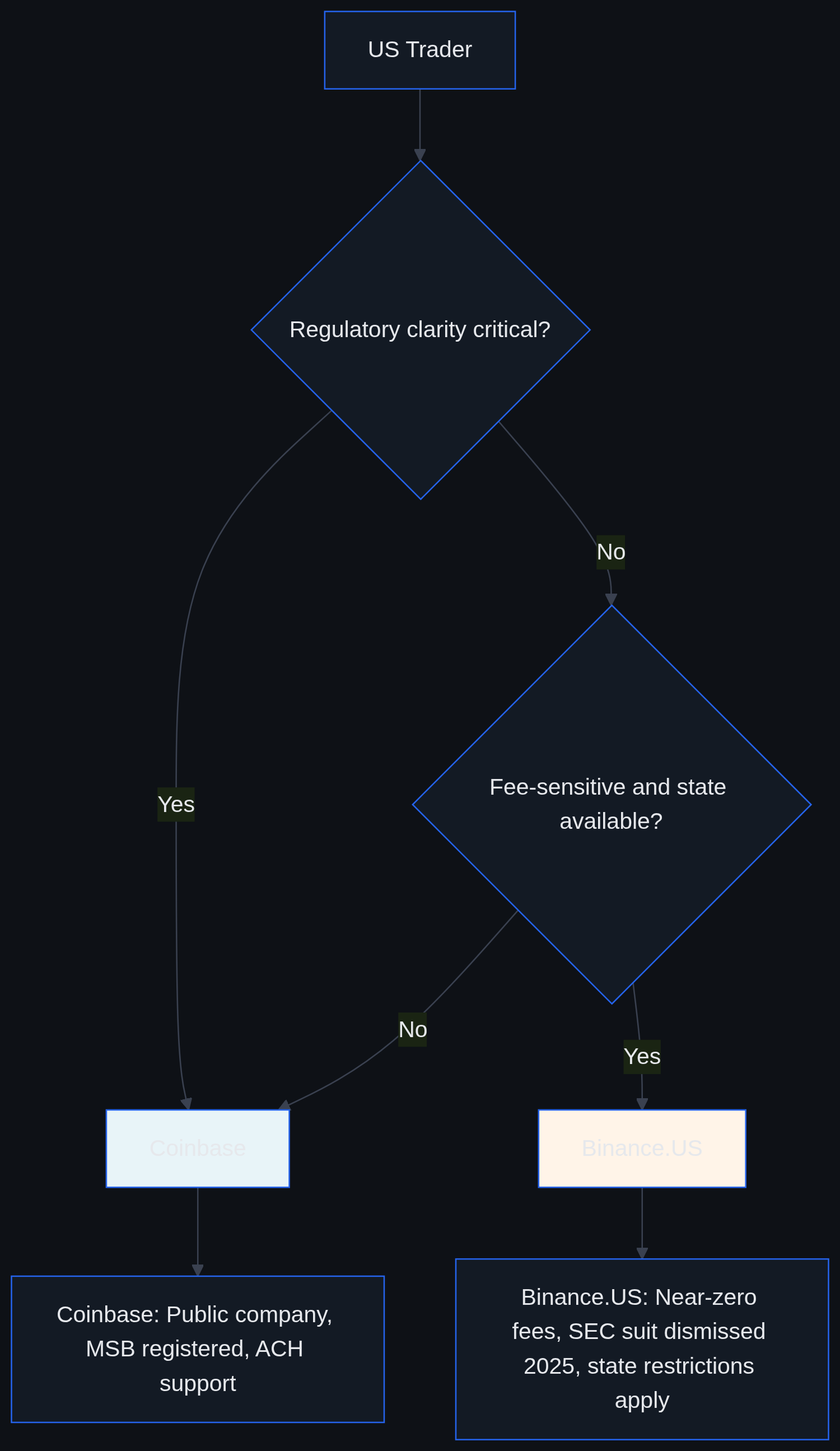
Regulatory Standing in the US
This is arguably the most critical dimension for US users in the current environment.
Coinbase is a publicly traded company listed on NASDAQ (ticker: COIN) and is registered as a Money Services Business (MSB) with FinCEN. It is subject to SEC oversight and has engaged in ongoing dialogue, and legal proceedings, with the SEC regarding asset classification. Its public-company status means it files regular disclosures, providing a degree of transparency unusual in the sector.
Binance.US (operated by BAM Trading Services) is a legally separate entity from Binance Holdings Limited, the global platform that reached a $3.4 billion FinCEN consent settlement in November 2023 for Bank Secrecy Act violations; that settlement named Binance Holdings and affiliated global entities, not Binance.US or BAM Trading Services directly. Binance.US was, however, a co-defendant with Binance Holdings in an SEC lawsuit filed in June 2023 alleging unregistered securities offerings; the SEC voluntarily dismissed that case against Binance and Binance.US with prejudice in May 2025. Availability remains the bigger practical constraint: per Binance.US’s own supported-states list, the platform is not available in a number of states and territories — including New York, Texas, Vermont, Washington, Oregon, Ohio, North Carolina, North Dakota, Connecticut, Georgia, Maine, and Alaska — while Hawaii is currently supported. The list changes over time, so users should verify current state availability directly on Binance.US’s official supported-states page before registering.
User Experience and Interface
Coinbase has historically prioritized accessibility. Its default interface is designed for users new to crypto, with a streamlined buy/sell flow and educational resources. Coinbase Advanced Trade, available within the same account, surfaces limit orders, order books, and volume charts for more experienced traders.
Binance.US mirrors the design philosophy of the global Binance platform to a degree, offering a denser information environment, including spot order books, trade history panels, and basic charting. Some traders find this layout more efficient; others may find it less intuitive than Coinbase’s consumer interface.
Both platforms offer mobile applications for iOS and Android. Independent app-store ratings fluctuate; checking current reviews on the App Store or Google Play at the time of decision is advisable, as ratings may shift following app updates or platform incidents.
Security Architecture
Both exchanges implement standard institutional-grade security measures, including:
- Two-factor authentication (2FA), both platforms require 2FA; hardware-key (FIDO2/WebAuthn) support varies by platform version.
- Cold storage, Coinbase states that the majority of customer assets are held in offline cold storage, per its security documentation. Binance.US publishes similar claims; independent verification is not publicly available.
- Insurance, Coinbase maintains a commercial crime insurance policy for assets held in hot wallets; this is distinct from FDIC insurance, which covers only USD cash balances held in custodial bank accounts, not crypto holdings. Binance.US has described a SAFU (Secure Asset Fund for Users) structure mirroring the global platform, though the funding level of the US-specific fund is not publicly audited to the same standard.
No major exchange is entirely immune to security incidents. Both platforms have experienced varying levels of user-account compromises historically, typically attributed to phishing or credential reuse rather than core exchange breaches. Users should enable all available 2FA options and consider self-custody for large holdings.
Which Platform May Be More Appropriate for Different US Users
Users Who May Prefer Coinbase
- First-time buyers who value a simple, guided purchase flow
- Traders who prioritize regulatory clarity and the transparency of a publicly listed company
- Users who need reliable USD fiat on/off ramps via ACH or wire
- Those in states where Binance.US availability is restricted
- Users interested in staking or earning products with a more established US compliance history
Users Who May Consider Binance.US
- Active spot traders in states where Binance.US remains fully operational and who are fee-sensitive
- Traders familiar with the Binance interface from prior use of the global platform
- Users who have reviewed the current regulatory status and are comfortable with the risk profile
For those still evaluating the broader space, our best crypto exchanges guide covers additional US-accessible platforms that may align with different priorities, including Kraken. For direct head-to-heads with that third platform, see our Coinbase vs Kraken and Binance vs Kraken comparisons. If you are new to purchasing digital assets entirely, the how to buy crypto guide outlines the typical account setup and verification process.
Frequently Asked Questions
What is the best platform to buy crypto in the US?
There is no single universally best platform; it depends on trading volume, desired assets, and fee tolerance. Coinbase is frequently cited by analysts as one of the more regulated and accessible options for US retail users. Platforms such as Kraken, Gemini, and Coinbase Advanced Trade are also commonly referenced in independent comparisons. Evaluating fee structures, supported assets, and current regulatory standing before choosing is advisable.
What are the main disadvantages of Binance for US users?
For US users, the primary disadvantages of Binance.US include: a smaller asset catalog than the global platform, a 2023–2025 suspension of ACH fiat services (since restored), a since-dismissed SEC lawsuit (resolved May 2025), unavailability in a significant number of US states and territories, and a more complex regulatory backdrop than Coinbase. The global Binance.com platform is not available to US residents under its terms of service.
Are Binance fees higher or lower than Coinbase?
As of April 2026, Binance.US’s standard spot trading fee is 0% maker / 0.02% taker for all users, with no volume tiers, lower than both Coinbase’s Simple interface and its Advanced Trade tiers. Coinbase Advanced Trade’s entry tier (under $1,000 in 30-day volume) charges 0.60% maker / 1.20% taker, stepping down to 0.35% / 0.75% from $1,000 and 0.25% / 0.40% from $10,000. The practical comparison also depends on deposit/withdrawal methods and whether promotions are active. Always consult the current fee schedules on each platform directly before transacting.
Is Binance US allowed in the USA?
Binance.US (operated by BAM Trading Services) is a separate entity from global Binance and operates legally in many US states. It was a co-defendant, alongside Binance Holdings Limited, in an SEC lawsuit alleging unregistered securities offerings; the SEC voluntarily dismissed that suit with prejudice in May 2025. The November 2023 FinCEN Bank Secrecy Act settlement applied to Binance Holdings Limited (the global entity), not to Binance.US directly. However, per Binance.US’s own supported-states list, residents of a number of states and territories — including New York, Texas, Vermont, Washington, Oregon, Ohio, North Carolina, North Dakota, Connecticut, Georgia, Maine, and Alaska — currently cannot register; Hawaii is currently supported. US residents should not use Binance.com (the global platform), which explicitly restricts US users in its terms of service. Checking Binance.US’s current state availability page before registration is strongly recommended.
Can I transfer between Binance.US and Coinbase?
Generally, yes, users may withdraw supported cryptoassets from one platform and deposit them to the other using on-chain transfers. Standard network fees (gas, miner fees) apply. Always verify the correct network and wallet address before initiating any transfer, as errors in crypto transactions are typically irreversible.