How to Buy XRP in the US: A Step-by-Step Guide
XRP can be purchased on several major US-based cryptocurrency exchanges, including Coinbase, Kraken, Uphold, and Robinhood, as well as on some international platforms that accept US residents. The process typically involves creating a verified account, funding it via bank transfer or debit card, and placing a market or limit order for XRP. This guide covers where to buy XRP in the United States, how to compare platform fees, and how to custody your tokens once purchased.
In this article
What Is XRP?
XRP is the native digital asset of the XRP Ledger (XRPL), an open-source, public blockchain maintained by a distributed network of validators. Ripple Labs, the company that originally developed the XRPL, holds a significant portion of the total XRP supply in escrow, according to disclosures on Ripple’s official site. The ledger was designed to facilitate fast, low-cost cross-border payments; according to XRPL documentation, transactions on the network typically settle in three to five seconds.
One of the most consequential developments in XRP’s regulatory history came in July 2023, when a US federal court ruled in SEC v. Ripple Labs that programmatic sales of XRP on public exchanges did not constitute unregistered securities offerings, although certain institutional sales were found to be. Both sides appealed, but the case was formally concluded in August 2025, when the SEC and Ripple dropped their respective appeals, leaving the 2023 findings as the final word. Ripple paid a $125 million civil penalty and remains subject to an injunction on direct institutional XRP sales in the US. The outcome gave XRP relatively clear regulatory footing for secondary-market (exchange) trading, which contributed to US platforms relisting or expanding XRP pairs and, in 2025, to the launch of the first US XRP exchange-traded funds. For our full assessment of the bull and bear case, see our XRP investment analysis; for what forecasting models currently project, see our AI XRP price prediction overview. On March 17, 2026, the SEC and CFTC issued a joint interpretive release (Release Nos. 33-11412 and 34-105020) that sorts crypto assets into five categories and names XRP as a digital commodity, which places it under CFTC rather than SEC oversight. An interpretive release is agency guidance rather than legislation, so following news from the SEC and the CFTC remains advisable before transacting.
Where to Buy XRP in the United States
Several regulated and well-capitalized platforms currently offer XRP to US retail customers. Coverage and availability may vary by state due to licensing requirements. The table below summarizes key attributes of commonly used platforms based on publicly available fee schedules and feature documentation.
| Platform | Approx. Spot Trading Fee (Retail) | XRP Withdrawals to External Wallet | US Availability | Regulatory Notes |
|---|---|---|---|---|
| Coinbase | Simple buy ~1% spread + fee; Advanced Trade from 0.60% maker / 1.20% taker at the entry tier (under $1K monthly volume), falling with volume | Yes, on-chain withdrawal supported | All US states | Publicly traded (NASDAQ: COIN); FinCEN registered MSB |
| Kraken | Kraken Pro maker from 0.40%, taker from 0.80% (entry tier since July 9, 2026; discounts for volume or assets held) | Yes, on-chain withdrawal supported | Most US states; not available in New York or Maine | FinCEN registered MSB; state money transmitter licenses |
| Uphold | Spread-based model; no disclosed flat commission, spread may vary | Yes, on-chain withdrawal supported | Not available in New York; check Uphold’s current state list before signing up | FinCEN registered MSB |
| Robinhood Crypto | Commission-free (revenue via spread and order routing) | Yes, crypto withdrawals available | All US states | FINRA member broker-dealer; separate crypto arm licensed |
| Bitstamp | Maker from 0.30%, taker from 0.40% (base tier; volume discounts apply) | Yes, on-chain withdrawal supported | Most US states | Acquired by Robinhood Markets (2025); NY BitLicense holder; FinCEN registered |
Fee data reviewed September 21, 2026. Fees and state availability change frequently; verify current details on the platform before transacting. See our crypto exchange fees guide for a broader comparison across platforms.
Comparing Spread-Based vs. Commission-Based Platforms
Platforms such as Robinhood and Uphold do not charge a visible per-trade commission; instead, they build revenue into the bid-ask spread quoted at execution time. For small trade sizes, a commission-free spread model may result in lower visible costs than a percentage-fee structure, but total execution cost depends on prevailing liquidity and the width of the spread at the moment of the trade. Platforms with explicit maker/taker fee schedules, such as Kraken or Coinbase Advanced Trade, can be more cost-transparent for larger or more frequent trades, though this comparison varies with volume tier.
Buying XRP Exposure Through an ETF
Since 2025, US investors have also been able to gain XRP exposure through exchange-traded funds (ETFs) — first via futures-based products and later spot funds — which trade through an ordinary brokerage account alongside stocks. An ETF can be simpler for investors who do not want to manage a crypto exchange account, a wallet, or private keys, and it fits inside traditional brokerage and retirement accounts. The trade-offs are that you do not hold actual XRP (so you cannot withdraw it to self-custody or use it on the XRP Ledger), and the fund charges an annual expense ratio. For direct ownership of the token itself, a crypto exchange remains the route; the steps below cover that path.
How to Buy XRP: Step-by-Step
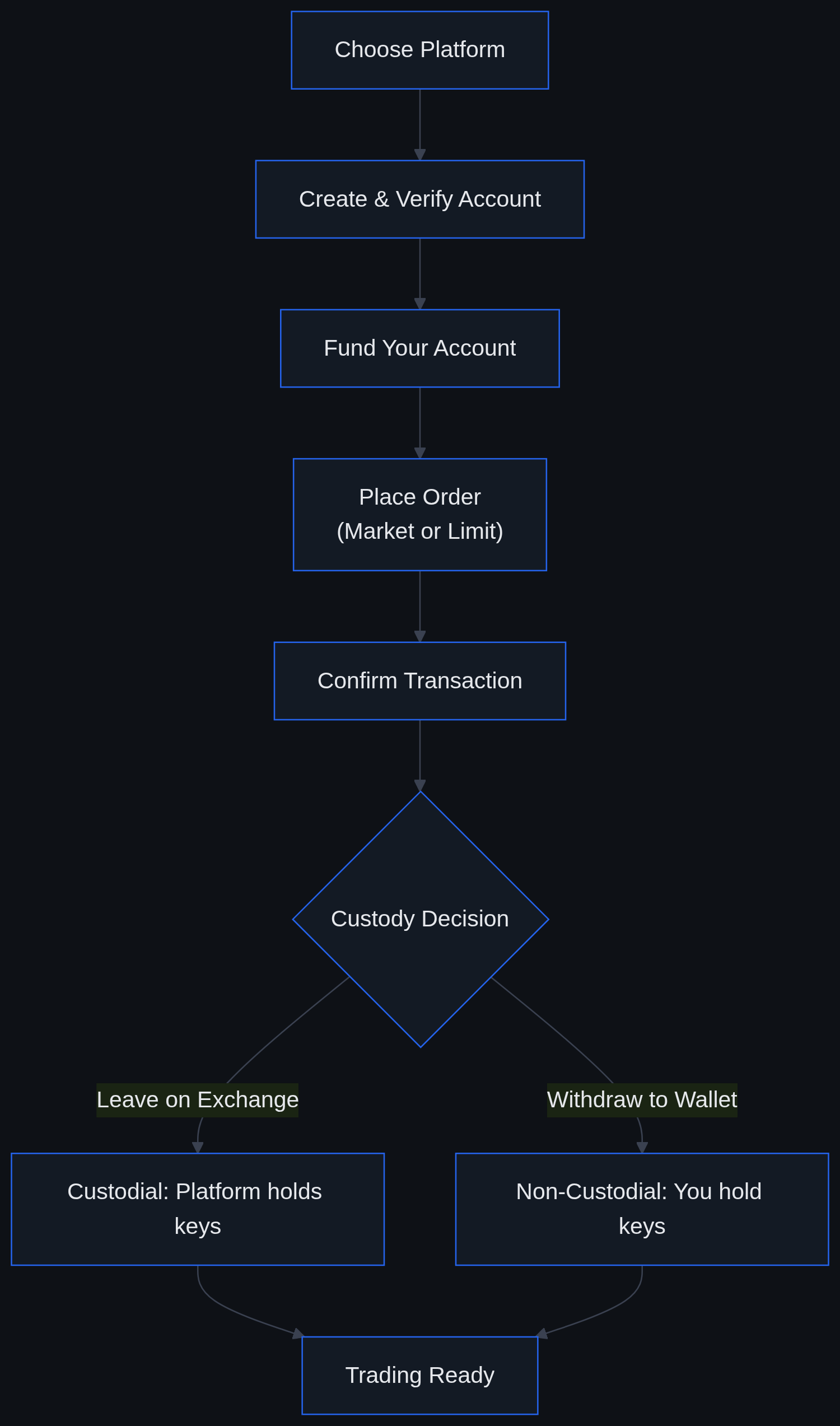
- Choose a platform. Select a US-licensed exchange or broker that lists XRP. Review fee structures, withdrawal policies, and state availability. Our guide to best crypto exchanges provides a comparative overview across major platforms.
- Create and verify your account. US platforms are required by FinCEN regulations to collect Know Your Customer (KYC) information, which typically includes a government-issued photo ID and, in some cases, a selfie for liveness verification. Verification may take minutes or several business days depending on the platform and submission volume.
- Fund your account. Common funding methods include ACH bank transfer (typically 1–5 business days; sometimes with instant buy limits), wire transfer (typically 1–2 business days), or debit card (often instant, but usually at a higher fee). Credit card funding, where permitted, generally carries the highest transaction cost and may be treated as a cash advance by card issuers.
- Place your order. Navigate to the XRP trading pair (commonly XRP/USD). A market order executes immediately at the best available price; a limit order allows you to specify the maximum price you are willing to pay and executes only if the market reaches that level. For new users, a market order is simpler to place, though a limit order may offer marginal cost savings in liquid markets.
- Confirm the transaction. Review the fee estimate and total cost before confirming. Some platforms display a final confirmation screen with an all-in cost breakdown; verify this before proceeding.
- Decide on custody. After purchase, you may leave XRP on the exchange (custodial) or withdraw to a self-custody wallet (non-custodial). Both approaches carry distinct risk profiles, discussed in the section below.
For a broader walkthrough of the purchase process across asset types, see our how to buy crypto guide.
XRP-Specific Technical Details to Know Before Buying
The XRP Ledger Reserve Requirement
The XRP Ledger imposes a minimum account reserve, currently 1 XRP (reduced from 10 XRP in December 2024 via validator fee vote), though this parameter is subject to future amendment by the validator network, that must remain in any XRPL wallet address and cannot be spent or sent. According to XRPL.org documentation, this reserve mechanism is designed to prevent spam account creation. If you intend to withdraw XRP to a self-custody XRPL wallet, you should factor this reserve into the amount you acquire; the reserve XRP is not “lost” but is locked to the address for the life of the account.
Destination Tags
When depositing XRP to a centralized exchange, most platforms require a destination tag, a numeric identifier appended to the transaction that routes funds to the correct user account. Sending XRP to an exchange address without the correct destination tag may result in funds being unrecoverable. Always copy the destination tag exactly as displayed in your exchange deposit interface.
How to Store XRP After Purchase
Once you have acquired XRP, you have two broad custody options: leaving tokens on the exchange or moving them to a self-custody wallet.
Exchange Custody (Custodial)
Leaving XRP on a regulated exchange is convenient for active traders or users who do not yet have a self-custody setup. The platform holds the private keys on your behalf. The primary risk is platform insolvency or a security breach, events that, while historically uncommon at large regulated exchanges, have occurred in the industry. Most US-regulated platforms maintain some form of insurance or cold storage segregation, but coverage terms vary and are not equivalent to FDIC or SIPC insurance.
Self-Custody Wallets (Non-Custodial)
Moving XRP to a wallet where you control the private keys eliminates counterparty risk from the exchange, but introduces the responsibility of securing your own seed phrase. XRP is supported by several hardware and software wallets:
- Hardware wallets: Ledger devices support XRP via the XRP app; Ledger’s documentation outlines the setup process. Trezor’s Model T also supports XRP.
- Software wallets: XUMM (now rebranded as Xaman) is a purpose-built XRPL wallet; details are available at xaman.app. Exodus and Trust Wallet also list XRP support in their respective documentation.
Regardless of wallet type, the seed phrase (recovery phrase) should be stored offline, in multiple secure locations. If the seed phrase is lost, access to the wallet, and any XRP it holds, may be permanently unrecoverable.
Tax Considerations for US Buyers
In the United States, the IRS treats cryptocurrency, including XRP, as property for federal tax purposes, per IRS guidance on virtual currencies. This means that selling, exchanging, or spending XRP may trigger a taxable event; the gain or loss is calculated as the difference between the cost basis and the fair market value at the time of the transaction. Short-term capital gains (assets held one year or less) are taxed at ordinary income rates; long-term gains (assets held more than one year) are generally taxed at lower preferential rates. Investors are advised to maintain detailed records of acquisition cost, date, and disposal proceeds, and to consult a qualified tax professional for guidance specific to their situation.
Frequently Asked Questions
Is XRP available to buy in all US states?
Availability varies by platform and state licensing. Most major exchanges, Coinbase, Kraken, Bitstamp, Robinhood, serve a majority of US states, but some impose additional restrictions. Kraken, for example, is not available in New York or Maine, and Uphold does not operate in several states. Always verify availability in your state directly with the platform before creating an account.
Can I buy a fractional amount of XRP?
Yes. XRP is divisible to six decimal places (the smallest unit is called a “drop,” equal to 0.000001 XRP, per XRPL documentation). Most exchanges allow purchases well below one full XRP, though each platform may impose its own minimum order size, commonly in the range of $1–$10 USD equivalent.
How long does an XRP transaction take?
On-chain XRP Ledger transactions historically settle in approximately three to five seconds under normal network conditions, according to XRPL.org’s consensus documentation. Exchange-to-exchange transfers may take longer due to exchange-side processing and confirmation policies.
Is buying XRP the same as investing in Ripple Labs?
No. Purchasing XRP tokens on the secondary market does not constitute equity ownership in Ripple Labs, Inc. XRP is a digital asset that trades independently; Ripple Labs is a private company. The two are related in that Ripple Labs holds a substantial XRP reserve and develops software for the XRPL ecosystem, but XRP token holders do not hold shares, dividends, or voting rights in Ripple Labs.
Did XRP win its case against the SEC?
The case ended in August 2025 when both the SEC and Ripple dropped their appeals, leaving the 2023 court findings in place: programmatic XRP sales on public exchanges were not unregistered securities offerings, while certain institutional sales were. Ripple paid a $125 million civil penalty and remains under an injunction on direct institutional XRP sales. The result is widely viewed as providing regulatory clarity for secondary-market XRP trading in the US, though it does not guarantee how future regulation will treat the asset. Our XRP investment analysis covers what this means for the asset’s outlook.
What fees should I expect when buying XRP?
Fees depend on the platform and payment method. Trading fees on major exchanges range from near zero (for market makers on high-volume platforms) to approximately 0.50%–1.50% for retail spot purchases, with additional fees potentially applicable for debit card or instant purchases. Withdrawal fees for sending XRP on-chain are typically small (often a flat XRP amount), but vary by platform. Always review the current fee schedule on your chosen exchange before transacting. Our crypto exchange fees page provides a current comparison.
What happens if I send XRP without a destination tag?
Sending XRP to an exchange deposit address without the required destination tag may result in the exchange being unable to credit your account automatically. Recovery procedures vary by platform, some exchanges have a manual recovery process that may involve a fee and an extended timeline; others may not be able to recover the funds. Always confirm whether a destination tag is required before initiating a transfer, and double-check the tag value before sending.