Best Cold Wallets for XRP: Hardware Storage Compared

Choosing the best cold wallet for XRP means balancing two things specific to XRP: the XRP Ledger’s account reserve requirement and its mandatory destination-tag system. Weighing those factors against certification, firmware transparency, and price, Ledger’s lineup comes out as the most versatile all-round pick for most holders, Tangem is the strongest choice for a no-battery, tap-to-sign setup, and the Ballet REAL suits anyone who wants the most literal, fully non-electronic version of “cold” storage. The rest of this guide compares Ledger, Trezor, Tangem, and Ballet in detail and explains how XRPL-specific mechanics should shape your choice of cold storage wallet for XRP, not just generic security specs.
In this article
- At a Glance: Top Cold Wallets for XRP
- Why XRP Needs Special Cold-Storage Considerations
- What Is a Cold Wallet, and Do You Need One for XRP?
- How We Evaluated These Wallets
- Best Cold Wallets for XRP Compared
- Feature Comparison Table
- Security Deep Dive for XRP Cold Storage
- How to Cold-Store Your XRP: Step-by-Step
- Common Pitfalls When Cold-Storing XRP
- Cold Wallet vs. Hot Wallet vs. Exchange Custody for XRP
- XRPL-Native Features That Affect Cold Storage Choice
- Institutional and High-Balance Holder Considerations
- Our Verdict: Best Cold Wallet for XRP by Use Case
- FAQ
At a Glance: Top Cold Wallets for XRP
| Wallet | Type | Price Tier | Security Chip | Native XRPL Support | Best For |
|---|---|---|---|---|---|
| Ledger Flex / Stax / Nano X | Hardware | Premium / Mid-range | Secure Element | Ledger Live app | Broadest coin and app support |
| Trezor Safe 3 / Safe 5 | Hardware | Entry / Mid-range | Secure Element | Trezor Suite | Open-source firmware |
| Tangem | Hardware (NFC card) | Card-based | EAL6+ certified chip | Xaman (via NFC pairing) | No-battery, tap-to-sign use |
| Ballet REAL | Hardware (steel card) | Card-based | None (non-electronic) | Manual/paper-style import | Fully offline, non-electronic storage |
| Xaman (paired with Tangem) | Software + hardware signer | Free app + card | Depends on paired device | Native XRPL wallet | DEX, trust lines, and XRPL-native actions |
The XRPL reserve figures and the Ledger Flex price cited below are verified as of 2026-08-10.
Why XRP Needs Special Cold-Storage Considerations
The XRPL Reserve Requirement Explained
Every account on the XRP Ledger must hold a minimum balance to remain active. Following a validator-approved change that took effect on December 2, 2024, the base reserve is 1 XRP, down from the previous 10 XRP, and each additional ledger object an account owns, a trust line, an open offer, an escrow, adds an owner reserve of 0.2 XRP, according to the official XRPL.org blog. This means a newly created cold-storage address cannot simply sit empty; it needs to hold at least the base reserve before it can function as a receiving address at all. Anyone moving XRP into a hardware wallet for the first time should account for this locked-in minimum rather than assuming every unit sent is available for later withdrawal.
Destination Tags: Why One Missing Number Can Cost You
Unlike Bitcoin or Ethereum addresses, many XRP deposits to exchanges and custodial services rely on a shared address plus a destination tag, a secondary numeric identifier that tells the receiving platform which internal customer account the funds belong to. Omitting or mistyping a required destination tag when sending XRP to an exchange can result in funds that are delayed, unreconciled, or in some cases unrecoverable without manual support intervention. This is a structural feature of how many custodial XRP deposit addresses are architected, not a wallet bug, and it applies whether you are moving funds into cold storage or back out to an exchange.
Why These Two Quirks Matter More for XRP Than for BTC or ETH
Bitcoin and Ethereum wallets generally do not require a minimum reserve to keep an address “alive,” and neither typically depends on a secondary tag field for routing deposits. For XRP holders, a cold wallet’s user interface needs to clearly expose both the reserve implications and a destination-tag input field, since a technically secure device can still lead to a user error that has nothing to do with private-key safety.
What Is a Cold Wallet, and Do You Need One for XRP?
A cold wallet keeps private keys generated and stored on a device that never exposes them to an internet-connected computer or phone, in contrast to a hot wallet (software running on an always-online device) or leaving assets in exchange custody, where the platform, not the user, holds the keys. The case for cold storage is that it removes counterparty exposure: if an exchange is hacked, freezes withdrawals, or becomes insolvent, self-custodied holdings in a hardware wallet are not directly affected.
The case against moving everything to cold storage is added friction. Hardware wallets require careful seed-phrase backup, they add a step to every transaction, and a lost or damaged device without a backed-up recovery phrase can mean permanently lost funds. For a small trading float used for near-term buying and selling, many users find it more practical to keep those funds on a reputable exchange or in a hot wallet and reserve cold storage for longer-term holdings. If you are still deciding how to acquire XRP in the first place, see our guide on how to buy XRP for exchange-level considerations before moving funds into self-custody.
How We Evaluated These Wallets
This comparison weighs each device on: whether it uses a certified secure chip, whether firmware is open-source and independently auditable, whether the companion app handles XRP natively (including a destination-tag input field), backup and recovery options, and general price positioning. Any security-certification or breach-history claim referenced below is drawn from each vendor’s own product or security documentation rather than third-party marketing copy, since manufacturer claims about “military-grade” security or “unhackable” designs are common in this space and should be treated with appropriate skepticism.
Best Cold Wallets for XRP Compared
Ledger (Nano X, Flex, Stax): Best All-Round Support
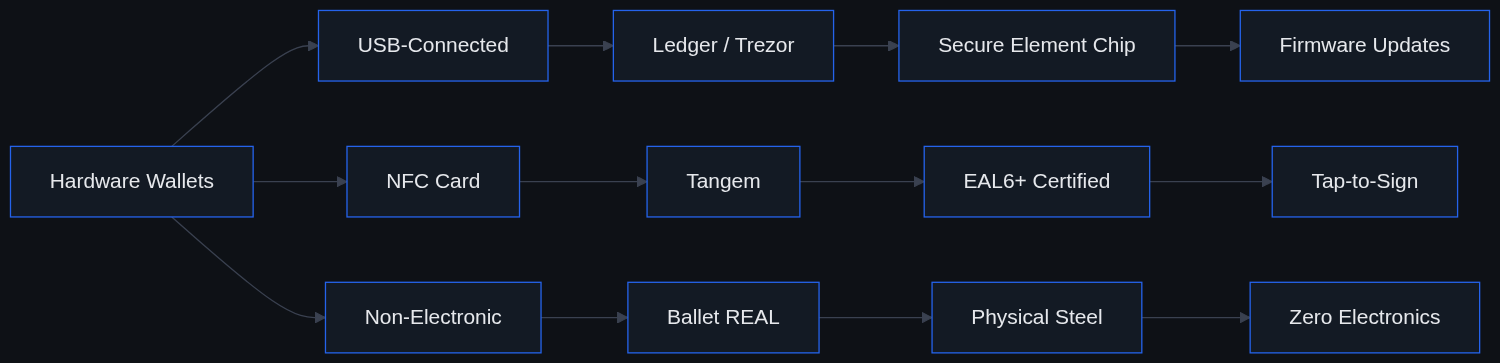
Ledger’s device lineup pairs a Secure Element chip with the Ledger Live companion app, which supports XRP account setup, including an address and destination-tag field for exchange transfers, per Ledger’s XRP wallet page. The current Ledger Flex retails at $249, according to Ledger’s own device comparison page. Ledger also continues to sell the Stax and the older Nano X as alternative form factors, reportedly priced around $399 and $149 respectively, per aggregator reporting, though hardware vendors periodically adjust device lineups and discontinue older SKUs.
- Pros: Broadest multi-coin support beyond XRP; mature companion app; widely used in the industry
- Cons: Closed-source firmware components; premium devices carry a higher price than entry-level competitors
Trezor Safe 3 / Safe 5: Best for Open-Source Purists
Trezor’s Safe series pairs a secure chip architecture with Trezor Suite, the companion desktop and web app that supports XRP account management, per Trezor’s official XRP wallet page. Trezor’s guidance reinforces that a destination tag is required when withdrawing XRP to an exchange, consistent with the XRPL-wide destination-tag mechanics described above. Trezor’s devices are positioned as more open than many competitors, with firmware code published for independent review, which appeals to users who prioritize auditability over brand convenience.
- Pros: Open-source firmware; strong community audit history; straightforward XRP setup flow
- Cons: Smaller companion-app ecosystem than Ledger; fewer XRPL-native dApp integrations

Tangem: Best Card-Based, No-Battery Hardware Option
Tangem takes a different form factor entirely: a credit-card-sized device with an embedded chip that generates keys on-card and requires no battery or USB connection, signing transactions via NFC tap. According to Tangem’s own product documentation, the XRP card uses an EAL6+ certified secure chip, a certification level comparable to those used in biometric passports, and integrates with the Xaman app for XRPL-native functions such as DEX access, all through tap-to-sign authentication rather than a seed phrase written down by the user.
- Pros: No battery or cables to fail; no traditional seed phrase to store; simple tap-based signing
- Cons: Recovery model differs from seed-phrase wallets, so users must understand Tangem’s own backup-card process; smaller physical form factor can be misplaced
Ballet REAL: Best Fully Offline, Non-Electronic Option
According to product descriptions, the Ballet REAL is a stainless-steel card with no battery, no USB port, and no on-device screen, with keys reportedly embossed or encoded physically rather than stored in active electronics. This design is marketed as one of the more literally “cold” options available, since there would be no firmware to update or battery to fail. Multi-currency versions are reportedly designed to support assets including XRP.
- Pros: Reportedly no electronics at all, which would eliminate firmware and battery failure points; durable physical design
- Cons: No companion app for transaction signing on the card itself; recovery and setup process is less intuitive than app-guided hardware wallets
Xaman Paired With a Hardware Signer: Best XRPL-Native Software Layer
Xaman is a widely used mobile app built specifically for the XRP Ledger, supporting trust lines, escrows, and DEX interactions in a way few general-purpose wallet apps do. It is important to be precise about terminology here: Xaman on its own, installed on an internet-connected phone, is a hot wallet, not cold storage, because its keys are generated and can be accessed on a networked device. It becomes part of a genuine cold-storage setup only when paired with an offline hardware signer such as a Tangem card, where the card holds the private key and Xaman serves purely as the transaction-construction and broadcast interface, per Xaman’s own product site. Some marketing language in the space describes Xaman loosely as a “cold wallet,” which overstates what the standalone app provides.
Feature Comparison Table
| Wallet | Coins Supported | Connectivity | Destination-Tag Field | Backup Method |
|---|---|---|---|---|
| Ledger Flex / Stax / Nano X | Multi-coin | USB-C / Bluetooth (model-dependent) | Yes, via Ledger Live | Seed phrase (24 words) |
| Trezor Safe 3 / Safe 5 | Multi-coin | USB-C | Yes, via Trezor Suite | Seed phrase, with Shamir backup on select models |
| Tangem | Multi-coin | NFC (tap-to-sign) | Yes, via Xaman pairing | Backup card set, no written seed phrase |
| Ballet REAL | Multi-coin | None (non-electronic) | Manual entry when funding from an exchange | Physical steel card |
Security Deep Dive for XRP Cold Storage
A Secure Element chip is a dedicated, tamper-resistant component built to resist physical extraction attacks, distinct from the general-purpose processors used in ordinary consumer electronics. Ledger and Trezor both use this class of chip in their current lineups, and Tangem’s card uses an EAL6+ certified chip, a rating in the same tier used for government identity documents. Open-source firmware, championed most visibly by Trezor, allows independent researchers to review the code that runs on the device, while closed-source approaches argue that limiting code visibility can reduce certain attack surfaces. This remains an ongoing debate in the hardware-wallet community rather than a settled question.
Seed-phrase backups deserve as much attention as the device itself. Writing a recovery phrase on paper leaves it vulnerable to fire, water damage, or simple degradation; many experienced holders instead use metal backup plates, and some Trezor and Ledger models support Shamir Secret Sharing, which splits a recovery phrase into multiple shares so that no single share alone can reconstruct the wallet. Advanced XRPL users can also configure multi-signature accounts natively on the ledger itself, requiring signatures from more than one device before a transaction is valid, a setup covered further below for larger holdings.
On the question of which brand is “most trusted,” there is no single objectively correct answer. Rather than picking a winner, it is more useful to compare each vendor’s certification level, firmware transparency, and track record as disclosed on their own security documentation, and to weigh that against your own technical comfort level and the assets you intend to store.
How to Cold-Store Your XRP: Step-by-Step
- Purchase the hardware wallet directly from the manufacturer’s official store rather than a third-party marketplace, to avoid the risk of a tampered device.
- Initialize the device and write down the generated seed phrase offline, never photographing or typing it into a connected device.
- Install the companion app, Ledger Live, Trezor Suite, or Xaman, and add an XRP account to the device.
- Fund the account with at least the current base reserve before attempting to receive further deposits, since an XRPL account below the reserve threshold cannot hold a balance in the normal sense.
- Generate the receiving address and, if funding from an exchange, confirm whether a destination tag is required and enter it exactly as shown.
- Send a small test transaction first and confirm it arrives correctly before moving a larger balance.
- Store the seed-phrase backup in a separate secure physical location from the device itself.
Common Pitfalls When Cold-Storing XRP
- Forgetting the destination tag when withdrawing from an exchange, which can delay or misroute funds
- Sending less than the required reserve to a new account, leaving it unable to properly hold or receive XRP
- Buying a hardware wallet through an unofficial reseller, introducing tampering risk before the device ever reaches you
- Storing a seed phrase digitally, in a photo, note app, or cloud drive, rather than offline
- Treating a standalone Xaman installation as true cold storage when it is not paired with an offline hardware signer
Cold Wallet vs. Hot Wallet vs. Exchange Custody for XRP
| Storage Type | Key Control | Convenience | Hack Exposure | Best Use Case |
|---|---|---|---|---|
| Cold wallet | User holds keys offline | Lower, extra steps per transaction | Low, if device and backup are secured properly | Long-term holdings |
| Hot wallet | User holds keys on a connected device | High | Moderate, exposed to device/malware risk | Active DeFi or dApp use |
| Exchange custody | Platform holds keys | Highest | Depends on platform security practices | Active trading float |
A hybrid approach is common in practice: keep a modest trading float on a reputable platform (our best crypto exchange for beginners comparison covers several options) or in a hot wallet for active use, while moving the larger portion of long-term holdings into cold storage.
XRPL-Native Features That Affect Cold Storage Choice
The XRP Ledger supports trust lines for issued currencies, escrow for time- or condition-locked payments, and native decentralized exchange functionality including automated market maker pools. Funds held in a properly configured cold wallet can still participate in these mechanisms in principle, since they are account-level features of the ledger itself rather than something tied to a specific wallet brand, but each transaction still needs to be signed by the offline device, meaning power users who actively use trust lines, escrows, or the DEX will want a wallet whose companion app exposes those functions clearly, which is where XRPL-native apps like Xaman (paired with a hardware signer) tend to offer a smoother experience than a generic multi-coin app.
Institutional and High-Balance Holder Considerations
Holders managing larger XRP balances sometimes move beyond a single device toward multi-signature setups, where several independent hardware wallets must each sign a transaction before it is valid on the ledger, reducing the risk that a single compromised device or lost key results in a total loss. Institutions and large holders also weigh custody-as-a-service providers against pure self-custody: third-party custody can offer insurance and operational support but reintroduces counterparty trust, while self-custody (including running dedicated XRPL infrastructure) maximizes control at the cost of added operational responsibility. The right choice generally scales with balance size and the internal resources available to manage keys securely.
Our Verdict: Best Cold Wallet for XRP by Use Case
For most XRP holders seeking broad coin support and a mature companion app, Ledger’s lineup remains the most versatile all-round pick. Users who prioritize open, auditable firmware over brand convenience may prefer Trezor’s Safe series. Tangem stands out as the best budget-friendly, no-battery option for holders who want simple tap-to-sign access, particularly when paired with Xaman for XRPL-native features. For those who want the most literal interpretation of “cold,” no electronics whatsoever, the Ballet REAL is the closest fit, though it trades away app-guided convenience. There is no single best wallet for XRP that fits every holder; the right pick depends on balance size, technical comfort, and how often you expect to interact with XRPL-native features versus simply holding.
For broader context, see our guide to How To Buy Crypto.
FAQ
Should I put my XRP in a cold wallet?
For holdings beyond what you need for near-term trading, moving XRP into a cold wallet removes exposure to exchange-level risks such as hacks or insolvency. Smaller trading balances are often kept on an exchange or hot wallet for convenience instead.
Where is the safest place to store my XRP?
A properly set up hardware wallet with the seed phrase backed up offline in a separate secure location is generally considered safer than leaving large balances on an exchange, though no storage method eliminates all risk, including physical loss or user error such as a missing destination tag.
How do I cold store my XRP?
Buy a hardware wallet from the manufacturer directly, initialize it and record the seed phrase offline, install the matching companion app, fund the account above the required reserve, confirm any destination tag when transferring from an exchange, and test with a small amount before sending a full balance.
What is the most trusted crypto cold wallet?
There is no single wallet universally regarded as “most trusted.” Instead, compare each vendor’s chip certification, firmware transparency, and published security documentation, and match that against your own technical needs.
Can I stake or use XRP while it’s in cold storage?
XRP itself does not use a staking mechanism, but ledger-native features like trust lines, escrow, and DEX trades can still be signed from a cold wallet in principle, since these are account-level XRPL functions rather than features tied to a specific device. Each such transaction still requires signing on the offline hardware, so an app with clear XRPL-native support, such as Xaman paired with a hardware signer, tends to make these interactions more straightforward.