ChatGPT XRP Price Prediction: How Accurate Is It?

Large language models such as ChatGPT have become a common starting point for retail crypto researchers seeking rapid price commentary on assets like XRP (Ripple). When prompted with market context, ChatGPT can synthesize publicly available data, on-chain fundamentals, and historical price patterns into a structured outlook, though it is not a financial adviser, does not access live market feeds by default, and carries significant epistemic limitations that any responsible reader must weigh carefully. This guide examines what ChatGPT typically says about XRP, how those outputs are generated, and why they should be treated as one data point among many rather than a reliable signal.
In this article
- Understanding How ChatGPT Generates Crypto Price Views
- What ChatGPT Typically Says About XRP’s Fundamentals
- ChatGPT XRP Price Prediction: What the Model Has Said
- Factors ChatGPT Identifies as Driving XRP Price
- Should You Use ChatGPT for Crypto Research?
- Comparing AI Price Prediction Sources
- Frequently Asked Questions
Understanding How ChatGPT Generates Crypto Price Views
ChatGPT is a generative AI developed by OpenAI. In its base configuration, the model draws on a training dataset with a fixed knowledge cut-off; it does not stream live price data from exchanges or aggregators such as CoinGecko or CoinMarketCap unless connected to a real-time tool or plugin. This distinction matters enormously when interpreting any output labelled an “AI XRP price prediction.”
When users supply current price context in their prompt, for example, pasting in a recent price level and asking for a 30-day target, ChatGPT attempts to reason about that figure using learned patterns from its training corpus. The result is a probabilistic language output, not a quantitative model trained specifically on order-book dynamics, on-chain flows, or derivatives positioning. Some analysts argue this makes ChatGPT outputs useful as a structured summary of mainstream narrative rather than as independent price discovery.
Key Limitations to Keep in Mind
- No live data access by default. Unless the user is running a tool-enabled session, ChatGPT cannot see the current spot price, volume, or open interest.
- Training-data bias. The model reflects the sentiment and analytical frameworks prevalent in its training text, which may over-represent retail-facing media rather than institutional research.
- Hallucination risk. Generative models can produce confident-sounding but factually incorrect statistics. Any specific figure ChatGPT cites about XRP supply, transaction speed, or historical price should be verified against primary sources such as the XRP Ledger documentation or Ripple’s official publications.
- No accountability loop. A licensed analyst faces regulatory consequences for materially misleading forecasts; a language model does not.
What ChatGPT Typically Says About XRP’s Fundamentals
When prompted about XRP’s underlying technology and use case, ChatGPT generally highlights several factors that analysts and researchers commonly discuss in public forums. The following reflects the kind of structured summary ChatGPT produces, not an endorsement of any claim:
Use Case and Network Role
ChatGPT typically notes that XRP functions as a bridge currency on the XRP Ledger (XRPL), designed to facilitate low-cost, near-instant cross-border payments. Ripple Labs, the company most closely associated with XRP’s development, targets the correspondent banking and remittance markets. According to XRPL.org, the ledger settles transactions in roughly 3–5 seconds with fees that have historically been fractions of a cent. ChatGPT usually reproduces these benchmark figures, though it may round or slightly misstate them, users should verify against the source directly.
The SEC Lawsuit and Its Aftermath
Any complete ChatGPT response about XRP will almost certainly reference the U.S. Securities and Exchange Commission’s December 2020 lawsuit against Ripple Labs. The SEC alleged that XRP was offered as an unregistered security. In July 2023, Judge Analisa Torres issued a mixed ruling finding that programmatic sales of XRP on exchanges did not constitute securities transactions, while institutional sales did. This ruling, and subsequent settlement proceedings, has been described by some market observers as a pivotal regulatory clarity event for the asset. ChatGPT typically identifies the lawsuit’s resolution as a key bullish catalyst that prompted several exchanges to relist XRP in the U.S. market. For our own assessment of what that resolution means for the asset’s fundamentals, see our XRP investment analysis.
Supply and Escrow Structure
ChatGPT generally notes that a significant portion of XRP’s total supply is held in escrow by Ripple Labs and released on a periodic schedule. Specific supply figures change over time; for current circulating supply, readers should consult a live aggregator. The escrow mechanism is documented on XRPL.org. This periodic release is a factor some analysts cite when modeling potential selling pressure.

ChatGPT XRP Price Prediction: What the Model Has Said
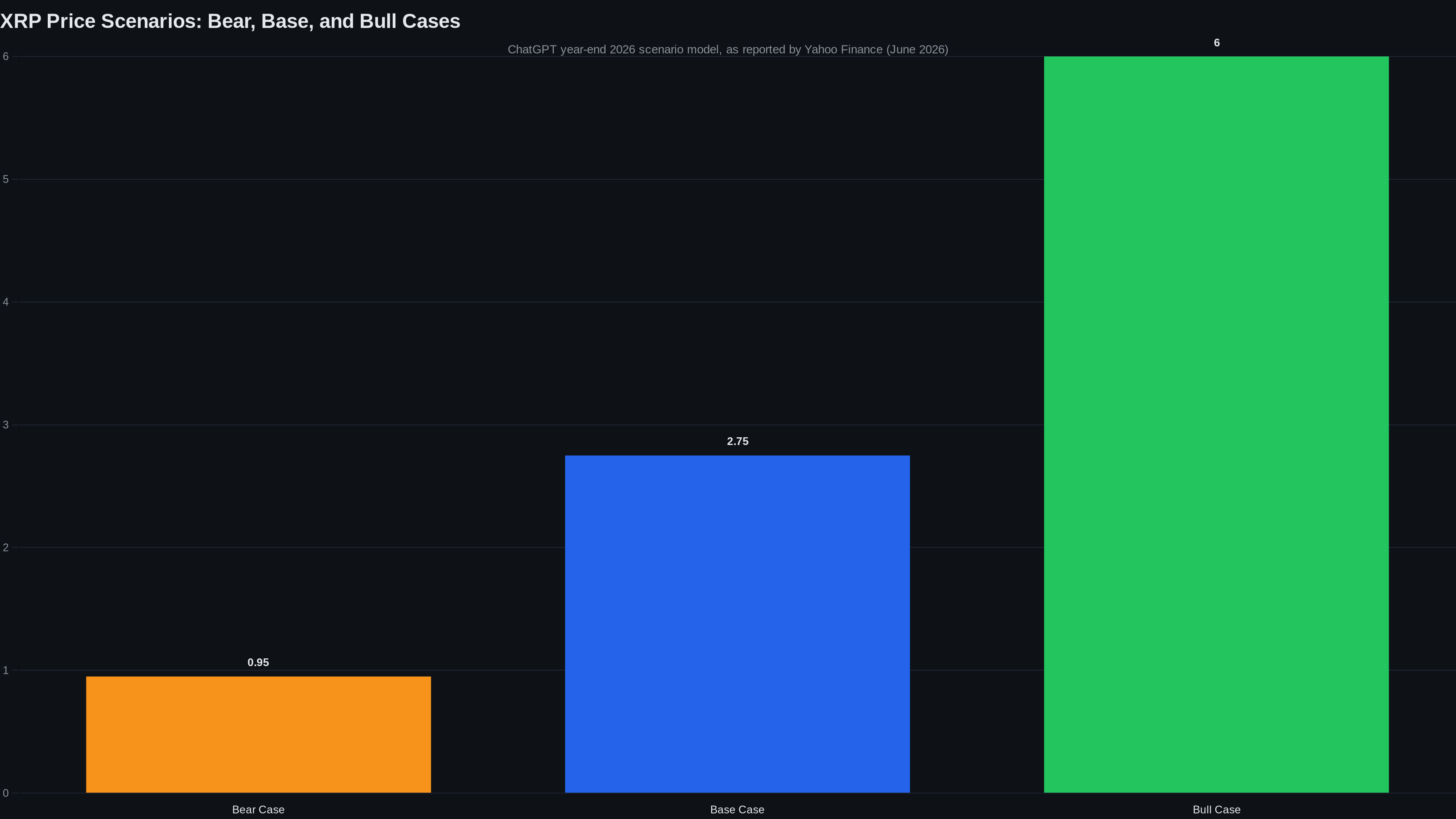
In circulating screenshots and articles published in mid-2026, users prompted ChatGPT with then-current market context and received structured 30-day and 12-month outlooks. According to reporting from Yahoo Finance (June 8, 2026), one widely-shared ChatGPT response, given a prompt stating XRP was trading near $1.16, returned a 30-day range of approximately $1.55–$1.80, citing a deeply oversold RSI reading, strong recent XRP ETF inflows, and XRP’s track record of recovering from earlier 2026 selloffs as supporting factors.
Several important caveats apply to interpreting that output:
- Prompt dependency. ChatGPT’s output is heavily shaped by how the question is framed. A bullishly framed prompt often produces a bullishly framed answer. Independent replication of exact outputs is therefore difficult.
- Point-in-time snapshot. Any specific range cited reflects the context supplied at the time of the query. Market conditions for XRP, or any crypto asset, can shift materially within days based on macro events, exchange listings, regulatory news, or broader risk-off sentiment.
- Not a model-generated forecast. ChatGPT is not running a regression, a time-series model, or a Monte Carlo simulation. It is generating text that plausibly fits the narrative context it has been given.
Readers comparing these figures to third-party aggregator forecasts, such as those published by platforms like Changelly, should note that dedicated prediction platforms typically employ algorithmic models trained on price-history data, which is a methodologically different approach than generative language modeling, even if the outputs may appear superficially similar. For a roundup of what multiple AI models and algorithmic platforms project for XRP — rather than how ChatGPT specifically behaves as a research tool — see our companion piece on AI XRP price predictions across the major models.
Factors ChatGPT Identifies as Driving XRP Price
Across commonly shared ChatGPT responses about XRP, several recurring factors appear. These broadly align with what independent crypto-market analysts also discuss:
| Factor | Typical ChatGPT Characterization | Analytical Note |
|---|---|---|
| Regulatory clarity (U.S.) | Bullish catalyst following 2023 ruling and settlement | Ongoing; future enforcement actions remain possible under SEC or CFTC jurisdiction |
| Ripple partnerships | Financial institution adoption supports demand narrative | Partnership announcements vary in disclosed scale; verify against Ripple press releases |
| Bitcoin market cycle | XRP historically correlates with broad crypto market direction | Correlation is not constant; altcoin-specific catalysts can decouple temporarily |
| RLUSD stablecoin launch | Ripple’s USD stablecoin may increase on-chain activity | Early-stage; volume data should be tracked via XRPL explorers |
| Escrow releases | Periodic supply additions may create selling pressure | Ripple has historically re-escrowed unsold portions; actual market impact is debated |
| ETF speculation | Potential XRP spot ETF filings cited as demand catalyst | Subject to SEC review; no guarantee of approval timeline |
Should You Use ChatGPT for Crypto Research?
ChatGPT can serve as a useful brainstorming and summarization tool within a broader research workflow. For example, it may help a reader quickly outline the regulatory history of XRP, generate a list of questions to investigate, or explain technical concepts like the Federated Consensus mechanism used by the XRPL. These are legitimate research support functions.
Where it is less reliable is in generating precise price targets, interpreting recent on-chain metrics it cannot see, or identifying near-term catalysts that emerged after its training cut-off. Supplementing ChatGPT’s output with primary sources, exchange announcements, XRPL on-chain data from explorers like XRPScan, and regulatory filings from SEC.gov, materially improves the quality of research conclusions.
For readers new to acquiring crypto assets, our guide to how to buy crypto walks through the account setup, verification, and order-type basics that apply across major U.S.-regulated platforms, and our XRP-specific walkthrough covers how to buy XRP in the US step by step. Understanding exchange mechanics, including fee structures covered in our crypto exchange fees breakdown, is a foundational step before acting on any market thesis, AI-generated or otherwise.
Comparing AI Price Prediction Sources
ChatGPT is not the only AI-adjacent tool producing XRP commentary. The table below outlines how different source types differ in methodology, which helps contextualize what any given “AI prediction” actually represents:
| Source Type | Methodology | Strengths | Limitations |
|---|---|---|---|
| ChatGPT (general) | Generative language model, static training data | Fast synthesis of public narrative; accessible | No live data; hallucinates specifics; prompt-sensitive |
| Algorithmic price aggregators | Statistical models trained on OHLCV data | Reproducible; uses actual historical price series | Past performance does not predict future results; sensitive to parameter choices |
| On-chain analytics platforms | Raw ledger data (wallets, flows, exchange reserves) | Grounded in verifiable blockchain activity | Requires interpretation; correlation to price is imperfect |
| Licensed research desks | Macro + fundamental + technical analysis | Accountable; often discloses conflicts of interest | Access often restricted; may still be wrong |
Frequently Asked Questions
What does ChatGPT say about XRP?
When given market context in a prompt, ChatGPT typically summarizes XRP’s cross-border payment use case, the resolution of the SEC v. Ripple lawsuit, and factors like Bitcoin’s market cycle and Ripple’s institutional partnerships as price drivers. Specific price ranges it outputs depend heavily on the context supplied by the user and should not be treated as an independent quantitative forecast. As noted by Yahoo Finance, prompts supplied with specific price context in mid-2026 generated ranges that reflected the bullish narrative dominant at the time.
Is ChatGPT reliable for XRP price predictions?
ChatGPT is a language model, not a financial forecasting system. Its outputs on price are better understood as structured narrative summaries than as quantitative predictions. For more rigorous analysis, users may want to cross-reference on-chain data platforms, algorithmic aggregators, and primary sources such as exchange filings and regulatory documents. Our overview of AI and model-based XRP price predictions compares what the different forecasting approaches currently show.
Where can I verify XRP supply and network data?
Primary sources for XRP Ledger data include XRPL.org, the XRPScan block explorer, and Ripple’s official insights blog. Live circulating supply figures are published by aggregators such as CoinGecko and CoinMarketCap; always check the date of any figure you reference.
Did the SEC lawsuit affect XRP’s U.S. availability?
Yes. Following the SEC’s December 2020 complaint, several U.S.-based exchanges suspended XRP trading. After the July 2023 partial summary judgment and subsequent settlement proceedings, a number of platforms relisted XRP for U.S. customers. The SEC’s original complaint and related documents are publicly accessible via SEC.gov. Readers considering exchange options can review our best crypto exchanges guide for platforms currently supporting XRP in the United States.
Does ChatGPT have access to live XRP prices?
In its standard configuration, ChatGPT does not have access to live market data. Users running ChatGPT with browsing or plugin tools enabled may receive more current context, but even then the model’s reasoning process is distinct from a dedicated quantitative trading system. Always confirm live prices directly on an exchange or a reputable aggregator before making any trading decision.