Can You Claim Crypto Losses on Taxes? What Counts and How Much
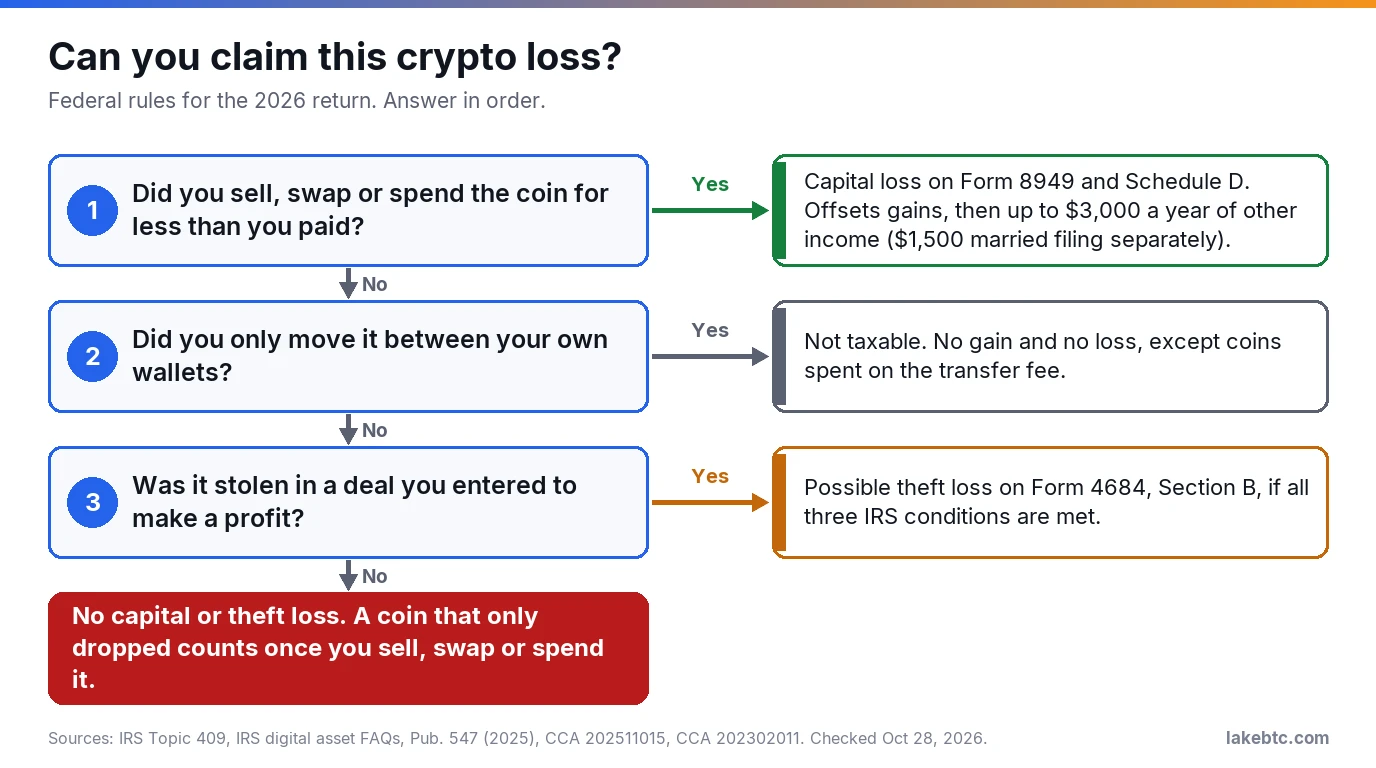
Yes, when you sell, trade or spend crypto for less than you paid. Losses cancel gains first, then up to $3,000 of other income a year. The rest carries forward.
A crypto loss only counts for taxes once it’s real. That means you sold the coin, swapped it for another one, or spent it, and got less than you paid. A coin that’s deep in the red in your wallet doesn’t give you a deduction yet, however painful it looks.
For federal taxes your crypto is property, not currency, so a loss works much like a loss on a stock. It first cancels out your capital gains for the year. Whatever’s left can lower your other income, within a yearly limit, and you carry the rest into later years.
Everything below is for the 2026 return you’ll file in spring 2027. Where the IRS hasn’t posted 2026 instructions yet, the year of the rule is named.
Before you count on a crypto loss
- 🟢 A loss counts once you sell, swap or spend the coin for less than you paid.
- 🟡 Losses cancel your capital gains first, then up to $3,000 of other income a year ($1,500 married filing separately).
- 🟢 Unused losses carry forward to later years.
- 🔴 A coin that only dropped in price, or a romance scam, gives you no deduction.
In this article
- Which crypto losses you can claim
- How much you can deduct each year
- Short-term and long-term losses
- How to report a crypto loss
- Scam and theft losses
- Does the wash sale rule apply to crypto?
- Keep records that match your 1099-DA
- The fake IRS letter that targets crypto holders
- Frequently Asked Questions
- What to do before you file
Which crypto losses you can claim
The question isn’t whether you lost money. It’s what happened to the coin. This table covers the cases people run into most:
| What happened | Can you claim it? | Where it goes |
|---|---|---|
| Sold crypto for dollars below what you paid | Yes, as a capital loss | Form 8949, then Schedule D |
| Swapped one coin for another worth less than your cost | Yes, as a capital loss | Form 8949, then Schedule D |
| Spent crypto on goods or services worth less than your cost | Yes, as a capital loss | Form 8949, then Schedule D |
| Still holding a coin that crashed but still trades | Not yet. It counts once you sell, swap or spend it. | Nothing to report for the drop |
| Moved coins between your own wallets or accounts | No. It’s not taxable, except coins used to pay the transfer fee. | Nothing for the move itself |
| Stolen in a scam you entered to make a profit, such as a fake investment | Possibly, as a theft loss, if three IRS conditions are met | Form 4684, Section B |
| Lost in a romance or kidnapping scam | No. A 2025 IRS memo treated it as a personal loss. | Not deductible |
| Lost keys, or sent coins to a wrong address | Not as a capital loss, in our reading. It’s not a sale or swap. | A tax professional can check your facts |
The crashed-coin row trips people up most. In a 2023 legal memo, the IRS looked at a token that fell from $1 to under a cent but still traded on an exchange. Its answer: no deductible loss, because the owner hadn’t sold it and it wasn’t worthless. If you want the loss on your return, you have to dispose of the coin.
Moves between your own wallets are the opposite case. A transfer between wallets that all belong to you is a non-taxable event, so there’s no gain and no loss. The one exception is crypto used to pay the network fee, which counts as spent.
How much you can deduct each year
The math runs in a fixed order. Your losses first wipe out your capital gains, from crypto, stocks or anything else you sold. If losses are still left over, you can deduct the smaller of $3,000 or your net loss against your other income. That limit is $1,500 if you’re married filing separately.
Anything above the limit isn’t lost. You carry it forward to later years and use it the same way, gains first and then up to the yearly limit. The Capital Loss Carryover Worksheet in the Schedule D instructions works out the amount.
One catch: when you figure the carryover, each year’s allowable deduction counts as taken whether or not you claimed it. Leave it off one return and that slice of the loss is gone, so claim it every year until the carryover runs out.
Here’s how a big loss plays out. Say you’re single, you sold coins for a $10,000 net loss in 2026, and you have no gains in the next few years. In our calculation, you’d use it like this:
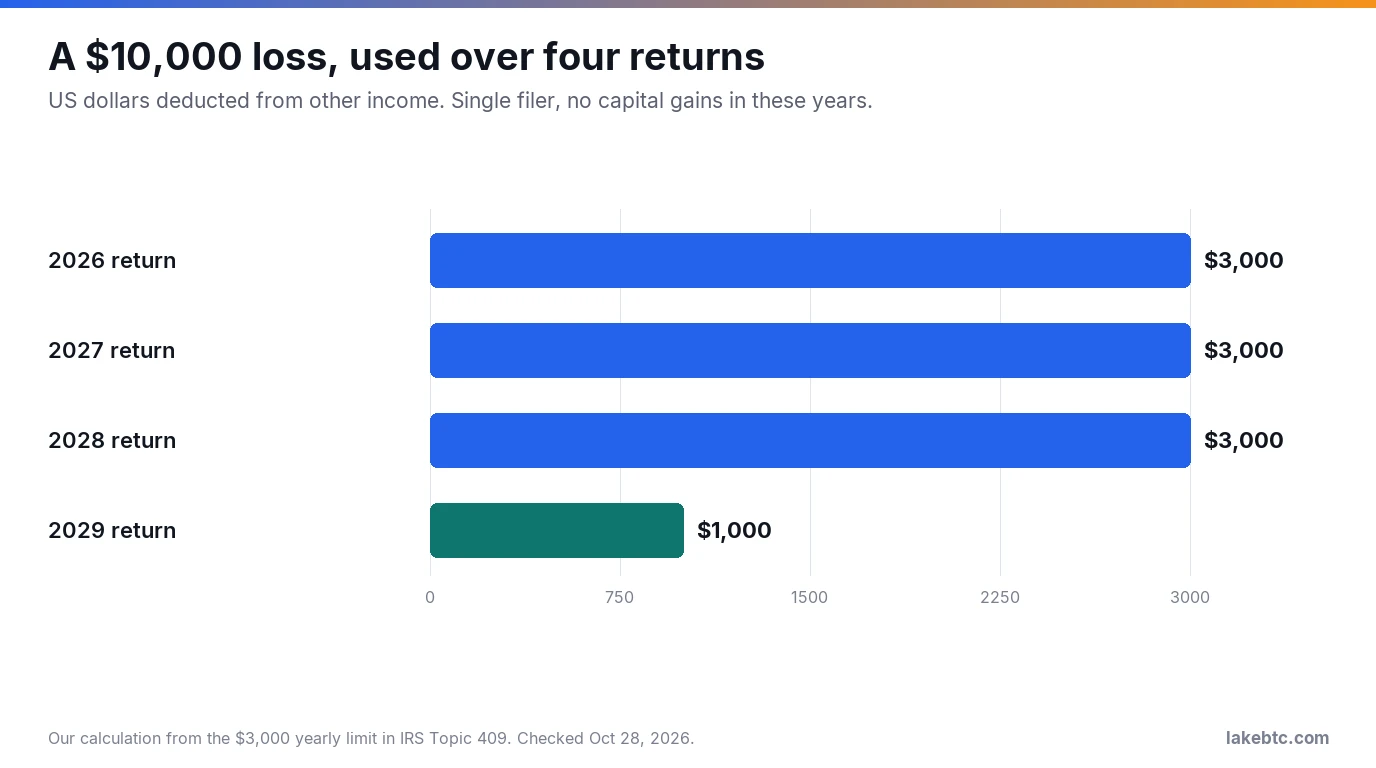
Gains change the picture fast. A $10,000 loss in a year with a $7,000 gain leaves $3,000, which you can use in full that same year. Nothing carries over.
These are federal rules, and your state may not follow them. New Jersey’s 2025 resident instructions, for example, don’t let a net loss in one category of income reduce another, so a crypto loss there can’t lower your wages.
Short-term and long-term losses
How long you held the coin decides the type of loss. One year or less makes it short-term. More than one year makes it long-term.
The type matters because the gains it cancels are taxed differently. Net short-term gains are taxed like your wages, at ordinary rates. Net long-term gains get lower rates, and for 2026 some of them are taxed at 0%. So in our reading, a loss that cancels a short-term gain saves more per dollar than one that cancels a long-term gain taxed at a lower rate.
A carried-over loss keeps its type, IRS Publication 550 says, so a short-term loss carried into 2027 is still short-term there.
How to report a crypto loss
Every sale, swap or spend goes on your return, whatever the amount, even at a loss and even if no tax form shows it. Here’s the order:
- List each disposal. For every sale, swap or spend, note the date acquired, the date sold, what you got for it, and your cost. Your cost includes the fees you paid to buy.
- Match it to your Form 1099-DA. For 2026 sales, exchanges report proceeds on almost every sale, though small stablecoin and some NFT sales can be left off. They must report your cost only for coins bought on that platform in 2026 or later. Coins bought earlier, or moved in from elsewhere, may show proceeds with no cost, so your own records fill the gap.
- Pick the right Form 8949 box. The Form 8949 instructions (2025 edition, the latest posted as of October 28, 2026) use boxes G, H and I for short-term digital assets and J, K and L for long-term. The Applicable checkbox on Form 8949 line on your 1099-DA points to the right one.
- Carry the totals to Schedule D. That’s where gains and losses net out and the yearly limit applies.
- Answer the digital asset question. Form 1040 asks whether you sold, exchanged or otherwise disposed of a digital asset. If you had a loss, the answer is still Yes.
Got a 1099-DA that doesn’t match your records? Our Form 1099-DA guide shows which box is which and how to correct a wrong cost on Form 8949.
Scam and theft losses
Losing crypto to a scam isn’t a capital loss, because you didn’t sell anything. It can still be deductible as a theft loss, but only in some cases. There are three IRS conditions, and all of them have to apply:
- The loss came from conduct that counts as theft under your state’s law.
- You have no reasonable prospect of getting the money back.
- The loss came from a transaction you entered into for profit.
The third condition splits scam victims in two. In a 2025 memo, IRS lawyers looked at five scam cases from 2024. A pig butchering crypto investment scam passed, and so did an account takeover where an impersonator posed as a fraud specialist at the victim’s financial institution. Romance and kidnapping scams failed, because there was no profit motive. Those count as personal losses, which the law didn’t allow for 2018 through 2025.
That personal-loss limit didn’t end after 2025. The IRS says Congress made it permanent, and from 2026 it also covers state-declared disasters. In our reading, a romance scam still isn’t a disaster, so it stays non-deductible on the 2026 return.
When a theft loss does qualify, the amount is your cost basis in what was stolen, not its value on the day it went. It’s claimed in the year you discovered it and saw no real chance of recovery, on Form 4684, Section B. The memo applies to its own facts, so a tax professional can confirm how it fits yours.
Check where it lands before you count on it. A theft loss isn’t a capital loss, so the yearly capital loss limit doesn’t cap it. But individuals deduct a loss of income-producing property on Schedule A, so in our reading it only lowers your tax if your itemized deductions beat the standard deduction. And if some of the money comes back after you’ve deducted it, you may have to report the recovered amount as income in that year, Publication 547 notes.
Does the wash sale rule apply to crypto?
The wash sale rule blocks a loss on stock or securities if you buy the same thing back within 30 days before or after the sale. The IRS publication on investments writes it for stock or securities. It doesn’t mention digital assets, which count as property for federal taxes.
So as published, the rule covers stock and securities, not the coins themselves. Rules can change, though, so check the 2026 Schedule D instructions before you file if you sold and bought back the same coin.
Keep records that match your 1099-DA
From January 1, 2025, crypto cost basis is tied to each wallet or exchange account, not pooled across everything you own. Rev. Proc. 2024-28 gave a safe harbor for sorting your old cost into each wallet as of that date. A loss you can’t back with a purchase date and price is hard to defend.
Coins you moved onto an exchange count as noncovered, so the exchange doesn’t have to report what you paid. Keep the receipt from the platform where you bought them. That record is what turns a blank cost on your 1099-DA into the loss you’re owed.
The fake IRS letter that targets crypto holders
Tax season brings its own scam. On July 30, 2026, IRS Criminal Investigation warned that fake IRS letters are being mailed to crypto holders. They say you must enroll in a “Digital Asset Compliance Portal” before a deadline and send you through a QR code to a site made to look like IRS.gov. That site may ask for personal details, wallet information and exchange logins. The IRS doesn’t run such a portal.
Don’t scan the code, and never share your recovery phrase or private keys. Check anything that claims to be from the IRS by going to irs.gov yourself. If you already typed in an exchange login, contact the exchange right away and change your passwords. The same playbook shows up with fake exchanges that demand bogus taxes before you can withdraw, covered in our guide to taxes before a crypto withdrawal.
Frequently Asked Questions
How much in crypto losses can you write off?
Usually all of it, over time. Losses offset every dollar of capital gains, then up to the yearly limit of other income, and the rest carries forward. Claim the deduction every year, though: a year you skip still counts as used.
Do I have to report crypto on my taxes if I lost money?
Yes. Each sale, swap or spend goes on your return whether it made or lost money, usually on Form 8949. If your 1099-DA shows basis reported to the IRS and nothing needs adjusting, you can put the totals straight on Schedule D. Either way, you answer Yes to the digital asset question.
Can crypto losses offset stock gains?
Yes, in our reading of Schedule D. Crypto and stock gains and losses all net together as capital gains and losses.
Will I be taxed on $1,000 of crypto profit?
Usually, yes. If you held it a year or less, it’s taxed at your ordinary rate. If you held it longer, it can fall in the 0% bracket for 2026 when your taxable income, including the gain, stays at or under $49,450 single or $98,900 married filing jointly.
Can I claim a loss on a coin that went to zero?
Not while it still trades and you still hold it. Sell or swap it, even for almost nothing, and the loss becomes real.
Do carried-over losses expire?
No. You carry the loss to later years until it’s completely used up. It doesn’t pass on, though: a capital loss carryover can’t be deducted on your estate’s income tax return.
What to do before you file
Pull together every sale, swap and spend from 2026, with dates and what you paid. Match them against each 1099-DA when it arrives in early 2027. If you want a loss on the 2026 return, the sale, swap or spend has to happen in 2026. A coin you still hold at a loss on December 31 waits for a later year.
If part of your loss came from a scam, sort out which kind it was first. Only the profit-motivated kind can be a theft loss.
Drafted with AI by the LakeBTC Editorial Team, then edited and fact-checked against the sources linked in the text. How we use AI · Report an error