Is Fetch.ai (FET) a Good Investment? An Honest Analysis

The market for AI-linked crypto tokens remains one of the more speculative corners of digital assets, shaped as much by shifting regulatory posture as by usage data. In March 2026, the SEC and CFTC jointly issued interpretive guidance introducing a five-category taxonomy for digital assets, a framework that is still being applied token by token. Fetch.ai (FET) sits at the intersection of that regulatory uncertainty and the broader “decentralized AI agent” narrative, making it a useful case study for how to evaluate an AI-crypto asset on fundamentals rather than sentiment. In short, FET is a high-risk, speculative small-cap AI-crypto token best suited for risk-tolerant investors, not a straightforward buy or avoid.
In this article
- Quick Verdict: Is FET a Good Investment Right Now?
- What Is Fetch.ai (FET)? A 60-Second Primer
- The ASI Alliance Merger: What Actually Changed
- FET Price History and Current Market Context
- Fetch.ai (FET) Price Prediction: Bull Case
- Fetch.ai (FET) Price Prediction: Bear Case
- Neutral Takeaway: Weighing the Realistic Scenarios
- FET Price Prediction 2030 and FET Crypto Forecast: How to Read These Numbers
- FET Fundamentals Health-Check
- FET vs. Other AI-Crypto Tokens
- How to Size an FET Position: A Risk Framework
- Where and How to Buy/Hold FET Securely
- Pros and Cons Summary
- FAQ
Quick Verdict: Is FET a Good Investment Right Now?
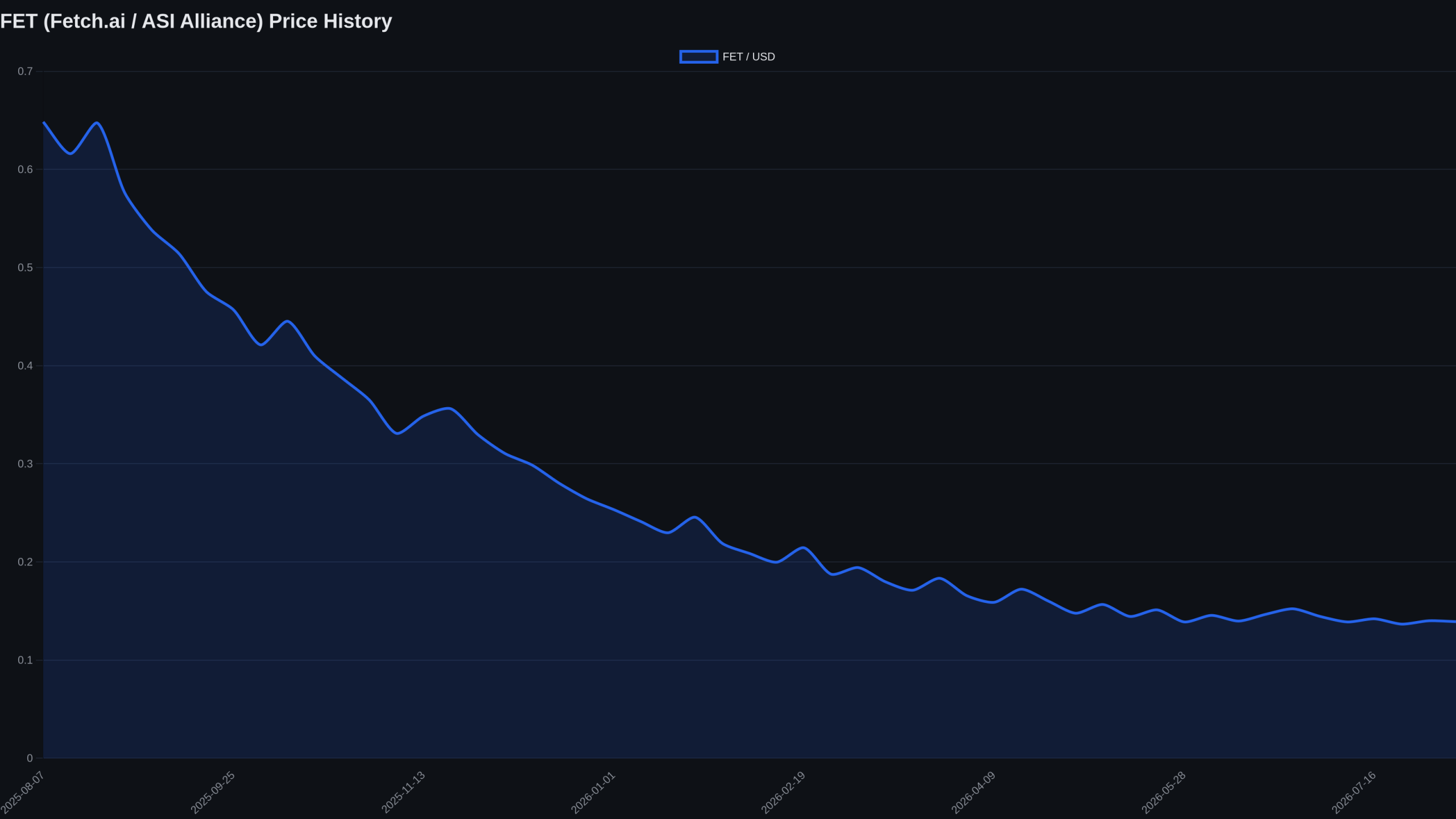
Fetch.ai’s native token, FET, trades within a fast-consolidating “AI + decentralized agents” category that has seen substantial structural change over the past two years, most notably the formation of the Artificial Superintelligence Alliance. According to CoinMarketCap data checked on August 6, 2026, FET was trading near $0.141914, down 5.20% over the prior 24 hours, with a market capitalization ranking it around #92 among tracked digital assets. Because spot price, market cap, and rank shift continuously, treat that snapshot as a point-in-time reference rather than a current quote.
- All-time high: $3.47, reached March 28, 2024, according to Coinbase pricing data.
- Distance from ATH: the token remains well below that 2024 peak.
- Supply: circulating supply is reported at approximately 2.24 billion FET against a max supply near 2.72 billion FET, per Coinbase; these figures move as legacy AGIX and OCEAN tokens continue migrating into FET, so treat them as approximate.
- Category: AI + decentralized-agent infrastructure, sometimes grouped loosely with “AI-crypto” or “DeAI” tokens.
- Ticker note: FET is now the unified token symbol for the Artificial Superintelligence Alliance, having absorbed several previously separate project tokens.
In plain terms: FET is a highly volatile, small-cap infrastructure token tied to an ambitious but still-unproven thesis about autonomous AI agents transacting on-chain. Whether it qualifies as a “good investment” depends heavily on an individual’s risk tolerance, time horizon, and view on whether agent-based AI economies will generate real on-chain demand. This is not financial advice, and readers should conduct their own research (DYOR) before acting on any of the information below.
What Is Fetch.ai (FET)? A 60-Second Primer
Origins and mission
Fetch.ai describes itself as a decentralized machine-learning network designed to let software agents perform tasks autonomously on behalf of users, rather than requiring constant manual input. The project’s stated goal is to build infrastructure where independent pieces of software can discover each other, negotiate, and transact without a centralized intermediary.
Autonomous Economic Agents (AEAs) explained
The technical core of the project is the Autonomous Economic Agent, or AEA. Per Fetch.ai’s own developer documentation, an AEA is “an Agent representing an individual, family, organisation or object (its ‘owner’) in the digital world, acting autonomously with minimal owner interference.” In practice, this concept is illustrated with use cases such as an agent that automatically rebalances a DeFi position when a threshold is crossed, or an agent that schedules electric-vehicle charging around fluctuating grid prices, or one that searches and books travel arrangements based on a user’s stated preferences.
How the FET token is used
FET functions as the network’s utility asset: it is used to pay transaction and gas-style fees for agent activity on the network, it can be staked to help secure the underlying infrastructure, and it is the settlement currency in which agent-to-agent transactions are ultimately denominated. As the token supporting the newly merged Artificial Superintelligence Alliance, FET’s utility now spans a broader stack than the original Fetch.ai network alone.
The ASI Alliance Merger: What Actually Changed
Timeline
Fetch.ai, SingularityNET, and Ocean Protocol combined to form the Superintelligence Alliance (branded the Artificial Superintelligence Alliance, or ASI Alliance), with token migration and consolidation contracts for legacy AGIX and OCEAN tokens beginning in July 2024, according to official alliance documentation. The alliance later expanded: CUDOS, a distributed compute project, was accepted into the alliance following a community vote held September 19–24, 2024, adding a compute-infrastructure layer to the group’s combined stack.
Token consolidation mechanics
Under the merger, holders of the legacy AGIX and OCEAN tokens were able to convert their holdings into FET through dedicated migration contracts, with CUDOS tokens folded in on similar terms following its admission. The intent was to unify liquidity, branding, and governance under a single token rather than maintaining four separate assets competing for attention within the same thesis.
Governance structure post-merger
The alliance operates through a shared governance structure spanning the constituent foundations, though the practical mechanics of how roadmap decisions get made across formerly independent teams remain a developing area that prospective holders should watch rather than assume is fully settled.
Fact-check callout
Not every founding member has stayed in the alliance. Ocean Protocol Foundation withdrew from the ASI Alliance effective around October 9, 2025, ending its formal collaboration with Fetch.ai and SingularityNET. Reporting at the time cited roughly $270 million in OCEAN tokens left unconverted as a result of the exit, though the exact figure and date vary slightly across secondary sources and should be treated as an approximation. That departure is a material development for anyone evaluating the alliance’s current scope, since it reduces the “full-stack” narrative (data, compute, agents, reasoning) that the original four-way merger was built around.
FET Price History and Current Market Context
Key milestones
FET reached its all-time high of $3.47 on March 28, 2024, during a broader rally in AI-narrative tokens that coincided with heightened interest in generative AI more generally. That peak sits far above current trading levels.
Subsequent drawdown drivers
Multiple forces plausibly contributed to FET’s retreat from its 2024 high, including the general tightening in risk-asset liquidity across crypto markets, the operational complexity of absorbing three (later effectively two, after Ocean’s exit) separate token communities into one, and periodic large token unlocks or treasury movements that are common across newly merged crypto projects. Readers should treat any single explanation for the drawdown with some skepticism, since multiple macro and project-specific factors typically overlap.
Where FET sits today
At a market cap rank near #92 as of the August 2026 snapshot cited above, FET trades as a small-cap token relative to the broader crypto market, and its performance should be viewed within the context of the wider AI-crypto sector rather than in isolation.
Fetch.ai (FET) Price Prediction: Bull Case
Adoption trigger
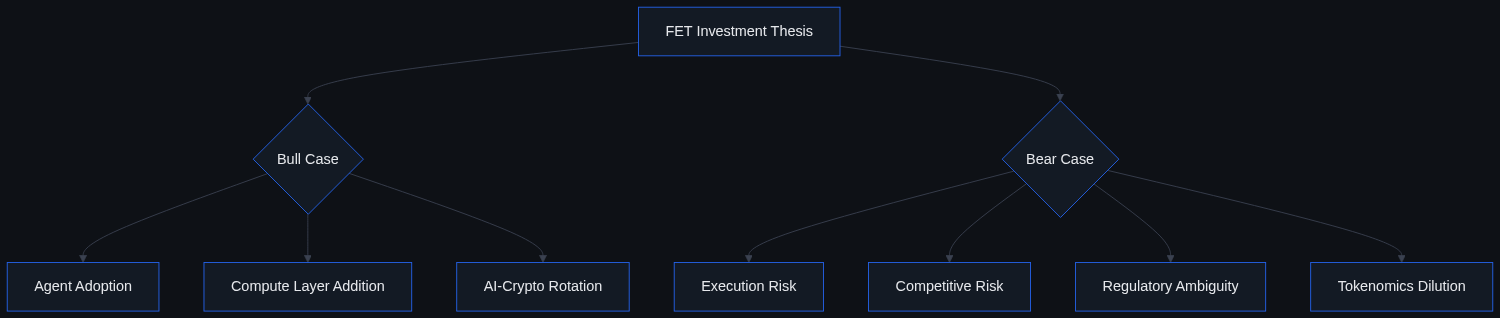
The bull case for FET rests substantially on whether enterprises and individual users begin routing meaningful transaction volume through autonomous agents rather than through traditional, manually operated interfaces. If agent-to-agent commerce becomes a real, measurable pattern of on-chain activity, network fee demand for FET could scale with it.
Compute-layer narrative
The addition of CUDOS gives the alliance a distributed compute component alongside Fetch.ai’s agent framework and Ocean’s data-marketplace heritage (prior to its exit). Some proponents argue this positions the alliance closer to a “full AI stack,” data, compute, and autonomous execution, than single-purpose AI tokens, though this remains a thesis rather than a demonstrated outcome.
Macro tailwind
A broader rotation of capital into AI-adjacent crypto assets, should one occur, would likely lift FET alongside comparable tokens, given its established position within the category. This scenario is dependent on market-wide sentiment shifts that are inherently unpredictable.
Fetch.ai (FET) Price Prediction: Bear Case
Execution risk
The core risk is straightforward: the agent economy Fetch.ai envisions may fail to attract paying users at scale, leaving the token’s utility largely theoretical.
Competitive risk
FET competes not only against other AI-crypto tokens but against well-resourced centralized AI platforms operated by large technology companies, which do not require users to interact with a token at all. It also competes within crypto against other agent- and compute-focused projects pursuing overlapping theses.
Regulatory risk
The March 2026 SEC/CFTC interpretive release introduced a five-category taxonomy intended to clarify which digital assets qualify as “digital commodities” rather than securities, with the Howey test remaining the governing legal standard. Based on available reporting, FET does not appear to be among the tokens explicitly named in the agencies’ published list of digital commodities, meaning its specific regulatory classification in the U.S. has not been publicly confirmed one way or the other. That ambiguity is itself a risk factor for U.S.-based holders and exchanges.
Tokenomics and dilution risk
The consolidation of AGIX, OCEAN, and CUDOS supply into FET, combined with an approximate 2.72 billion max supply against roughly 2.24 billion currently circulating, means additional token issuance remains a live consideration for anyone modeling long-term value per token.
Neutral Takeaway: Weighing the Realistic Scenarios
A balanced reading of FET suggests a base case in which the token continues to track broader AI-crypto sentiment cycles more than any specific fundamental catalyst, with a bull tail dependent on genuine agent-economy adoption and a bear tail shaped by execution failure, competitive displacement, or unresolved regulatory status. Any specific price prediction for FET between now and 2030 should be understood as speculation about an uncertain future, not as financial analysis grounded in verifiable data. Readers weighing a similarly speculative large-cap alternative may find it useful to compare this analysis with our related look at whether Solana (SOL) is a good investment.
FET Price Prediction 2030 and FET Crypto Forecast: How to Read These Numbers
Why long-range forecasts are inherently unreliable
Multi-year crypto price forecasts extrapolate from assumptions about adoption curves, regulatory outcomes, and macro liquidity that are all subject to change without warning. A 2030 forecast published today carries compounding uncertainty across six or more years of unknown variables.
What would have to be true
Rather than fixating on a specific dollar target, it is more useful to ask what conditions would need to hold for FET to command a meaningfully higher valuation: sustained, measurable agent-transaction volume; continued cohesion (or successful reorganization) of the alliance following Ocean’s exit; and clarity on FET’s U.S. regulatory status that removes exchange-listing uncertainty.
Evaluating third-party prediction sites critically
Readers researching “fetch ai price prediction 2030” content elsewhere should watch for red flags: forecasts with no stated methodology, numbers recycled across unrelated tokens, and sites that pair price targets with undisclosed affiliate incentives to open a trading account. None of the figures in this article are predictions; they are historical data points sourced and dated as noted above. This is not financial advice.
FET Fundamentals Health-Check
Developer activity
Ongoing GitHub commit activity on Fetch.ai’s public repositories, including the agents-aea framework, offers a leading indicator of continued technical development independent of short-term price action, though commit volume alone does not guarantee commercial adoption.
Network usage versus price divergence
As with many infrastructure tokens, on-chain agent activity and token price can diverge for extended periods; a rising number of deployed agents does not automatically translate into upward price pressure if transaction fees remain small relative to overall token supply.
Unlocks and treasury transparency
Given the scale of token consolidation from AGIX, OCEAN, and CUDOS, prospective holders should pay attention to how alliance treasuries and foundation-held tokens are disclosed and scheduled for release, since large concentrated holdings can influence market supply independent of organic demand.
FET vs. Other AI-Crypto Tokens
The AI-crypto category spans several distinct sub-theses: compute marketplaces (such as Render), decentralized machine-learning and validator networks (such as Bittensor), and agent/data-oriented projects like Fetch.ai and the broader ASI Alliance. Rather than presenting speculative market-cap comparisons that shift daily, it is worth noting the structural distinction: FET’s value proposition centers on autonomous agent transactions and, since the CUDOS addition, some compute infrastructure, whereas competing tokens may focus more narrowly on raw compute rental or machine-learning validation. Because these are meaningfully different bets on how AI and crypto intersect, diversifying exposure across compute-focused, agent-focused, and data-focused tokens, rather than concentrating in one, can reduce single-project risk within an AI-crypto allocation.
How to Size an FET Position: A Risk Framework
Speculative-allocation sizing
Investors who choose to hold FET often treat it as part of a smaller, higher-risk sleeve of a broader crypto allocation rather than a core holding, given its small-cap status, historical volatility, and unresolved regulatory classification. Position sizing is a personal decision that should reflect individual risk tolerance and time horizon, not a fixed percentage recommendation.
Dollar-cost averaging versus lump-sum
Given FET’s documented volatility, including a substantial decline from its March 2024 all-time high to current levels, a staged, dollar-cost-averaging approach may reduce the impact of poorly timed entries compared with a single lump-sum purchase, though neither approach eliminates downside risk.
Thesis-invalidation triggers
Practical triggers worth monitoring include further departures from the ASI Alliance similar to Ocean Protocol’s exit, stalled growth in measurable agent-transaction volume, or adverse regulatory action specifically naming FET. Any of these could materially change the token’s risk profile.
Where and How to Buy/Hold FET Securely
Exchange availability
Exchange listings and any state-specific restrictions for crypto tokens like FET can change over time as platforms update their offerings. For a broader overview of vetted platforms and how to get started, see our guide to choosing the best crypto exchange for beginners.
Self-custody versus exchange custody
Holding FET on an exchange is convenient for trading but means trusting that platform’s security practices; moving tokens to a self-custody wallet gives the holder direct control over private keys at the cost of added personal responsibility for backup and security.
Security reminders
AI-token hype has become a common vector for phishing and impersonation scams. Standard precautions apply: enable two-factor authentication, consider a hardware wallet for larger holdings, and treat unsolicited messages promoting “guaranteed” AI-token opportunities with suspicion.
Pros and Cons Summary
Pros:
- Ambitious infrastructure thesis spanning agents, and now, compute (via CUDOS)
- Concrete, documented use-case design through the AEA framework
- Consolidated token structure intended to unify liquidity and branding across the alliance
- Established multi-year track record relative to newer AI-token entrants
Cons:
- Trading far below its March 2024 all-time high
- Real-world adoption of autonomous agent commerce remains unproven at scale
- Ocean Protocol’s 2025 exit reduced the alliance’s original “full-stack” scope
- U.S. regulatory classification for FET specifically remains unresolved
- Complex, multi-source token supply following the AGIX/OCEAN/CUDOS consolidation
- High volatility typical of small-cap crypto assets
For broader context, see our guide to How To Buy Crypto.
FAQ
Is Fetch.ai (FET) a good investment in 2026?
That depends on an individual’s risk tolerance and view of the agent-economy thesis. FET is a small-cap, high-volatility token trading well below its 2024 high, with unresolved regulatory status; it is not something that can be labeled a “good” or “bad” investment in absolute terms. This is not financial advice.
What is Fetch.ai used for?
Fetch.ai’s network is designed to let Autonomous Economic Agents perform tasks such as DeFi position management, EV-charging scheduling, or travel-booking optimization, with the FET token used for network fees, staking, and agent-to-agent transaction settlement.
What is the FET price prediction for 2030?
No reliable, verifiable price target exists for a horizon that far out; any specific number circulating online should be treated as speculation rather than analysis, since it depends on unknowable future adoption and regulatory outcomes.
What is the ASI Alliance and how does it affect FET?
The Artificial Superintelligence Alliance combined Fetch.ai, SingularityNET, and originally Ocean Protocol (which later exited in 2025), later adding CUDOS, consolidating legacy tokens into FET as the alliance’s unified token starting in mid-2024.
Is FET riskier than other AI cryptocurrencies?
FET carries risks common to the AI-crypto category generally, small market capitalization, adoption uncertainty, and regulatory ambiguity, plus alliance-specific risk stemming from Ocean Protocol’s departure and the complexity of its multi-token merger history.